
International SEO is not an option in 2026 because it is a pillar of the digital strategy of businesses planning to go global. With the heightening competition in the online market, brands that have a well-defined international SEO strategy will have the benefits of the early movers: more visibility of the websites, increased traffic on the organic level, increased conversion rates, and more trust with their foreign target markets.
The difference between international and local SEO and the traditional SEO work is that SEO for international seeks to optimize your site in a number of countries, languages, and search engines, unlike local one, which limits you to one region. It will require solving cultural peculiarities, content adaptation, and technical frameworks that will assist search engines in interpreting your pages even beyond national boundaries.
When properly done, it can turn a site once focused on a single market into one that will draw foreigners, gain credibility, and increase revenue on a global scale. International SEO basics provides the path to success of sustainable global search for companies that are willing to go international.

TL;DR
- International SEO is a core growth channel, not a nice-to-have.
- Validate demand first using GA4 and GSC, then test one to two priority markets.
- Choose targeting model: language, country, or a phased hybrid.
- Pick a scalable URL structure (ccTLD, subdomain, or subdirectory) and stick to it. Avoid language parameters.
- Implement hreflang with self-canonicals, locale sitemaps, and an x-default. Do not force IP redirects; use a gentle locale prompt.
- Localize beyond translation: wording, tone, currency, dates, holidays, imagery.
- Do market-specific keyword research with local phrasing and long-tail queries.
- Build local authority through country-level backlinks, PR, directories, and creators.
- Meet legal and operational needs: GDPR, CCPA, LGPD, PIPL, taxes, payments, and TMS plus human review.
- Measure per locale: organic traffic, rankings, conversions, engagement, and run quarterly technical audits.
- Avoid common traps: machine translation, flags for languages, thin resources across too many markets.
Are You Ready for International SEO?
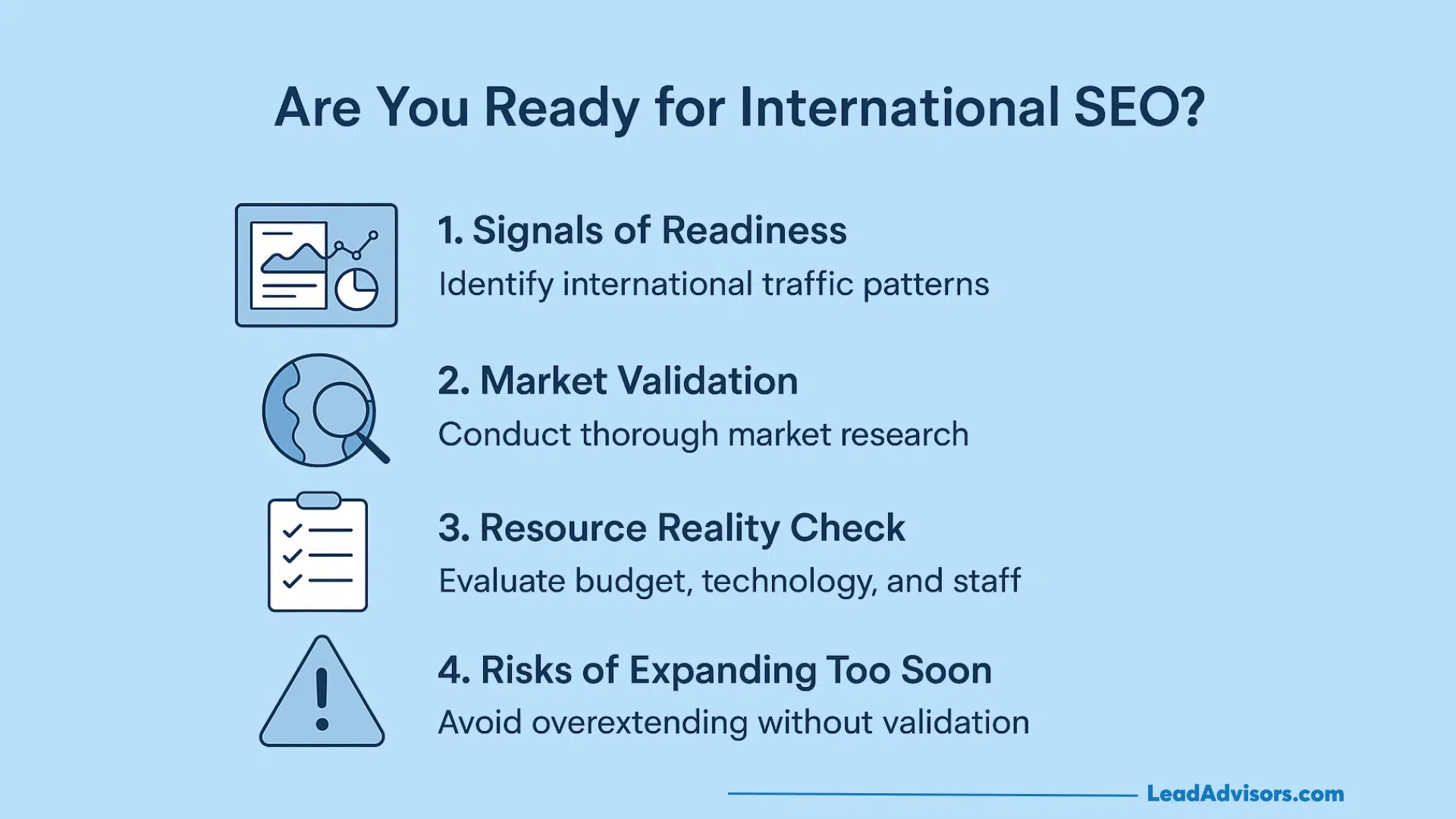
Entering new markets is a thrilling activity, but getting international with SEO will demand more than just the translation of a few web pages. You must ensure that your company possesses all the signals, resources, and validation to prosper before implementing international SEO strategy. Soon, expansion may be a waste of precious SEO time and brand reputation.
1. Signals of Readiness
The first indicator is data. The international traffic pattern could be found in Google Analytics (GA4) and Google Search Console – consistently active visitors of various countries, an outstanding audience in a particular region, or queries written in other languages. When the international traffic already comes to your site, this is a good indication that the search engine optimization in those markets may lead to increased organic traffic and conversions.
2. Market Validation
It is dangerous to make use of assumptions. Carry out an in-depth market analysis in order to assess demand and viability. Get insights into the market size, digital adoption, and competition using tools such as Semrush, Ubersuggest, or government trade portals such as WTO and Trade.gov. Competitor research: Benchmark local competitors to understand their performance in search engine results and the key keywords they rank. This assists in establishing whether your target market is both reachable as well as profitable.
3. Resource Reality Check
Successful international SEO efforts require ongoing investment. Ask:
- Do you have the funds to invest in professional translation or rather localized content production?
- Does your technical stack support the need to change URL structure, addition of hreflang tags, and multi-lingual content?
- Do you have personnel (in-house or agency) to handle international SEO best practices on a regular basis?
Even the best international SEO process will come to a halt in the absence of proper budget and technical support.
4. Risks of Expanding Too Soon
Coming into the new market without the validation of demand may thin the team and decrease ROI. Companies tend to fail because they:
- Use of machine translation rather than culturally sensitive content.
- Target several countries that are not well organized to support them.
- Forget about cultural subtleties and local likes, and the interaction is weak.
- Diffuse resources in a variety of markets, diluting performance in all markets.
It is a safe, evidence-based way of guaranteeing sustainable global growth. Begin with less- pick one target country or language variant, then measure international SEO performance and expand as you gain experience.
Research & Market Selection

One of the most important stages of an international SEO strategy is the selection of a location to expand. Not all the places are worth investment, and not all the target markets are in agreement with your brand objectives. With the integration of data, competitive knowledge, and cultural analysis, it is possible to find international markets that have search potential and are operationally feasible.
1. Evaluating Search Demand & Competition
International market research is anchored on the knowledge of demand. Google Analytics (GA4) and Google Search Console will help analyze which countries are already bringing stable visitors to the site. Combine it with the help of keyword tools like Semrush, Ahrefs, or Ubersuggest to estimate search results, volumes of keywords, and the competition level of each area.
Big demand is not necessarily equal to the chance – when the competition is strongly developed and the local giants hold the market, entering this market can be rather expensive.
2. Cultural Fit Matters
Data alone isn’t enough. Analyzing cultural subtleties will make your content come across to foreigners. As an illustration, product communication that is effective in the U.S. might not be effective in Asia or Europe without modification. Engagement and conversions are affected by local holidays, buying behaviors, and cultural differences.
By making your SEO activities in line with these considerations, you are able to create a trusting relationship and enhance local relevance.
3. Tools for Global Insights
| Tool / Source | Purpose | Why It Matters |
| WTO & Trade.gov | Provide economic and trade data for cross-border potential | Helps validate whether a target market has sustainable demand and growth. |
| Internet Usage Reports | Highlight digital adoption rates, device usage, and connectivity trends | Ensures your international SEO plan aligns with regions that are digitally mature. |
| Google Keyword Planner | Reveal relevant keywords and search queries in each local market | Identifies demand, intent, and content gaps to guide SEO efforts. |
4. Competitor Benchmarking
It is important to know the local competitors. With a VPN or local search engines, you will be able to do a search engine analysis within your targeted country. Find overlapping keywords, backlinks, and on-page strategies. It is possible to identify weaknesses in which your brand is able to perform better, and this assists in creating a successful international SEO strategy.
5. Prioritizing Markets
Opportunities are not all equal. The most successful international brands compromise between revenue potential and operational feasibility. For instance:
- A high-demand target country that has complicated legal obstacles can be less desirable.
- A smaller market that is consistent in digital adoption and lacks competition has the potential to have a better ROI.
Begin with a new market or two, test international SEO, and go bigger. This is a gradual process that minimizes risks and enables your SEO team to perfect processes before scaling.
International SEO Strategy: Language vs. Country Targeting
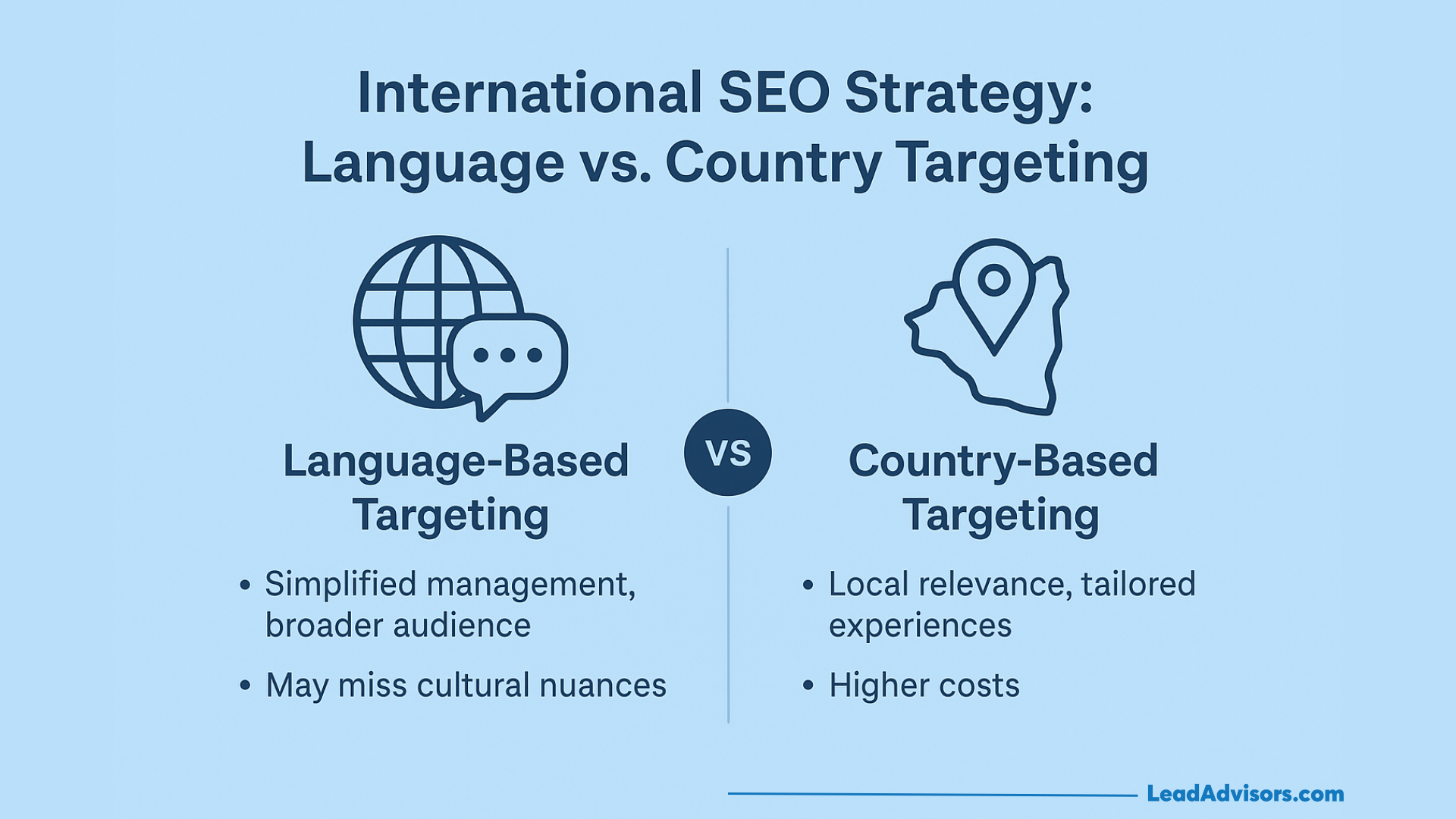
One of the most important components of international SEO success is whether to address users on a language or a country basis. Both of them can make international SEO successful, yet they can be used in different ways based on the target audience and business model.
Language-Based Targeting
Language-first strategies are effective where you have products or services that are attractive to the speakers of a similar language, in various areas. As an illustration, a single site written in the Spanish language can be used by users in Latin America. This would make management easier, cheaper, and would assist in producing localized content that could be seen by a wider audience.
It might not catch the subtlety of culture, though, such as coche (Spain) and carro (Mexico). The search engines know the basic language, but as the interests vary in a country, local differences in keywords may influence the engagement.
Best for: When the brand is trying out the market, the business has limited resources, and the cultural difference in the industry is slight.
Country-Based Targeting
The country-specific ones generate a specific experience for the users in the respective countries of operation. This could be individual versions of Spain, Mexico, and Argentina, each with local idioms, currency formats, and search engine results that are local expectations. It is more expensive, but it maximizes the local relevancy, ensures an increase in traffic, and helps to comply with country-specific areas and legislation.
Best for: Established brands with strong resources, products that need regionalization, or companies in highly regulated industries.
Hybrid Approaches & Phased Rollouts
A hybrid strategy is followed by many successful global businesses, which initially introduce language targeting at the start of their operations in order to be cost-effective and then introduce country-specific sites when the market is already profitable. An example is that a company can be introduced with a single version in French, and then further divided into France, Canada, and Belgium branches when it gains momentum.
The strategy of phasing gives businesses time to test the market, gauge the performance of international SEO, and expand in a responsible manner without exceeding budgets.
Domain & URL Structures
One of the most significant technical decisions of international SEO is your domain structure and URL structure. It affects the engine performance of your site through the search engine, the trust you gain among the locals, and the ease with which you are able to expand into new nations. Both alternatives have advantages and disadvantages.
Common Options
| Structure Type | Example | Pros | Cons |
| ccTLDs | example.fr | Strong local relevance, trusted by users, signals the target country clearly to search engines. | Expensive to manage, splits domain authority, and harder to scale. |
| Subdomains | fr.example.com | Allows regional customization, easier to manage than multiple ccTLDs. | May not pass full link equity, sometimes treated as separate sites. |
| Subdirectories | example.com/fr/ | Centralizes authority under one domain, is cost-effective, and scalable. | May feel less “local” to users than ccTLDs, weaker country signals. |
| Parameters | example.com?lang=fr | Simple to implement. | Bad for SEO efforts, confusing for search engines, and poor UX. |
Real-World Examples
- Amazon → uses ccTLDs (amazon.fr, amazon.co.uk) to build deep trust in local markets.
- Shopify → favors subdirectories (shopify.com/es/), consolidating domain authority while serving different languages.
- Zara → blends subdirectories with hreflang, balancing scalability with localized content.
- Pinterest → adopted ccTLDs to strengthen its global footprint and enhance organic traffic in new markets.
International SEO Best Practices
- Consistency is key: Select a single URL format and use it consistently across all foreign markets. The combination of the strategies may bewilder users and search engines.
- Local language in URLs: Use /es/ropa/ instead of /es/clothing/ to align with localized content and improve engagement.
- Plan for scalability: In case you are planning to use a large number of target countries, subdirectories can tend to be more cost-effective, authoritative, and scalable than ccTLDs.
- Avoid parameters: This is not a very efficient global SEO strategy and tends to dilute ranking signals.
A properly selected URL hierarchy is not only beneficial to technical SEO – it defines the perception of your brand by users around the world. By connecting domain power to local relevance, you establish a source of sustainable international search engine performance in more than one region.
Technical SEO for International Sites
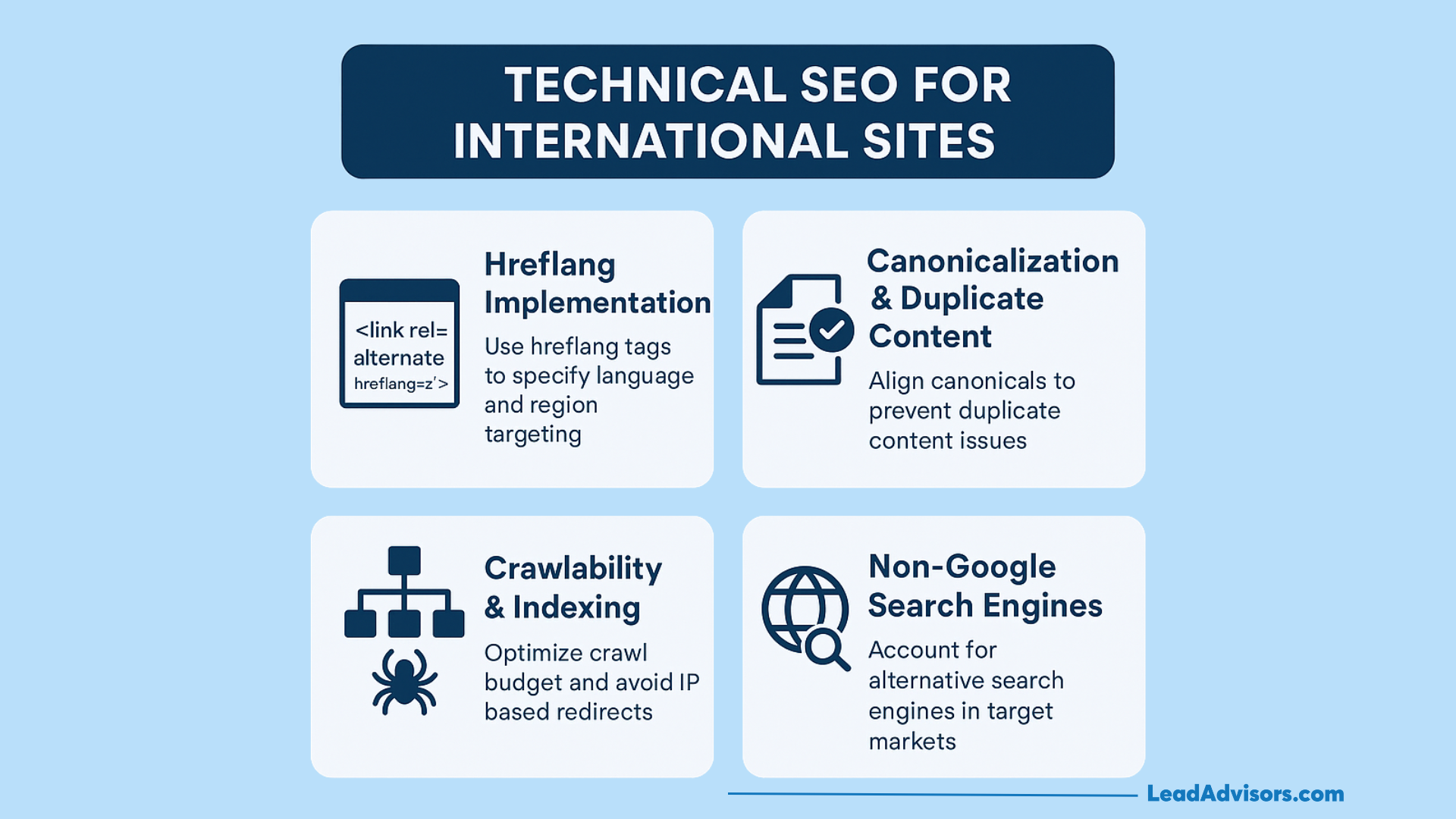
After choosing your target markets and URL structure, the second thing would be to create a solid technical base. Even the most localized content and relevant keywords that have been researched well might not work in search engines without proper implementation.
Technical optimization guarantees that search engines know which version of your site to display, avoids duplicate problems, and increases visibility in a variety of countries.
Hreflang Implementation
Purpose: Hreflang tags signal to search engines the language and region combinations of your pages. This prevents misaligned rankings (e.g., showing a French page to a Canadian user searching in English).
Anatomy of a Tag:
<link rel=”alternate” hreflang=”es-mx” href=”https://example.com/mx/” />
- Correct codes → es-mx for Spanish in Mexico, en-gb for English in the UK.
- Bidirectional referencing → If Page A references Page B, Page B must reference Page A.
Implementation Methods:
- HTML head → Most common, added to each page.
- HTTP headers → Useful for non-HTML resources like PDFs.
- XML sitemaps → Efficient for large sites with multiple language versions.
x-default Usage:
Use x-default for global fallback pages, such as a country/language selector.
Validation Tools:
- Screaming Frog (Hreflang report)
- Google Search Console (International Targeting)
- Semrush/Site Audit tools for implementation checks
Canonicalization & Duplicate Content
When sites serve different languages or variations of the same language (e.g., US vs. UK English), duplicate content risks arise.
- Align canonicals with hreflang → Canonical should point to the local version, not a global one.
- Near-duplicate handling:
- color vs. colour → Different markets, similar content.
- Spanish in Spain vs. Mexico → Use hreflang to distinguish, not canonicalization.
Correct alignment prevents cannibalization and ensures search engines reward the right version in the correct target country.
Crawlability & Indexing
Expanding into new markets multiplies your site’s size. Poor management can waste crawl budget.
- Crawl budget optimization: Ensure internal linking and sitemaps clearly guide crawlers to all regional pages.
- Avoid auto-redirects: Don’t send users (or bots) to different versions based on IP – this confuses crawlers and reduces visibility.
- Cookie/script-based swaps: Serving content changes only via JavaScript or cookies can block indexing.
- Performance: Use CDNs and, when possible, local hosting to reduce latency and improve international SEO performance.
Non-Google Search Engines
Google dominates globally, but some international markets rely on other engines. Optimizing for them is crucial for true global SEO success.
- Baidu (China):
- Requires government registration (ICP license).
- Limited JavaScript crawling.
- Prefers simplified metadata and fast-loading sites hosted locally.
- Yandex (Russia):
- Strong emphasis on local links and behavioral factors.
- Rewards regional sites with local content and hosting.
- Naver (South Korea):
- Functions as a portal rather than a pure search engine results.
- Content quality and integration with Naver services (blogs, directories) matter.
- Yahoo Japan:
- Powered by Google’s algorithm but influenced by Japanese-language optimization and local authority sites.
Key Takeaway
Technical SEO preconditions the expansion into other markets. Whether it is hreflang and canonicals or crawlability and alternative search engines, these elements are rightly considered when it comes to other search engines picking up what your site is about and the right target audience viewing the right content at the right time.
Content Localization Strategy
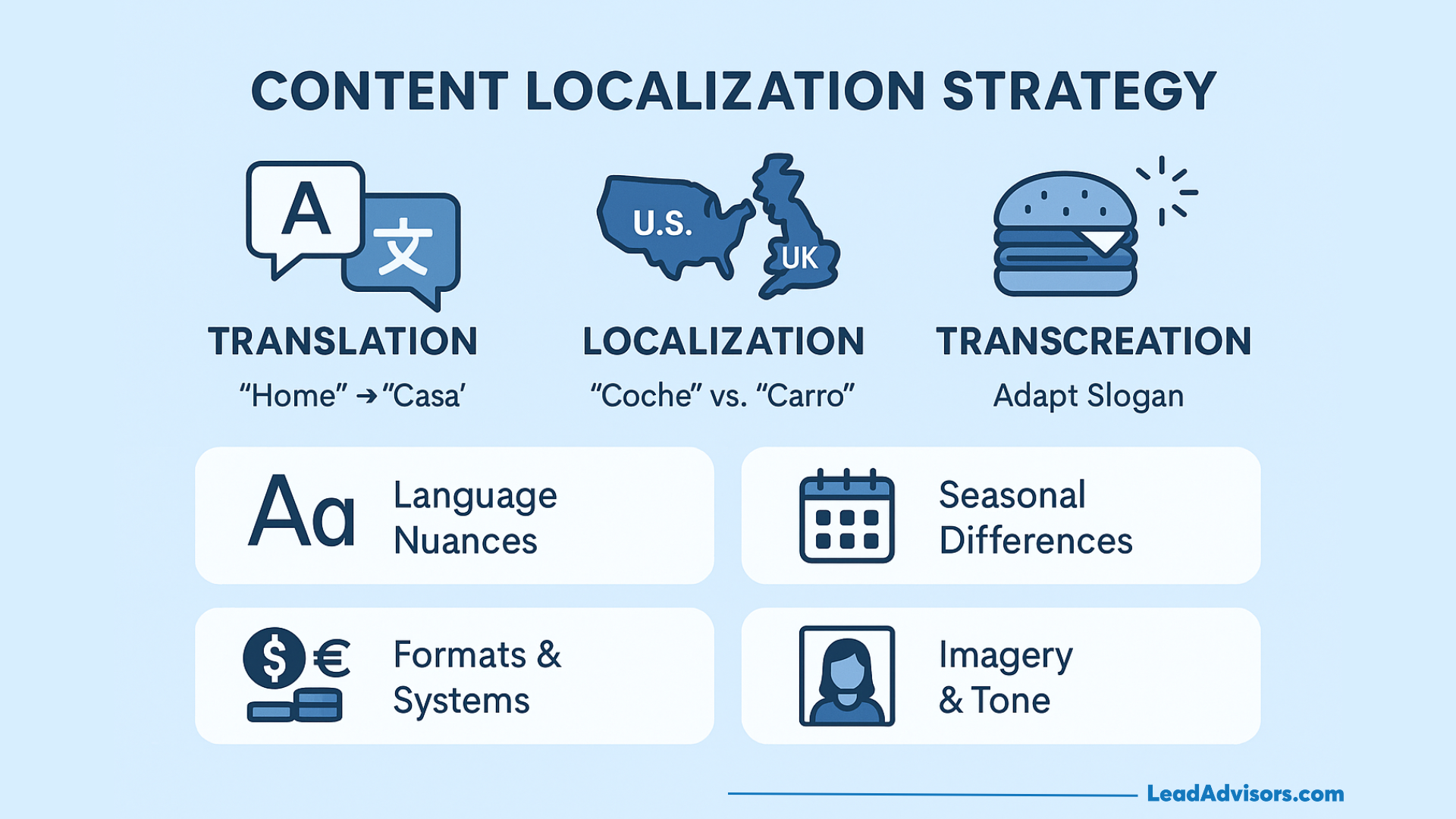
It takes more than translation to win in the international markets. Translation is a way of conveying meaning, but to achieve actual success in international SEO, one should be able to adjust the content to make it relevant to the local users. This is called localization, or, as it is also referred to, transcreation, which makes your brand message native in each region and yet helps in the SEO efforts.
Translation vs. Localization vs. Transcreation
| Approach | Definition | Example | Best Use Case |
| Translation | Converts text word-for-word into another language. Fast but often loses nuance. | “Home” → “Casa” (literal translation). | Technical documents, user manuals, or quick site updates. |
| Localization | Adapts content to cultural context, idioms, and local preferences. | “Color” (U.S.) → “Colour” (U.K.); “coche” (Spain) vs. “carro” (Mexico). | Product descriptions, websites, and marketing campaigns targeting local users. |
| Transcreation | Reimagines content to preserve emotional impact across global audiences. | McDonald’s adapts slogans and promotions per region (e.g., Teriyaki Burger in Japan). | Advertising, branding, and creative marketing campaigns. |
Adapting for Local Relevance
- Language nuances: Searchers might make different queries even in the same language. Making preferences for these variations will mean that search engines interpret intent.
- Seasonal/holiday differences: U.S. Mother’s Day campaign should take place at a different time (May) compared to the U.K. (March), and the Lunar New Year is ruling many Asian markets.
- Formats & systems: Proper currency, date formats, and methods of payment. The use of euros instead of dollars (or the incorrect credit card providers) is an indication of a lack of localization.
- Imagery & tone: The visuals and the brand voice should not violate the cultural norms. A conversational style that is acceptable in North America might not be professional in Japan.
Maintaining Brand Consistency
As you create localized content, it’s vital to maintain global brand identity. This means:
- Use consistent terminology across all language versions.
- Following brand voice guidelines while adapting tone to cultural expectations.
- Centralizing assets (logos, typography, product descriptions) but allowing local teams flexibility to adapt campaigns.
The effective international SEO strategies will provide a balance between local relevance and global uniformity so that customers in other nations will know of the brand and yet can feel that they are being addressed personally.
Case Studies
- H&M → Tailors in each of the target countries, with a focus on seasonal fashion that is a part of local culture. Its web versions change images and messages according to the cultural subtleties, enhancing the interaction.
- McDonald’s → This is an example of transcreation where menus, offers, and websites are adjusted to suit the market. Its local strategies form trust and retain brand identity in the form of the McAloo Tikki in India and the Teriyaki Burger in Japan.
Why It Matters
Developing localized content is not only related to superior UX, but traffic and conversions directly affect it. The searchers would have trust in websites that seem to be familiar and relevant to their culture. Companies that overlook cultural subtleties may lose their credibility, and those who invest in thinking about how to localize their operations in new markets have a competitive advantage.
International Keyword Research
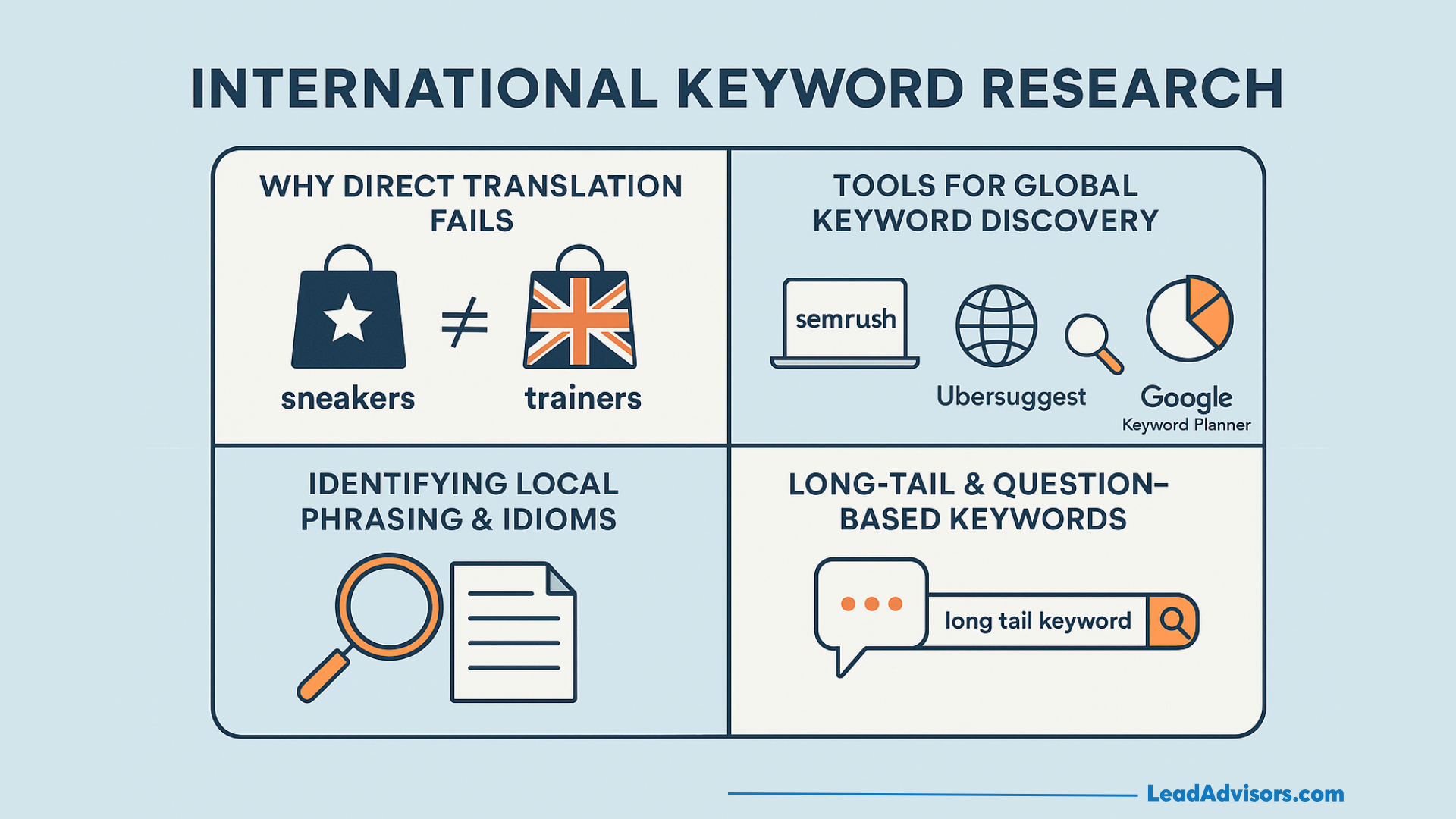
The basis of any international SEO plan is keyword research, which, however, does not often give results without translation. Direct translation does not work since it does not take into account cultural subtext, search purpose, and the manner in which users express queries in their native language. In order to attract an international audience, you must think locally.
Why Direct Translation Fails
A U.S. retailer can optimize on sneakers, but in the U.K., users optimize on trainers. In Spain, the term ordinador translates to computer, whereas computadora is used in Mexico. Search engines are aware of these variations, but unless you have targeted localized content and keywords to help in placing you in search result pages in the right target country, your website will not be reflected.
Tools for Global Keyword Discovery
Several SEO platforms support international keyword research:
| Tool | Purpose |
| Semrush | Identify search volumes, CPCs, and keyword overlaps in different countries. |
| Ahrefs | Analyze competitor rankings, backlinks, and keyword difficulty globally. |
| Ubersuggest | Budget-friendly tool for quick insights into new markets. |
| Google Keyword Planner | Free resource for finding relevant keywords and local phrasing by region. |
Identifying Local Phrasing & Idioms
Foreigners tend to make searches using region-specific slang or culture. Searching for local phrases is aimed at giving search engines an idea about the context and enhancing the natural flow of traffic. Holiday packages in the U.K. vs. vacation deals in the U.S.
Long-Tail & Question-Based Keywords
In expansion, it is impractical to go on wide, competitive terms. Rather, target long-tail keywords and questions, which:
Take better captures for purposes.
- Capture intent more precisely.
- Provide easier entry into competitive SEO markets.
- Generate higher-quality, targeted traffic.
For example, instead of “insurance Spain,” try “best health insurance for students in Spain.”
Market-Specific SERP Behavior
The search results of each region are unique, reflecting user behavior and local competitors. With a VPN or region-specific SERP analysis, you can view what type of content is prevalent (e.g., blogs, local directories, or marketplaces). This understanding will enable you to develop a strong international search engine optimization strategy that can be specific to a certain target market.
Lesson: International SEO needs more than translation to perform effective keyword research. With the help of the appropriate tools, emphasis on local expressions, and competitor evaluation in various markets, you can align your site to the top in areas that matter.
Building Global Authority
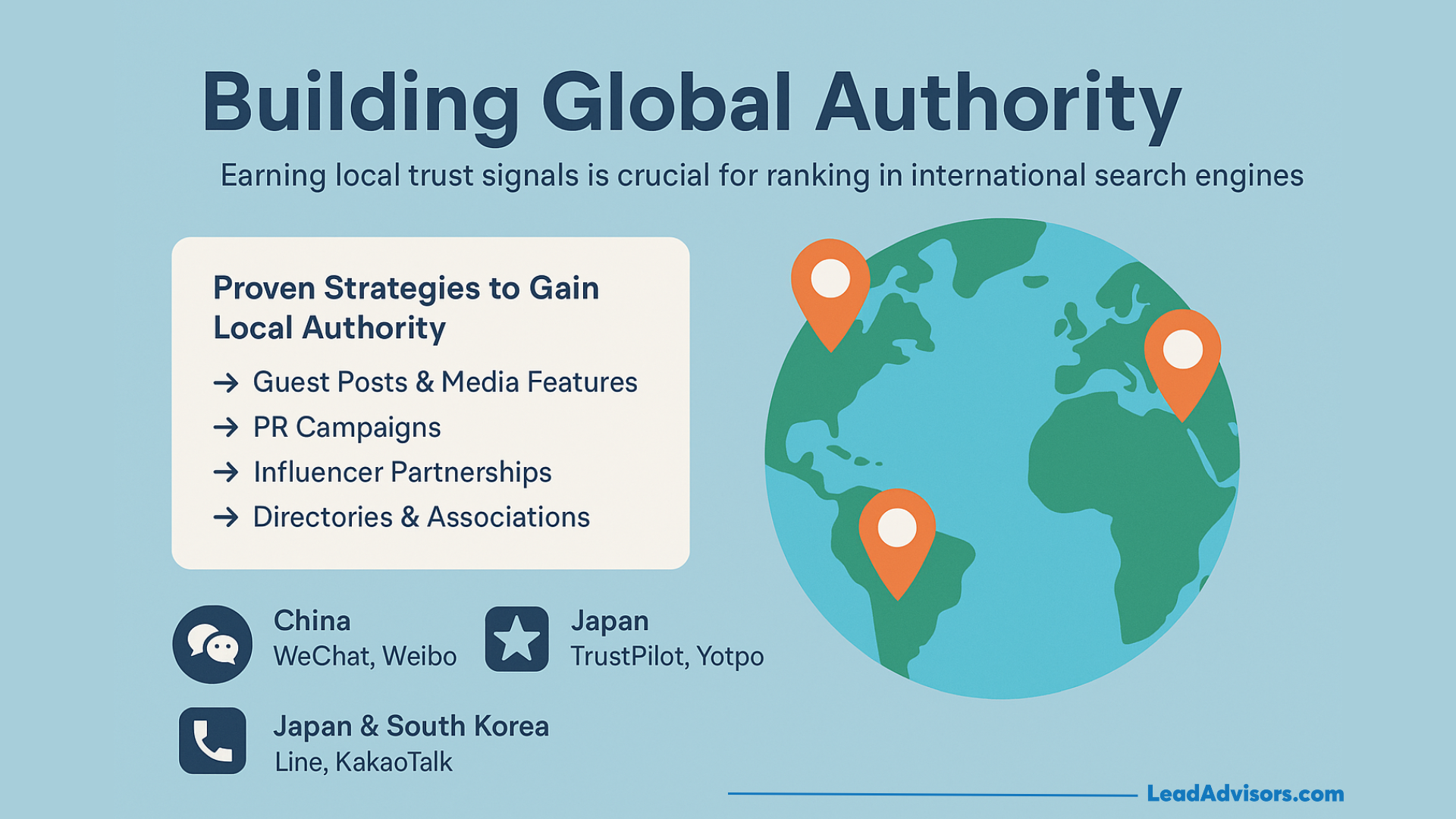
Being at the top of the international search engines is not all about technical optimization or localized content, but also about establishing trust in each target market. Similar to local SEO, which depends on citations and reviews, international SEO campaigns are successful when your site becomes country-specific trust signals, and this strengthens the relevance and credibility.
The Power of Local Backlinks
Local backlinks are very important since they give the search engines an indication that your brand has credibility in a particular locality. The country-specific links, like the country-specific link (.fr or .de), as country or local news sites or local blogs, have more authority than the unrelated global links. These backlinks enhance rankings and are beneficial in creating domain authority in other countries.
Proven Strategies to Gain Local Authority
- Guest Posts & Media Features → Be a contributor in local magazines or partner with blogs that are known locally.
- PR Campaigns → Country-specific press releases increase visibility and boost search engine optimization.
- Influencer Partnerships → Collaborations with local creators on Instagram, TikTok, or YouTube will mean that the content will appeal to the local audience.
- Directories & Associations → Inclusion in reputable directories, chambers of commerce, or industry associations enhances credibility and localization.
Leveraging Social Media & Review Platforms
Engagement on local platforms builds social proof. For example:
- China → WeChat and Weibo are essential for visibility beyond Google.
- Europe → TrustPilot and Yotpo reviews enhance confidence in eCommerce.
- Japan & South Korea → Platforms like Line and KakaoTalk double as both messaging apps and discovery engines.
These channels might not be directly effective in increasing the rankings, but they increase trust and targeted traffic, which indirectly helps in improving the performance of international search engine optimization.
Balancing Global & Local Signals
Global brands have to juggle between the domain-wide control and local trust indicators. A good international location creates credibility, and an inability to adjust to national competitors as well as to local demands may restrict success. The best international search engine optimization techniques combine both the global brand power and the local authenticity, so that the brand should be familiar globally yet should be personal and localized to the specific country.
It is a matter of gaining respect in the local area, which can be achieved by building authority overseas. The combination of local backlinks, PR, and localized community involvement may help businesses to increase their presence and ensure global consistency at the same time.
Compliance, Legal & Operational Considerations
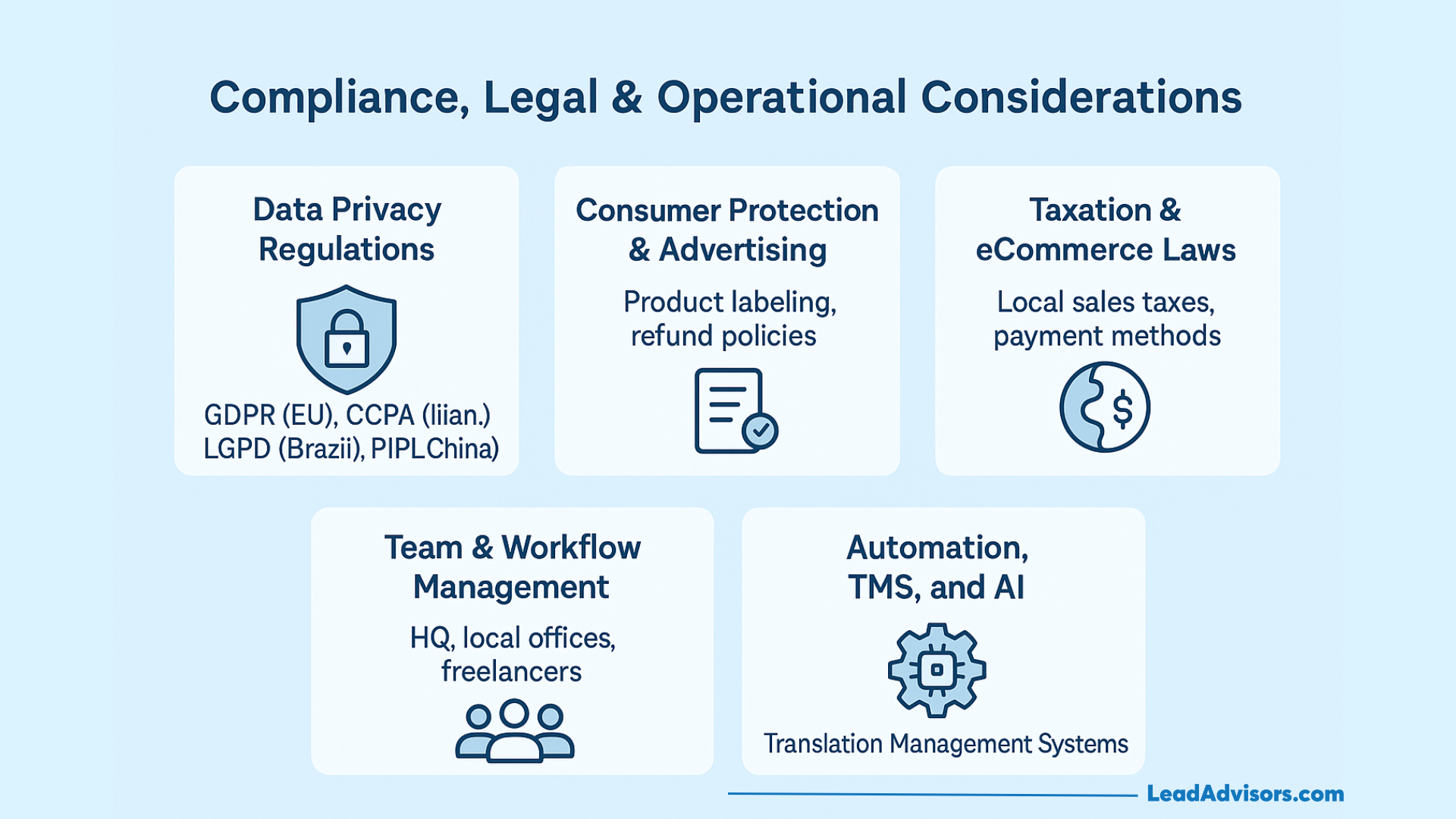
International market expansion is not merely a technical or marketing task; it is also a legal and operational task. Even the best international SEO plan will fall flat in case regional compliance requirements are overlooked. In order to scale in a responsible manner, companies need to consider privacy laws, consumer safeguards, taxation, and workflow organization, and use tools to ensure efficiency.
Data Privacy Regulations
Research on information gathering and monitoring varies greatly across geographical areas. Policies such as GDPR (EU), CCPA (California), LGPD (Brazil), and PIPL (China) establish the manner in which websites process the user information, consent, and cookies. Non-compliance may also result in fines and bad publicity, particularly for those with multiple international audiences.
| Regulation | Region | Key Focus | SEO Impact |
| GDPR | EU | User consent, data minimization | Requires cookie banners and clear consent tracking |
| CCPA | California, U.S. | Data transparency & opt-out rights | Affects how tracking pixels and analytics are deployed |
| LGPD | Brazil | Data protection & user rights | Similar to GDPR, but with local enforcement nuances |
| PIPL | China | Strictest consent, cross-border data transfer limits | Demands strong localization and local data hosting |
Consumer Protection & Advertising Standards
In addition to privacy, nations impose regulations on online advertising, labeling, and claims. As an illustration, European markets need proper refund policies, whereas Asian regulators can take a keen interest in comparative advertising. Through compliance with the local standards, there is trust with the international visitors, and no penalties will be imposed.
Taxation & eCommerce Laws
When entering new markets, it usually creates the effect of local taxation. Compliance is essential, whether it is the EU VAT regulations or an eCommerce tax in the U.S. states. International SEO performance is also influenced by using local modes of payment, as the payment options must be trusted by the customer; the conversion rate will increase, and the local relevance will be indicated.
Team & Workflow Management
Scaling into different countries requires coordinated execution. Common models include:
- HQ-driven control → Consistency but limited local nuance.
- Local offices or agencies → Strong cultural alignment but higher cost.
- Freelancers or hybrid teams → Flexible but require strong oversight.
The right mix depends on budget, speed, and long-term goals.
Automation, TMS, and AI
Translation Management Systems (TMS) and AI software are helpful to hasten the process of website localization, though they cannot entirely eliminate human skills. Automation is useful in scale, but human checks and balances are in place so as to preserve cultural nuances and tone. Companies that strike the right equilibrium in efficiency and authenticity gain more trust within new markets in a shorter time.
Lesson learned: Compliance is not something optional – it is an element of a sustainable global digital strategy. Through the congruence with privacy regulations, customer norms, and area operations, brands establish a base of safe and scalable international search achievements.
Measuring & Optimizing International SEO Performance
The best international SEO strategy requires evidence of effectiveness even when it has been thoroughly designed. It is not about being found in the search engines but about achieving success in reaching the right target markets, conversions, and better engagement.
In order to gauge the performance of international SEO, the brands need to monitor the KPIs on a regular basis, employ the appropriate tools, and enhance the strategies by conducting frequent audits.
Core KPIs for International SEO
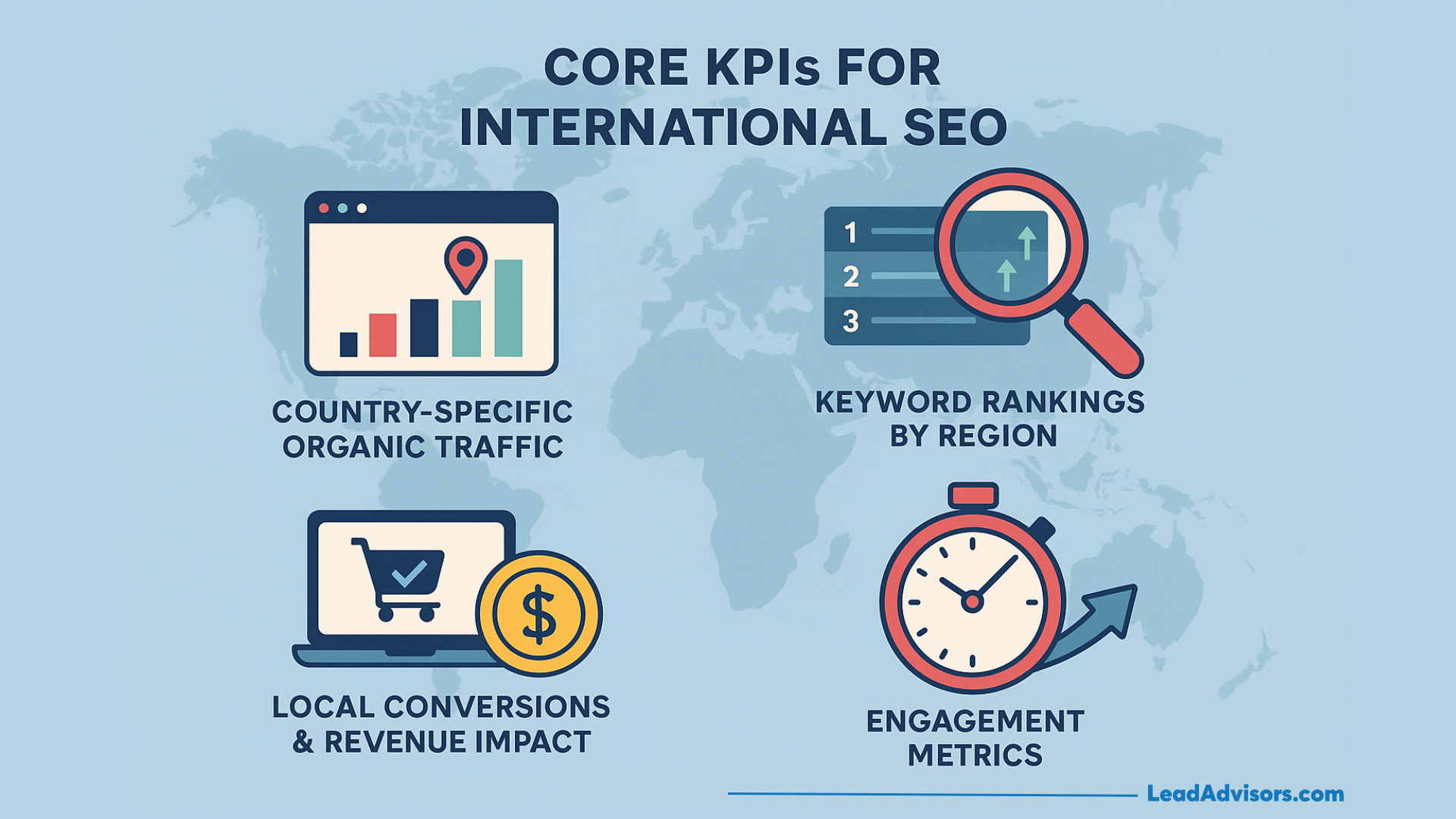
- Country-Specific Organic Traffic → Track the development of each target country in Google Analytics (GA4) and Google Search Console. This will affirm the fact that your localized content is bringing the right audiences.
- Keyword Rankings by Region → Semrush Position Tracking or Ahrefs to calculate the ranking of key keywords in each region. Different languages and international markets should be ranked differently.
- Local Conversions & Revenue Impact → Sales, leads, or sign-ups: the ultimate measure of success is what counts. Monitor regional conversion rates and revenue contributions to make sure that the SEO activities lead to specific business development.
- Engagement Metrics → Bounce rate, time on site, and patterns of navigation will tell you whether the international visitors are finding your site helpful. The lack of engagement can reflect on the problems of local preferences, UX, or content mismatch.
Tools That Power Tracking
- GA4 & GSC → Benchmark traffic, impressions, and user behavior by country and device.
- Semrush Position Tracking → Monitor keyword rankings across different countries and languages.
- Log File Analysis → Understand how search engines crawl your regional sites, identify wasted crawl budget, and spot errors in hreflang or canonical setups.
Competitive Benchmarking
Competitor analysis will help you know the position of your site. Establish the presence of their backlink profiles, rankings, and search engine results in every target market. Competitive benchmarking shows what you lack – like content types or local links you are lacking – that can make your international SEO more successful.
Iteration Through Audits
International SEO isn’t a “set it and forget it” project. Conduct periodic:
- Hreflang checks → Validate bidirectional tags and x-default setup.
- Crawl audits → Ensure all language versions are indexed correctly.
- Performance reviews → Reassess KPIs every quarter and adjust based on new market trends.
Bottom Line: International SEO performance measurement needs a combination of technical audit, KPI monitoring, and competitive intelligence. Through tracking progress and repetition, you will make sure that your SEO activities are on track and in accordance with the global strategy and local market conditions.
Case Studies & Examples
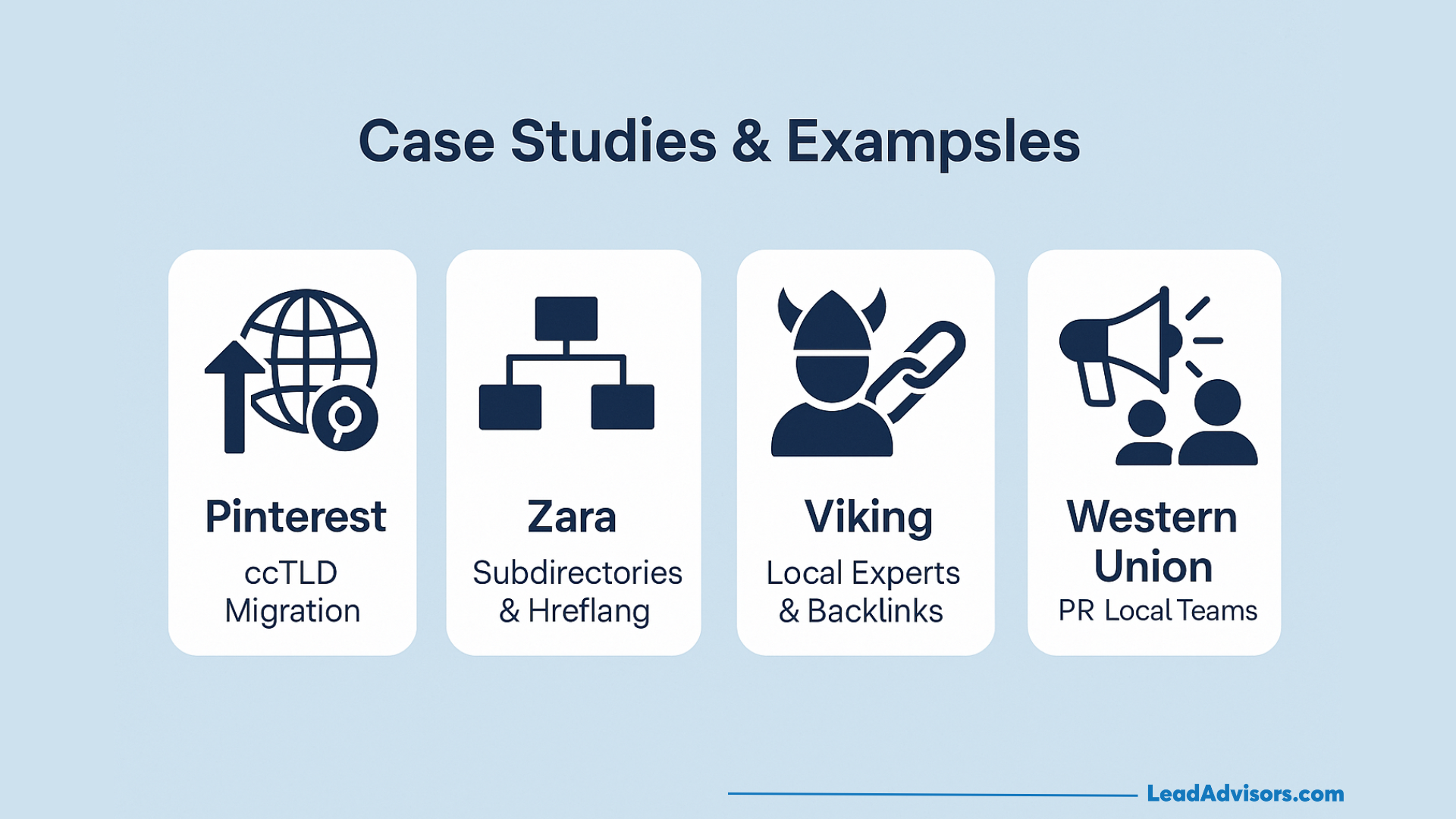
Practical cases show how global brands can create their international SEO strategies in order to achieve a balance between technical optimization, localized content, and scalability. The case studies below demonstrate various strategies – including the migration of ccTLDs to localized-backlinking – that have produced observable international SEO effectiveness.
Pinterest: Migration to ccTLDs for Regional Growth
Pinterest started off with regional subdomains (e.g., de.pinterest.com, uk.pinterest.com) to divide the content by country. With time, they moved to country code top-level domains (ccTLDs), including pinterest.de and pinterest.co.uk. This transition demanded a lot of planning:
- Implementing 301 redirects.
- Deploying hreflang tags across multiple domains.
- Managing unique XML sitemaps for each market.
The migration was resource-intensive, but it was worth it. Aligning the domain structure with the target countries, Pinterest enhanced the local rankings, increased organic traffic, and opened up the international SEO performance.
Read more about: Pinterest Marketing: The Ultimate Guide
Zara: Subdirectories with Extensive Hreflang
In contrast to Pinterest, Zara uses a subdirectory (i.e., zara.com/us, zara.com/us/stores-locator). This has the effect of centralizing authority in the domain and generates a clean hierarchy of URLs that is scalable.
Zara supplements this with wide-scale hreflang implementation, which makes sure that search engines understand what version of the page to serve. The version of the language and the pages of the regions are customized and contain localized product descriptions and keywords, as well as optimized navigation.
This plan resulted in Zara creating an approximate 19.13 million in monthly traffic value, which serves as an indication of the power of unrelenting SEO work based on subdirectories and hreflang by 2026.
Viking: Native Experts & Local Backlinks
Viking has its way of managing every foreign market as a unique one. Instead of general content, they involve the help of local experts to create specific campaigns that will attract the target population. Such a practice is connected with the cultural nuances, tone, and search intent.
Also significant, Viking spends a lot of money to obtain local backlinks from the authoritative regional websites. Such links build domain authority in each targeted country, which is a motivator to trust and rankings. Their think local mentality shows the effects of the integration of bespoke content and a local link-building approach.
Western Union: Scaling with PR & Local Teams
Western Union implemented a combined strategy – the use of PR campaigns and localized SEO implementation. Their global online policy made the company a leader in terms of cross-border payments, and local search engine optimization departments ensured that their keywords and content were in line with local tastes.
The results:
- +487% increase in organic search share
- Over 1.4 million new site visitors through SEO channels
This example demonstrates that the global power, combined with the localized content and the PR efforts, can make a small market grow exponentially.
Key Takeaway
These case studies highlight diverse yet effective approaches:
- Pinterest → ccTLD migration for stronger geo-targeting.
- Zara → Subdirectories and hreflang for scalability and language precision.
- Viking → Country-specific content with native experts and local backlinks.
- Western Union → Global PR combined with local SEO execution.
Combined, they demonstrate that the success of international SEO cannot be achieved without adapting it to business objectives, resources, and culture.
Common Mistakes to Avoid
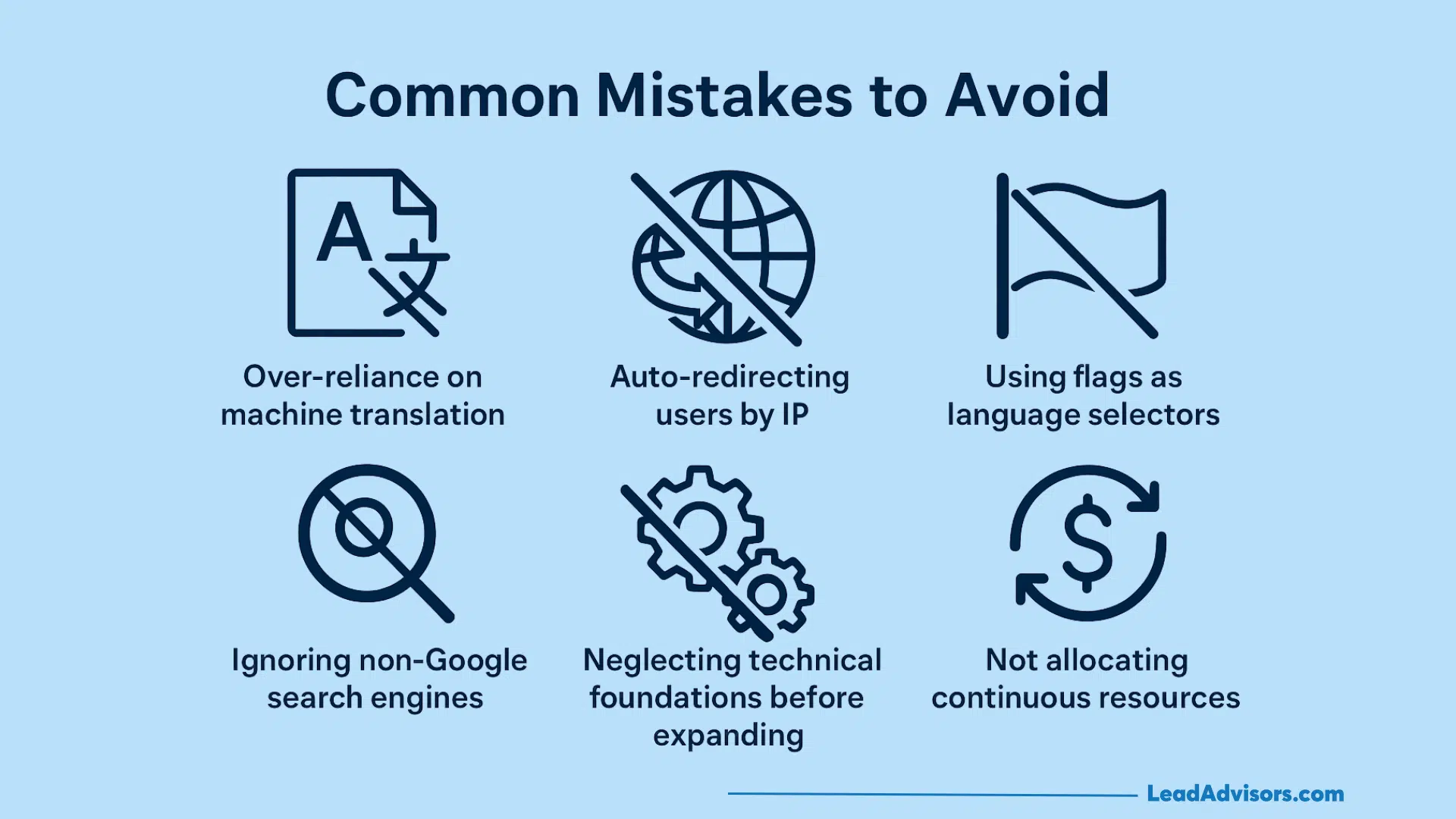
Even the best-established brands may fall when attempting to enter the global arena. The following are some of the most typical pitfalls in international SEO strategies – and the reasons why you should not fall into them:
- Over-reliance on machine translation
Context, idioms, and tone are usually lost in automated tools. Your site will be at risk of sounding clumsy as well without meaningful localized material, which reduces interaction with foreign audiences. It can be combined with native speakers or professional localization services. - Auto-redirecting users by IP
IP redirection can prevent search engines from accessing the appropriate version of your website. Rather, an explicit language/country selection and hreflang tags should be used to instruct users and bots to the appropriate content. - Using flags as language selectors
Flags are not language, but countries. Users will not be covered by a Spanish flag in Mexico or Argentina. Selectors in the form of text are more precise (e.g., Espaňol -Mexico) and remain in line with international SEO practices. - Ignoring non-Google search engines
China, Russia, South Korea, and Japan are some of the markets that depend on Baidu, Yandex, Naver, and Yahoo Japan. The concentration on Google would restrict the exposure in these new markets where other search engines prevail. - Neglecting technical foundations before expanding
Scaling leads to the launching of websites with no proper URL structure, no hreflang, and no crawl budget planning. Sustainable international SEO performance is based on strong technical SEO. - Not allocating continuous resources
International SEO efforts are something that have to be managed consistently: localization of the content, backlinking, and audits cannot be a one-time activity. Ranking and traffic will reduce with time unless it is constantly invested in.
Lesson: These are some of the pitfalls to avoid so that your international SEO strategy remains on course. It is those brands that focus on technical precision, cultural sensitivity, and stable resources that flourish internationally.
Bonus: One-Page International SEO Implementation Checklist
Use this as a quick audit to ensure your global SEO rollout is technically sound, localized, and measurable.
- URL strategy chosen and consistent (ccTLD, subdomain, or subdirectory – no mix-and-match)
- Language switcher UX in place, remembers user preference
- Hreflang across all alternates (with x-default fallback)
- Self-canonicals per locale (no cross-locale canonicals)
- Localized schema (inLanguage, currency, units, payments, legal details)
- Sitemaps by locale; internal cross-links between alternates
- No forced IP redirects; use an optional locale/language banner
- Core Web Vitals monitored by country; CDN and hosting optimized for international users
- Analytics & Search Console segmented per locale (dashboards + properties)
Quarterly audits on hreflang, indexing, Core Web Vitals, schema, and content parity