Most SaaS content programs publish a lot but generate little pipeline. Companies post regularly, rankings improve, and qualified leads still don’t follow. The system is broken, not the effort.
Two things broke the old formula. First, generative AI made content creation nearly free. Every company now produces blog posts at scale, covering the same topics in the same way. Publishing more adds to the noise. Second, search behavior shifted. AI tools like ChatGPT and Perplexity now answer questions directly. Many users never click through to a website at all. Top-of-funnel blog traffic is no longer a reliable source of pipeline.
The SaaS companies growing through content in 2026 are not the ones publishing the most. They are the ones running the right system. That means starting at the bottom of the funnel, measuring trials and pipeline instead of page views, and treating content as a full operational function. This playbook maps that system from start to finish.

Who Actually Runs SaaS Content Marketing in 2026
Most SaaS companies that read this playbook and try to run it themselves stall within six months. Content marketing at scale is a system, not a writing project. The companies that win in 2026 either have a full-time in-house team running it or they hand the full function to an operator. This playbook maps the system.
The question at the end of each section is simple: Does your team run this, or does someone else?
What Actually Changed in SaaS Content Marketing and What Did Not
Spend five minutes on LinkedIn or Reddit, and you will see founders saying content marketing is dead. They are not entirely wrong about the old way of doing it.
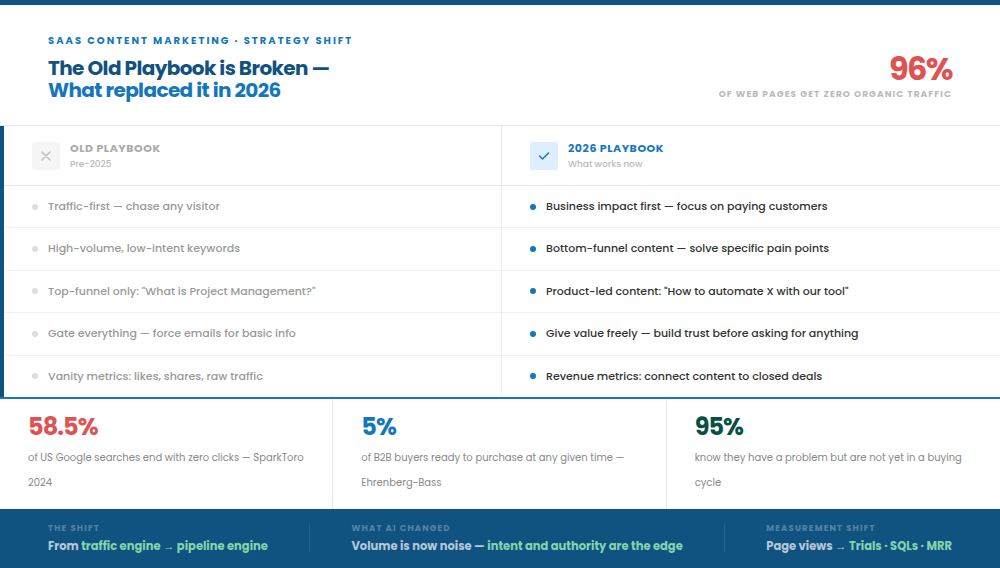
Studies show that over 96% of web pages receive zero organic traffic from Google. The reason is simple: AI has flooded the web with average blog posts. Creating content is now nearly free, so everyone does it.
Research shows the return on “just publish more” has dropped sharply. When every company can produce content at scale, volume is not a competitive edge. It is noise.
The Shift
In December 2025, Google released its third core update of the year, running from December 11 to December 29. The update was designed to better surface relevant, satisfying content across all types of sites. Users are increasingly getting answers directly from AI tools like ChatGPT and Perplexity, and many never click through to a website at all.
What Still Works
High-intent searches still convert. Queries like “alternative to [Competitor]” or “[Product] vs [Product]” are still used by buyers ready to make a decision. Buyers still research before they buy. That has not changed.
Zero-click browsing is now the norm. SparkToro’s 2024 Zero-Click Search Study found that 58.5% of US Google searches and 59.7% of EU searches end with zero clicks; users get their answer without ever visiting a site. This trend accelerated further in 2025 with the rollout of Google AI Overviews.
Brand Eligibility
AI tools now filter which brands they recommend. If your content is not cited by trusted sources, AI engines will not surface your product to users.
Old vs. New SaaS Content Marketing
To win in 2026, SaaS content must shift from broad reach to qualified buyers.
Old Playbook (Pre-2025) | 2026 Playbook |
Traffic-first: chase any visitor | Business impact first: focus on paying customers |
High-volume, low-intent keywords | Bottom-funnel content: solve specific pain points |
Top-funnel only: “What is Project Management?” | Product-led content: “How to automate X with our tool.” |
Gate everything: force emails for basic info | Give value freely: build trust before asking for anything |
Vanity metrics: likes, shares, raw traffic | Revenue metrics: connect content to closed deals |
A SaaS content program should work as a sales engine, not a library. The sections below show how to build that engine.
Strategic Foundations (Before You Create Anything)
Most SaaS companies skip this step and go straight to production. That is why most programs plateau early. The three foundations below must be in place before a single piece of content gets written.
Moving From “Search Volume” to “Business Impact”
Ranking for a high-volume keyword like “productivity” is often a waste of money for SaaS. Search engines now answer those broad questions on their own. A strong SaaS content strategy targets keywords that show someone is ready to buy.
Success metrics shift, too. Instead of tracking traffic, measure:
- Trials and Demos: How many people signed up after reading?
- SQLs (Sales Qualified Leads): Is the sales team getting better leads?
- MRR (Monthly Recurring Revenue): Is content helping close deals?
Business Goals, OKRs, and the Content Revenue Map
A content program must tie directly to ARR targets and CAC payback goals. If content costs $5,000 to produce but only brings in $100 in lifetime value, the math does not work. Map content to business goals. That turns the blog from a cost into a revenue system.
The 95:5 Rule Explained
Research by Professor John Dawes of the Ehrenberg-Bass Institute, published with the LinkedIn B2B Institute (2021), shows that only 5% of B2B buyers are ready to purchase at any given time. The other 95% know they have a problem but are not yet in a buying cycle.
A strong content strategy serves both groups:
- Demand Capture (The 5%): Content like “Best project management tool for remote teams” grabs buyers who are ready now.
- Demand Creation (The 95%): Educational content shows the 95% why their current approach is not working. When they are ready to buy, your brand is top of mind.
Customer-Led Research
The best content ideas do not come from keyword tools. They come from customers. The three research inputs below give content teams the raw material to build content that resonates with real buyers.
The Research Layer That Informs Every Content Decision
Static buyer personas without real behavioral data produce generic content that does not convert. In 2026, content strategy is built from direct customer input:
- Sales calls: What questions do prospects ask every time?
- Support tickets: Where do customers get stuck?
- Win/loss interviews: Why did a buyer choose you over a competitor?
Jobs-to-Be-Done (JTBD) for SaaS Content
The JTBD framework focuses on what customers want to get done, not who they are. A buyer does not pick project management software because of their job title. They pick it to avoid missing deadlines. Content that speaks to those goals stays relevant and useful.
Pain Point SEO (Beyond Keywords)
Keyword research tools are one input, not the whole picture. Pain Point SEO targets keywords that show someone is actively trying to fix a problem. A keyword with 50 monthly searches for “solution to [Specific Technical Bug]” is more valuable than 5,000 searches for a definition. Those 50 people need a real solution right now.
A content gap analysis maps what competitors rank for that you have not yet covered. This is the first research step before any content gets written.
The Content Maturity Roadmap (2026 Edition)
Most SaaS companies fail at content because they try to scale before the foundation exists. A content program needs to be built in the right order. The roadmap below shows the order and the campaign structure that follows from it.
The 9-Step SaaS Content Maturity Model
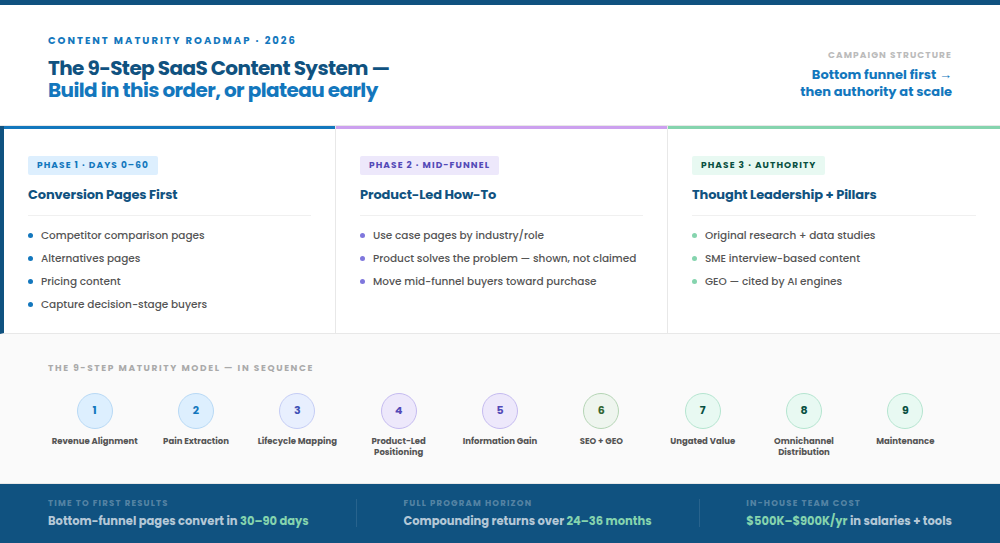
Building a SaaS content program is a process, not a one-time project. Most SaaS companies fail because they scale content before the foundation is in place. This is the system LeadAdvisors builds and runs for SaaS clients:
- Revenue Alignment: Match content goals to ARR targets.
- Customer Pain Extraction: Interview the sales team to find real buying objections.
- Lifecycle Mapping: Build content for every stage of the customer journey.
- Product-Led Positioning: Show the product solving real problems inside the content.
- Information Gain: Add unique data that does not exist anywhere else online.
- Technical SEO + GEO: Optimize for both Google and AI engines. See generative engine optimization.
- Ungated Value Strategy: Remove barriers to your best content to build trust faster.
- Omnichannel Distribution: Push content to social media, email, and community channels.
- Maintenance: Run regular content audits to fix decay and fill gaps.
Bottom-Funnel-First: The Inverted Strategy
LeadAdvisors builds SaaS content programs from the bottom of the funnel up. The campaign starts where buyers make decisions.
- Phase 1 (Days 0 to 60): Build conversion pages. Competitor comparisons, alternative pages, and pricing content capture buyers already in a decision cycle.
- Phase 2: Add how-to content for specific product use cases. This moves mid-funnel buyers toward a purchase.
- Phase 3: Build thought leadership and pillar content for long-term authority. See the difference between pillar content vs cluster content.
Content Creation That Converts (Not Just Ranks)
Knowing what to write is only part of the challenge. How you write it determines whether it ranks and whether it converts. The formats and production approaches below consistently drive results for SaaS content programs.
Content Types That Actually Drive SaaS Growth
Not all content formats produce the same results. These formats drive the highest ROI for SaaS:
- Use Case Pages: Show how a specific industry or role uses the product.
- Alternatives Pages: Capture users who are ready to switch from a competitor.
- Product-Led How-To Guides: Solve a problem with the product as the clear answer.
- Original Research: Data studies that earn inbound links and build authority.
A well-structured content hub groups these formats into a clear topic structure. This signals expertise to both search engines and AI platforms.
Product-Led Content (Without Being Salesy)
Product-led content shows rather than claims. Instead of saying a project management tool is great, write “How to run a remote sprint” with screenshots of the actual product. The product becomes the clear answer to the reader’s problem. No hard sell needed.
Interview-Based Content and SME Extraction
Generic AI content has no lived experience. It does not stand out, and it does not rank for long. Strong content comes from interviews with Subject Matter Experts: engineers, founders, and customer success leads. That insight cannot be copied by AI tools. It is a lasting advantage.
Information Gain as a Ranking Factor
Content that copies what is already in the top 10 results will not hold its ranking. To produce information gain, content must include:
- Unique data your team has collected
- Specific views based on real product or customer experience
- Insights that cannot be found anywhere else
AI, SEO, and GEO (Generative Engine Optimization)
Search is now split across two surfaces: Google and AI engines. A strong content program needs to perform on both. This section covers the technical and strategic requirements for each.
Technical SEO Still Matters (But Differently)
Technical SEO in 2026 is more than page speed. Site structure must help both readers and AI crawlers see how topics connect. Google Search Console monitoring now tracks how AI tools read a site’s expertise signals.
GEO: Showing Up in ChatGPT, Claude, and Perplexity
Generative engine optimization is the new discipline for AI-era visibility. To get cited by AI engines, content must show brand consistency and clear topic authority. AI tools favor brands that appear often in trusted communities and have well-organized content on their own sites.
For a step-by-step breakdown, see how to increase brand citations in AI responses.
AI in SaaS Content: What Works and What Does Not
AI handles some content tasks well. Others, it handles poorly. Here is the clear split:
- Use AI for: Keyword research, content outlines, first drafts, and scaling volume on simpler content.
- Do not use AI for: Final editorial views, brand voice, or deep technical content where real expertise is what makes the piece worth reading.
A human-plus-AI workflow is the current standard for content programs running at scale.
Distribution is 50% of the Game
Creating strong content is not enough. If it does not reach the right people, it does not generate a pipeline. The two components below cover how content gets in front of buyers and how a single piece of content can do the work of many.
Omnichannel Distribution for SaaS
Publishing a post and waiting for search to do the work is not a full strategy in 2026. Zero-click browsing means content must reach users directly rather than wait for them to search.
- LinkedIn: The top platform for B2B SaaS brands building authority through founder and team content.
- Email Marketing: Direct delivery to subscribers that does not depend on search algorithm changes.
- Communities: Active presence in Slack and Discord builds the kind of trust that turns into inbound leads.
The Remix Loop
One pillar article can become many distribution assets. Using content repurposing strategies, a single piece of content becomes:
- A five-post social media campaign
- A short-form video for social platforms
- An email nurture sequence
- A one-pager for the sales team to use in demos
This is part of an that grows the return on every piece of content over time.
Measurement, Optimization, and Content Decay
Content performance does not manage itself. Without the right metrics and a regular maintenance process, even strong content stops producing results. This section covers how to measure what matters and how to keep content performing over time.
Measuring What Actually Matters
If content reports only cover traffic and not pipeline, the measurement framework needs to change. Content performance should connect directly to revenue:
- Assisted Conversions: Did a user read multiple posts before signing up for a trial?
- Pipeline Velocity: Does content help close deals faster by handling objections before the sales call?
- Customer Lifetime Value (LTV): Do customers who read educational content stay longer?
Content Decay and the 6-Month Maintenance Protocol
Search rankings do not last forever. Content decays when data, screenshots, or positioning go out of date. A content audit every six months finds decay, spots consolidation chances, and flags gaps. This is part of the ongoing performance layer in a managed content program:
- Refresh: Update stats and visuals in high-performing posts.
- Merge: Combine weak posts into one strong guide.
- Remove: Cut content that no longer fits current product positioning or business goals.
The Managed Content Model: How LeadAdvisors Runs the System
The managed content model is not consulting. LeadAdvisors does not advise on SaaS content and hands the work back. It builds the system and runs it.
The Operator Difference
Content strategy, pillar content production, cluster articles, SEO execution, affiliate editorial placements on external sites, and performance reporting are all handled on the client’s behalf. The client reviews direction and results. LeadAdvisors handles the execution. This is a form of business process outsourcing applied to organic content and search.
Who It Is Built For
- SaaS companies that need organic inbound to run alongside paid acquisition and outbound sales.
- Teams that want a content engine producing qualified leads without managing writers, editors, SEO tools, and distribution in-house.
- Companies that have tried to build an in-house content team have hit the scaling wall that every in-house team eventually hits.
What Is Included
A managed SaaS content engagement includes:
- Content strategy and keyword research mapping
- Pillar content and cluster article production
- Affiliate editorial reviews and external property placements for brand authority and link building
- Technical SEO execution
- Distribution and content repurposing
- Monthly performance reports tied to organic traffic, inbound lead volume, and pipeline
The GEO and Brand Authority Connection
LeadAdvisors publishes authoritative content on external sites as part of every content engagement. This builds the client’s link profile and brand citation footprint at the same time. Brand citations are the specific signal that generative engine optimization and AI search engines use to surface brands in generated answers. This is part of the content service, not a separate product.
Content Audit and Organic Growth Assessment
The first step is a content audit and organic growth assessment. LeadAdvisors reviews the current content state, keyword opportunity in the vertical, and content and link gaps versus competitors. The output is a campaign structure built around those findings.