
In 2026, a successful content marketing strategy prioritizes solving pain points over simple keyword density. With 66% of businesses citing original content as their top success driver in 2025, content gap analysis has become the ultimate growth lever. By comparing your current assets to competitor websites, you identify the missing topics needed to capture search intent and build topical authority.
Case studies prove this impact: targeting long-tail gaps can yield a 45% boost in organic traffic and a 71% rise in sales. Use these valuable insights to map your content roadmap across the buyer’s journey, turning missed opportunities into sustained search engine dominance and increased turnover.


TL;DR: Master Your Content Gap Analysis
Stop guessing and start winning by identifying exactly what your competitors have that you don’t. An analysis is your roadmap to capturing untapped keywords and meeting search intent more effectively.
- The Goal: Find missing and underperforming content across the buyer’s journey to drive more sales.
- The Strategy: Move beyond simple keyword lists. Focus on “information gain”—adding valuable insights, proprietary data, and expert proof that AI and competitors lack.
- The Tools: Use Ahrefs, Semrush, or Google Search Console to find low-hanging fruit and market research opportunities.
- The 2026 Edge: Optimize for GEO (Generative Engine Optimization) by providing clear, direct answers and structured data that AI search engines love to cite.
- The Action: Prioritize gaps based on business value, refresh existing live content, and build topical authority through cluster content.
What Is Content Gap Analysis in SEO?
Content gap analysis is a deliberate move to discover where your current content assets do not meet what your target market needs. A content audit typically looks at the quality of your existing content, whereas a gap analysis reveals the content that you lack or is not performing well enough to attract potential customers.
A keyword gap analysis deals only with a list of keywords, while a comprehensive gap analysis charts the content findings against the buyer’s journey. This is more than a theoretical SWOT analysis; it is a plan for generating organic traffic. The situation is quite serious: around 60% of U. S. online retail sites experience a drop in their traffic due to their failure in addressing gaps that align with the needs of searchers.
By filling these gaps, you guarantee that your content marketing strategy is aligned with user intent and that you maintain your competitive advantage.
Beyond Missing Keywords
A modern content marketing strategy requires looking past target keywords. You must identify topic gaps where you ignore entire themes that your top competitors cover. Look for question gaps by using Google Search Console to find related keywords phrased as queries. If you don’t answer these, you lose the consideration stage.
Format gaps are equally vital. Maybe you lack long tail keywords optimized for landing pages, FAQs, or calculators. If competitor websites offer high-quality content via templates while you only provide a blog post, you have a format mismatch.
Finally, address trust gaps. Use seo tools to see if your search results lack authority. Content marketers often
- ignore the need for fresh content ideas,
- citations, and
- social proof.
By conducting an in-depth analysis of various stages of the customer journey, you find untapped keywords and untapped keywords that build credibility. Filling these holes via various stages of content creation ensures you dominate the search engine and drive more sales.
Why Content Gap Analysis Matters More in 2026
Search has become a conversation-style dialogue. AI-assisted discovery by future customers in 2026 will help them skip traditional solution lists, which will result in a scenario where 60% of searches will finish without even a single click. Since AI summaries now present direct answers, being on the first page of the results no longer assures organic traffic. If your content marketing campaign is not yielding data that these systems can interpret, your brand is off the radar.
Performing a thorough content gap analysis is now a must for developing topical authority. To stay “callable” for AI-generated summaries, you have to go beyond that one blog post and deal with the entire set of entities and subtopics within your area.
When you link keywords that are related to each other to form a consistent knowledge map, you tell a search engine that you are the very source of information. Gaining these insights is the only way to get noticed in a world ruled by zero, click intent, and AI-generated results.
Trust, Credibility, and Assisted Conversions
Filling content gaps also bridges the trust deficit. In an era of AI-generated noise, users crave high-quality content backed by valuable insights and primary data.
A content audit in 2026 must identify trust gaps
- missing expert quotes,
- outdated statistics, or
- a lack of case studies.
When you provide valuable content that addresses specific pain points, you establish the credibility needed to move users through the buyer’s journey.
Finally, gap analysis drives assisted conversions. The path to purchase has flattened; discovery and decision now happen within a single interaction. By mapping keyword opportunities to multiple touchpoints, you capture intent at the consideration stage.
Use SEO tools to find untapped keywords that competitors ignore. This lucrative opportunity focuses on ensuring your content strategy doesn’t just attract visitors—it generates more sales by being present exactly when the user asks their final, deciding question.
Four Types of Content Gaps You Need to Identify
To dominate the search engine, you must look beyond basic metrics. A truly effective gap analysis categorizes voids into four specific pillars. This framework ensures your content framework covers every angle of the customer journey while building long-term organic traffic.
Keyword Gaps
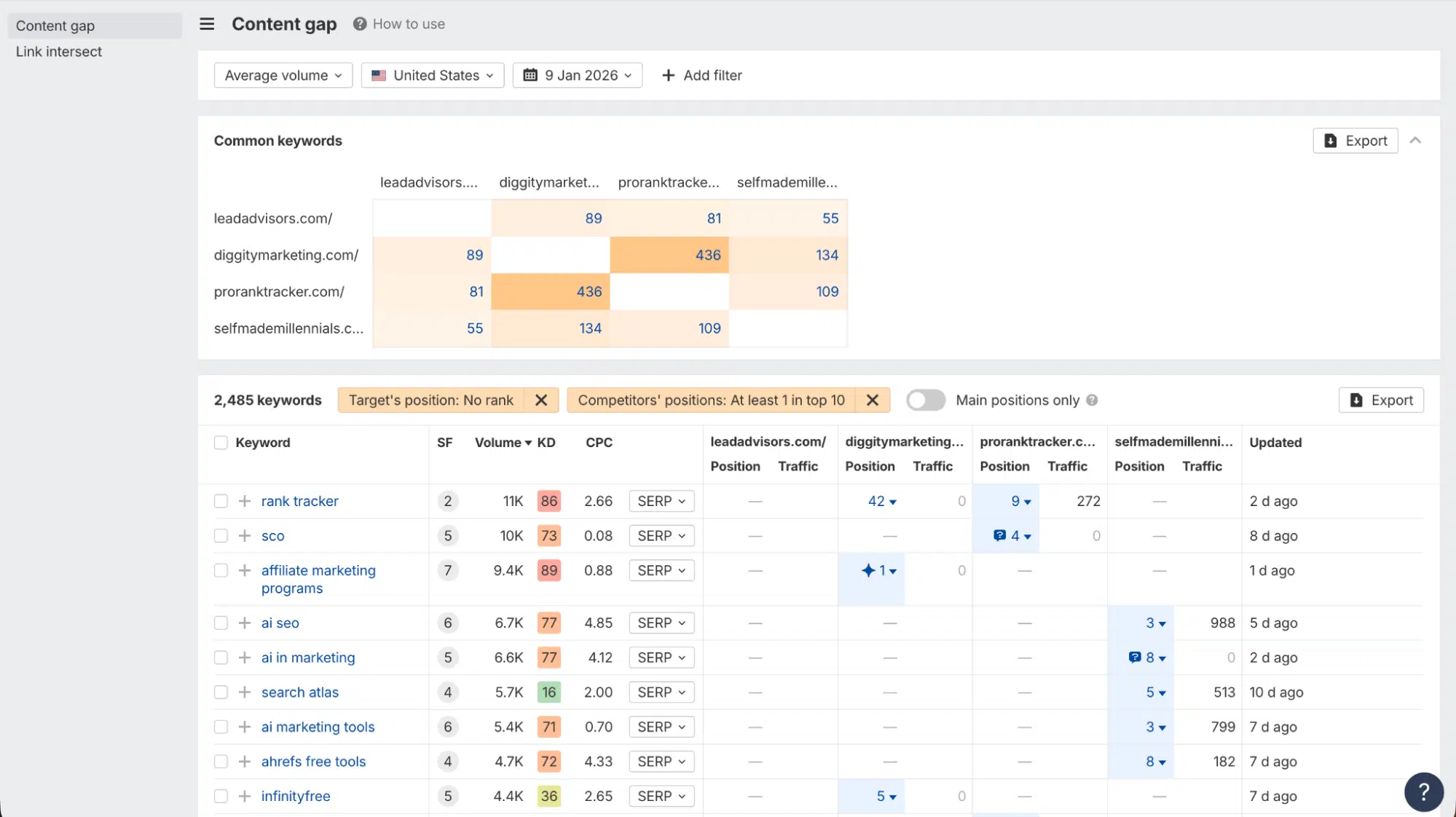
This is the most common gap analysis. It involves using the Ahrefs content gap tool to see where competitors rank for keywords that you miss entirely. Keyword gap analysis is perfect for finding low-hanging fruit and missing keywords.
However, it does not account for the nuance of search intent. You must differentiate between missing content and keywords that simply don’t fit your brand.
Topic and Topical Authority Gaps
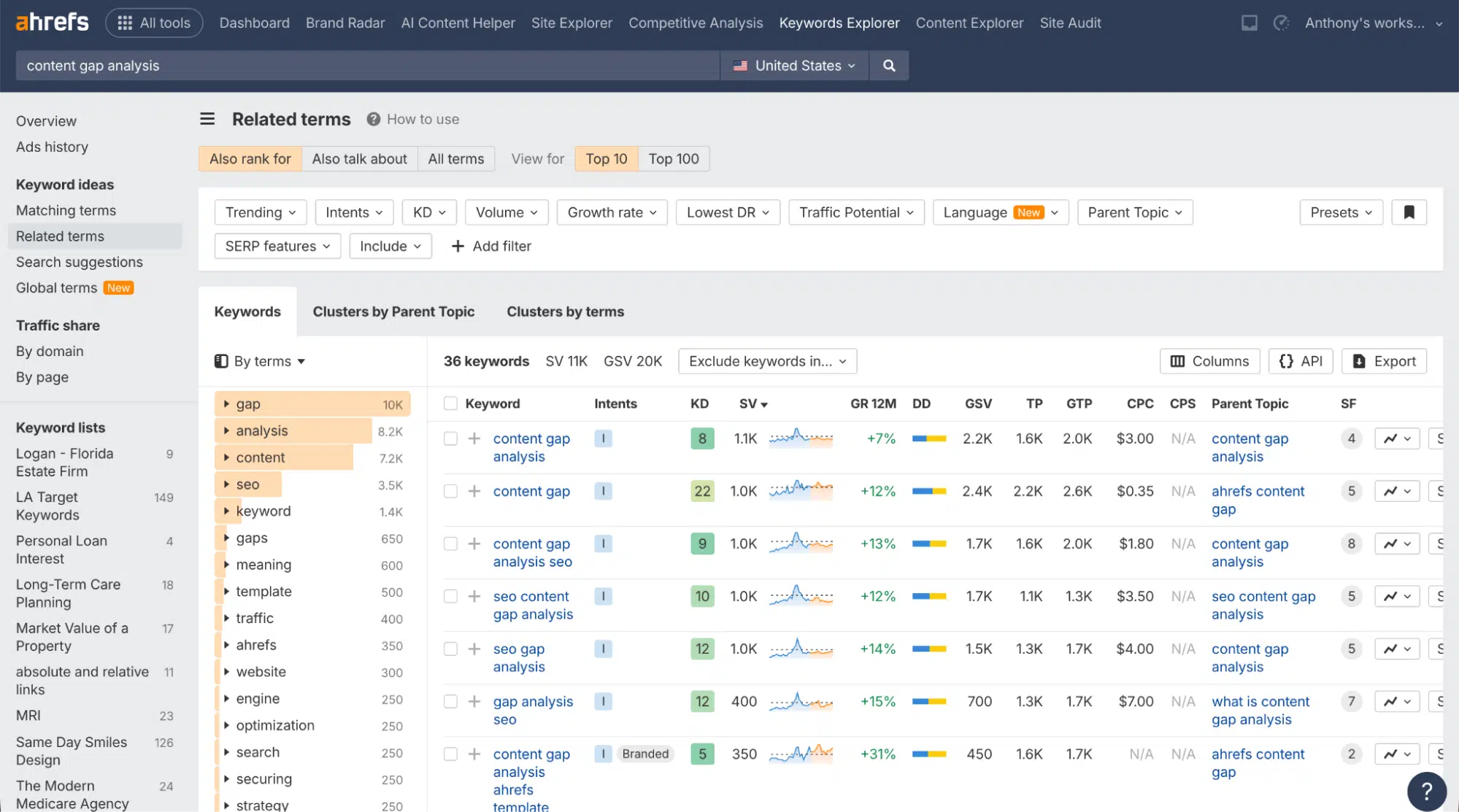
A single blog post rarely wins a competitive niche. You need fresh content ideas that form clusters. A gap analysis is important for authority means finding missing content across the entire subtopics.
If you lack high-quality content on related keywords, the search engine won’t view you as an expert. Use market research to identify opportunities for new content that supports your main pillars.
Buyer Journey Gaps
Many content marketers build awareness-heavy sites but ignore the consideration stage. This creates a massive content gap. You need valuable content for multiple touchpoints, including pricing, comparisons, and alternatives. Without these, you lose potential customers at the most critical stages of the buyer’s journey.
AI and GEO Visibility Gaps
In 2026, you must analyze gaps in website traffic coming from Generative Experience Optimization (GEO). If AI tools cite competitor websites instead of yours, you have a visibility gap.
This happens when your existing live content lacks the structured data or valuable insights AI models prioritize. Filling these untapped keywords is essential for more sales.
Read more: LLMO vs. GEO vs. AEO: How to Win Mentions, Citations, and Conversions from AI
When Should You Run a Content Gap Analysis?
Timing determines the impact of your content marketing strategy. For established websites, run an in-depth analysis whenever organic traffic plateaus or a new competitor enters the search engine rankings. If your site is new, skip the full gap analysis initially.
Focus first on building a foundational keyword list and securing low-hanging fruit. Once you have 30–50 pages of existing seed content, start your first content audit to identify opportunities for growth.
Consistency prevents underperforming content from decaying. Use a tiered approach to stay ahead of competitor websites.
Recommended Cadence
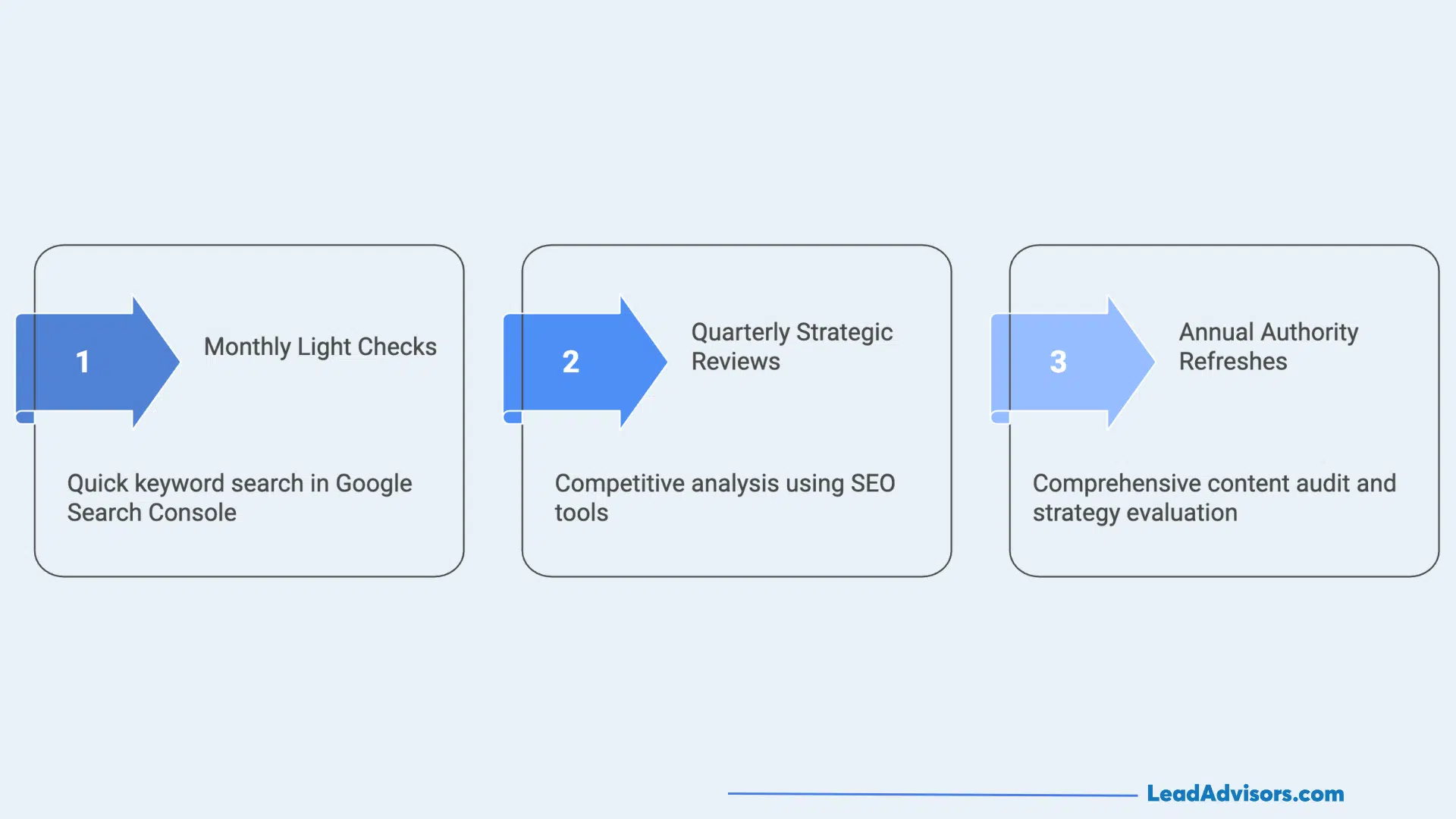
- Monthly light checks: Spend 30 minutes in Google Search Console to find missing keywords for which you already rank on page two. These are lucrative opportunities for quick updates. Check if competitors rank for trending new keywords in your niche.
- Quarterly strategic reviews: Perform a full competitive gap analysis using SEO tools like the Ahrefs content gap tool. Compare your landing pages and blog post performance against top competitors. Map these findings to the target audience’s buyer’s journey to ensure you cover the consideration stage.
- Annual authority refreshes: Conduct a comprehensive content audit of your entire seo strategy. Evaluate your topical authority and identify untapped keywords across various stages of the customer journey. Use this time to make content that fills large content gaps and addresses broad pain points.
Regularly scheduled reviews ensure you never miss opportunities. This proactive rhythm helps any small business owner maintain a strong presence in search results and drive more sales.
How to Do a Content Gap Analysis Step by Step
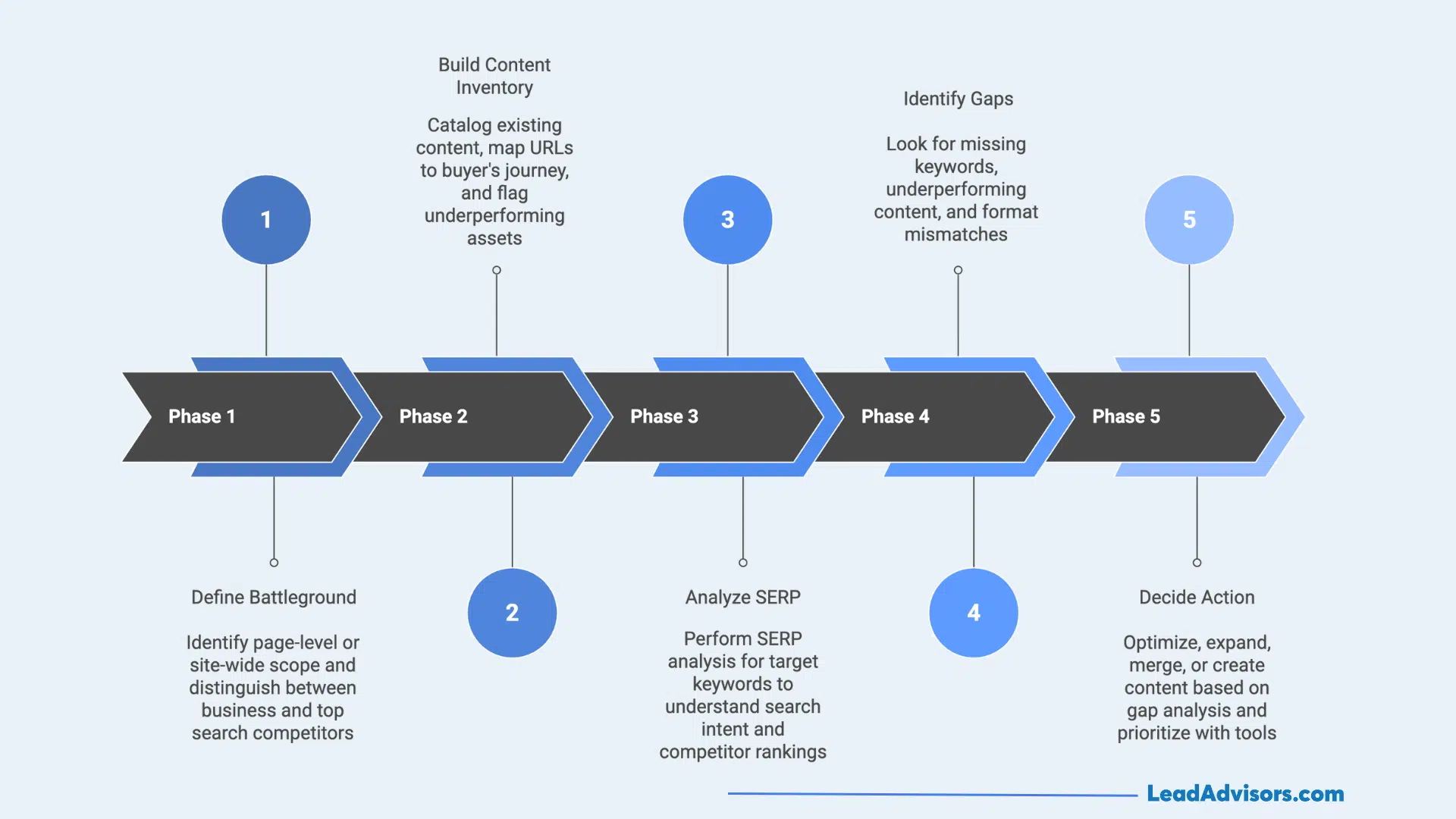
Execution defines your success. Follow this five-phase workflow to turn missing content into organic traffic and more sales.
Phase 1 – Define Your Battleground and Competitors
Decide if you need a page-level or site-wide gap analysis. Distinguish between business competitors and top competitors in search results. Often, a publisher’s blog post outranks you even if they don’t sell your product. Use SEO tools to identify opportunities against these digital rivals who steal your potential customers.
Phase 2 – Build a Focused Content Inventory
Catalog your existing content by mapping URLs to the target audience’s buyer’s journey. Note the search intent and funnel stage for each piece. Don’t overcomplicate this; focus on performance and freshness. Use Google Analytics to flag underperforming content that fails to meet your keyword strategy.
Phase 3 – Analyze the SERP for Intent and Expectations
Perform a SERP analysis for your keywords. The search engine reveals what it prefers: informational guides, commercial landing pages, or decision-focused tools. Look for various stages of subtopics that competitors rank consistently for. This helps you find related keywords that define the topic’s depth.
Phase 4 – Identify Meaningful Content Gaps
Look for missing keywords and untapped keywords where your coverage is thin. Check for missing content that lacks visuals, proof, or valuable insights. A format mismatch—like using a short article when the top competitors use in-depth videos—is a major content gap.
Phase 5 – Decide the Correct Action
Stop guessing and start acting. You have four choices: optimize existing content, expand and restructure weak pages, merge pages with keyword overlap, or draft content from scratch. Use ahrefs content gap data to prioritize low-hanging fruit. Always support new assets with cluster content to build topical authority and capture more traffic.
How to Do a Manual Content Gap Analysis (Without Tools)
You do not always need expensive software to identify opportunities. A manual gap analysis works best when you need to understand the nuance of search intent or when your own site is still small. It becomes inefficient once you manage thousands of URLs, but for a small business owner, manual reviews offer valuable insights that automated SEO tools often miss.
Reviewing Competitors Without Software
Start by examining competitor websites directly. Search for your keywords and read the top-performing keywords’ pages strategically. Look for “information gain”—what unique value do they provide that you don’t? Analyze their competitor’s blog structure.
If they include a pricing calculator or a video while you only have a text-heavy blog post, you have found a format-based content gap. This market research helps you create content that actually matches what the search engine rewards.
Using Google Search Console for Gap Signals
Your own search console data is a goldmine for missing keywords. Identify queries where there are a lot of impressions, but very few clicks; this means content that doesn’t quite meet the needs of the user, or you have not really addressed user pain points, so it is a perfect target for content creation.
Check for queries where you have partial coverage. If you rank on page two for related keywords that aren’t the main focus of your existing content, that is a sign you need new content or a dedicated landing page refresh.
GSC also highlights content decay. If a piece of content, which was once considered high-quality, loses its ranking, it is a content gap that the competitors will not hesitate to fill. When you align these signals with the buyer’s journey, you are able to discover new keywords and remediate missed opportunities without a subscription.
Best Tools for Content Gap Analysis
To execute an effective analysis, you need the right data. In 2026, SEO tools have moved a long way from just giving users simple lists and are now providing valuable insights into the searcher’s intent and topical authority.
No matter if you are a small business owner, enterprise lead, or any other category of users, these tools assist you in identifying the gaps, and thus, you can easily outrank your competitors’ websites.
Using Semrush for Content Gap Analysis
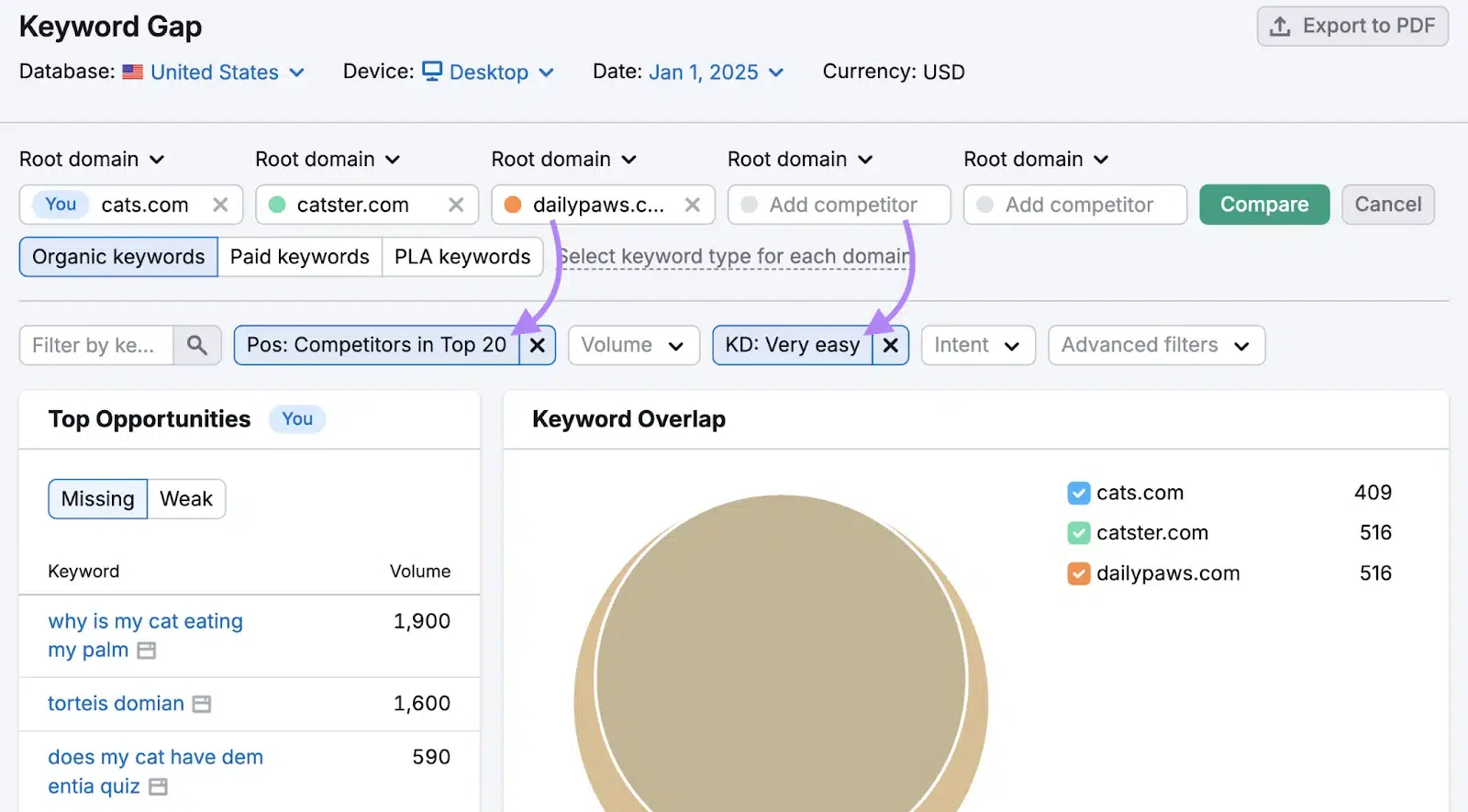
The Semrush keyword gap tool is a powerhouse for analyzing competitors. It breaks down the keyword gaps into three segments – “Missing,” “Weak,” and “Untapped. ” If you want to locate the keywords for which top competitors rank, but you don’t, choose the ‘Missing’ option.
For finding easy wins, set up the filter for keywords with a difficulty score of 0-49 and mainly go for “Informational” or “Commercial” search intent. This allows you to give content that meets the target audience’s buying journey, even at first glance.
Using Ahrefs for Content and Topic Gaps
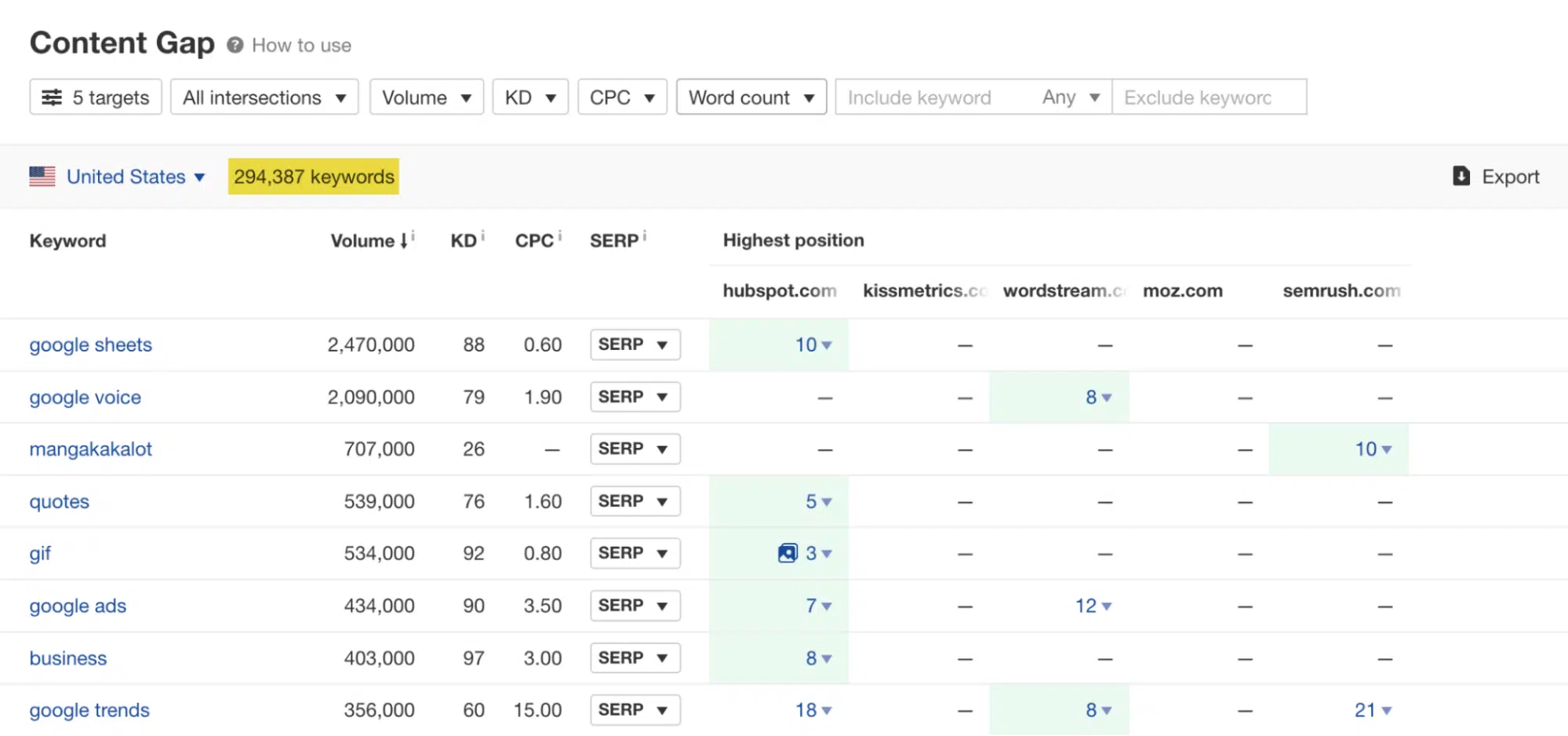
The Ahrefs content gap tool is the industry gold standard for finding keyword gaps. It allows you to perform page-level or domain-level comparisons.
By entering up to ten competitor websites, you can see exactly which long tail keywords drive their organic traffic. Use the “Intersections” filter to find missing content that every competitor covers—this signals a must-have topic for your content framework.
When Content Optimization Tools Are More Effective
While Ahrefs and Semrush are great for discovery, tools like Clearscope or SurferSEO excel at content creation. These are more effective when you need to fix underperforming content on your own site. They analyze the search results in real-time to suggest related keywords and subtopics that increase your topical completeness.
How to Choose the Right Tool for Your Goal
Choose Ahrefs or Semrush for high-level market research and discovery. Use optimization tools for refining a specific blog post or landing pages. If you are just starting, GSC and Google Analytics are often enough to identify opportunities and drive more traffic without extra costs.
How to Use AI for Content Gap Analysis in SEO
In 2026, AI is no longer just a writing tool; it is a pattern-recognition engine. Using AI to identify opportunities allows you to process vast amounts of competitor content and search results in seconds. This shift from manual sorting to AI-assisted intelligence helps any small business owner find lucrative opportunities before they become obvious.
What AI Is Good At
AI excels at pattern detection. It can analyze the top 10 search results for a target keyword and instantly find the “information gain” you are missing. It is perfect for subtopic expansion, helping you build a content marketing strategy that covers an entire niche rather than a single blog post. AI is also the fastest way to generate FAQ and comparison suggestions by scraping “People Also Ask” data and forum discussions to find potential customers’ real pain points.
What AI Cannot Replace
AI lacks SERP judgment. It cannot tell you if a keyword is too difficult for your own site based on your current backlink profile. It also fails at business prioritization; only you know which long tail keywords lead to more sales.
Finally, AI cannot manufacture trust signals. High-quality content in 2026 requires real-world experience, expertise, and proof—elements AI can organize but never truly create.
A Safe AI-Assisted Gap Analysis Workflow
Start small. Audit one underperforming content page by feeding the text and your competitor’s URL into an AI tool. Ask it to find missing and underperforming content sections. Always validate AI output manually to ensure the related keywords it suggests actually match search intent. This hybrid approach ensures your seo strategy remains human-led but AI-powered.
Example AI Prompts for Content Gap Analysis
Use specific, intent-driven prompts to find gaps:
- For missing subtopics: “Compare my page [URL] with [Competitor URL]. List five specific subtopics they cover that I have missed.”
- For intent mismatches: “Analyze the search results for ‘[Keyword]’. Is the intent informational or transactional? Does my page [URL] match this?”
- For depth: “What valuable insights or data points would make this blog post the most in-depth resource on the web for [Target Audience]?”
How to Find GEO and AI Visibility Gaps
In 2026, a traditional keyword strategy is not enough. You must address Generative Engine Optimization (GEO) to remain visible. Users now ask complex, multi-turn questions, and if your current assets aren’t structured for these “answer engines,” you face a massive visibility gap.
Identifying Prompts Where Competitors Dominate
Start by building a prompt list based on how your target audience actually speaks. Instead of “best laptop,” use “Which lightweight laptop is best for video editing under $1,000?” Test these in tools like Perplexity, ChatGPT, and search results via AI Overviews.
Identify the “source of truth” pages—the URLs these engines repeatedly cite. If competitor websites appear while your own site is absent, analyze their “Power Pages” for valuable insights you lack.
Content Traits AI Engines Reward
AI search doesn’t just rank; it synthesizes. To fill these gaps, create content that features:
- Clear definitions: Use the “is/as” format for immediate clarity.
- Direct answers: Place a concise summary at the top of your blog post.
- Scannable structure: Use bullet points and H3s so machines can parse data fast.
- Evidence and experience signals: AI rewards high-quality content that includes original data, citations, and “I” statements from experts.
The Role of Structured Data and FAQs
Structured data acts as a direct line to AI models, helping them interpret entities and relationships with perfect clarity. Use Schema.org markup to define your products and organizations. FAQs are particularly powerful for long tail keywords and conversational queries.
However, ensure they provide valuable content; if they repeat information already in the text, they add noise. Well-structured FAQs help you win citations in the consideration stage, driving more traffic and more sales.
How to Fill Content Gaps Using Information Gain
Filling a content gap is not an invitation to copy your rivals. If you simply rewrite what competitor websites have already published, you offer the search engine zero incentive to rank you higher. Success in 2026 requires “information gain”—providing unique, valuable insights that do not exist elsewhere. This strategy turns underperforming content into a market leader.
Optimize Existing Content vs Create New Pages
Deciding your next move depends on the search intent. If your existing seed content ranks on page two or three for keywords, a refresh often wins. Update the page with fresh content ideas and better keyword opportunities to reclaim organic traffic.
However, if you find missing keywords that represent a completely different stage of the buyer’s journey, you must create content on a new page. For example, if you have a top-of-funnel blog post but lack a bottom-of-funnel comparison, a new asset is required to capture more sales.
Information Gain Strategies That Actually Work
To truly outshine top competitors, integrate these four elements into your content strategy:
- Proprietary data: Conduct original surveys or market research. Use your own internal numbers to create charts and graphs that others will cite.
- Expert insight: Go beyond basic definitions. Interview your product team to provide in-depth commentary on industry pain points.
- Case studies: Nothing fills a content gap like real-world proof. Show potential customers exactly how you solved a problem.
- First-hand experience: In the era of AI, personal “I” statements and original photography signal high-quality content that machines cannot replicate.
By focusing on these unique additions, you ensure your SEO strategy provides a superior answer to every query. This approach doesn’t just fill a gap analysis
How to Prioritize Content Gaps That Drive Results
Identifying a content gap is easy; choosing which one to fix first is the challenge. You cannot fill every void simultaneously. A successful content strategy requires a ruthless focus on lucrative opportunities that yield the fastest organic traffic gains. Without a prioritization framework, you risk wasting resources on low-volume keywords while top competitors steal your potential customers.
Quick Wins vs Long-Term Authority Building
Focus first on page-one-adjacent opportunities. Use GSC to find underperforming content ranking in positions 11–20. These are low-hanging fruit. A simple refresh with missing keywords or, better, valuable content can push these into the top three results. Conversely, cluster-level investments involve creating new content to build topical authority. These take longer but protect your search engine rankings from future volatility.
A Simple ROI Scoring Model
Score every content gap on a scale of 1–5 across four metrics:
- Search demand: High search volume ensures the effort is worth it.
- Ranking feasibility: Use SEO tools to check if you can realistically beat competitor websites.
- Business value: Does the topic reach users in the consideration stage who are ready for more sales?
- Content effort: Is this a quick blog post update or an in-depth white paper?
Recommended Order of Execution
Start with your homepage to ensure your core messaging and keywords are aligned. Move to product and service pages; these drive the highest conversion rates. Next, optimize high-performing blog posts that are losing relevance. Finally, focus on net-new content to fill underperforming content areas discovered during your gap analysis. This sequence ensures your SEO strategy generates cash flow while you build long-term dominance.
Content Gap Analysis for SaaS, Agencies, and In-House Teams
The framework for an effective gap analysis changes based on your business model. Whether you are scaling a software platform or managing a client’s portfolio, you must tailor your gap analysis to the specific pain points of your industry.
SaaS-Specific Gaps
SaaS content marketers often fall into the trap of only creating top-of-funnel blog post content. To drive more sales, you must identify gaps in the consideration stage.
- Use cases: Ensure you have dedicated landing pages for every vertical you serve. If competitors rank for “CRM for real estate” but you only have a general product page, you have a content gap.
- Alternatives and comparisons: Potential customers actively search for “Your Brand vs. Competitor.” If you don’t make content for these queries, your competitors will write the narrative for you.
- Pricing and ROI: Use SEO tools to find untapped keywords related to cost and value. Transparency in the decision stage reduces friction in the buyer’s journey.
What Agencies Typically Deliver
When you hire an agency for a content gap analysis SEO project, expect more than a keyword list. A professional deliverable should include a competitor analysis of 3–5 top competitors, a content audit of your own site, and a prioritized roadmap.
Agencies use advanced SEO tools like the Ahrefs Content Gap tool to provide valuable insights into share of voice and keyword overlap. Their goal is to find low-hanging fruit that quickly improves your search engine rankings.
When to Keep Gap Analysis In-House
Keep your gap analysis in-house if you have a highly technical product that requires deep subject matter expertise. While agencies excel at keyword research, your internal team best understands the target audience’s buyer journey and specific product nuances.
Use GSC and Google Analytics internally to identify opportunities based on real user behavior. For small business owners, a manual in-house review of competitor websites is often more cost-effective than outsourcing.
Your 2026 Content Gap Analysis Checklist
Transform your content strategy from reactive to proactive. Use this streamlined workflow to bridge content gaps and capture more traffic across various stages of the buyer’s journey.
- Audit for low-hanging fruit: Use Google Search Console to find underperforming content ranking in positions 11–20. These pages only need minor in-depth updates to hit the first page.
- Run a competitive keyword gap analysis: Plug your own site into the Ahrefs content gap tool. Identify keywords where top competitors rank, but you are invisible.
- Map topics to the customer journey: Ensure you have high-quality content for every phase. Most sites lack valuable content for the consideration stage, such as comparison guides and pricing pages.
- Analyze for information gain: Review search results for your target keywords. If you cannot provide valuable insights, proprietary data, or expert insight that competitors lack, do not publish.
- Identify AI visibility gaps: Test conversational prompts in search engines. If AI tools cite competitor websites instead of yours, restructure your existing live content with clear definitions and structured data.
- Prioritize by business value: Score every content gap based on search volume, ranking feasibility, and its potential to drive more sales.
- Execute with clusters: Never publish a standalone blog post. Create a pillar page and support it with related keywords to build topical authority.
- Measure and iterate: Use Google Analytics to track assisted conversions and engagement. Conduct a content audit quarterly to stay ahead of missing content.
Your 7-Day Content Gap Analysis Action Plan
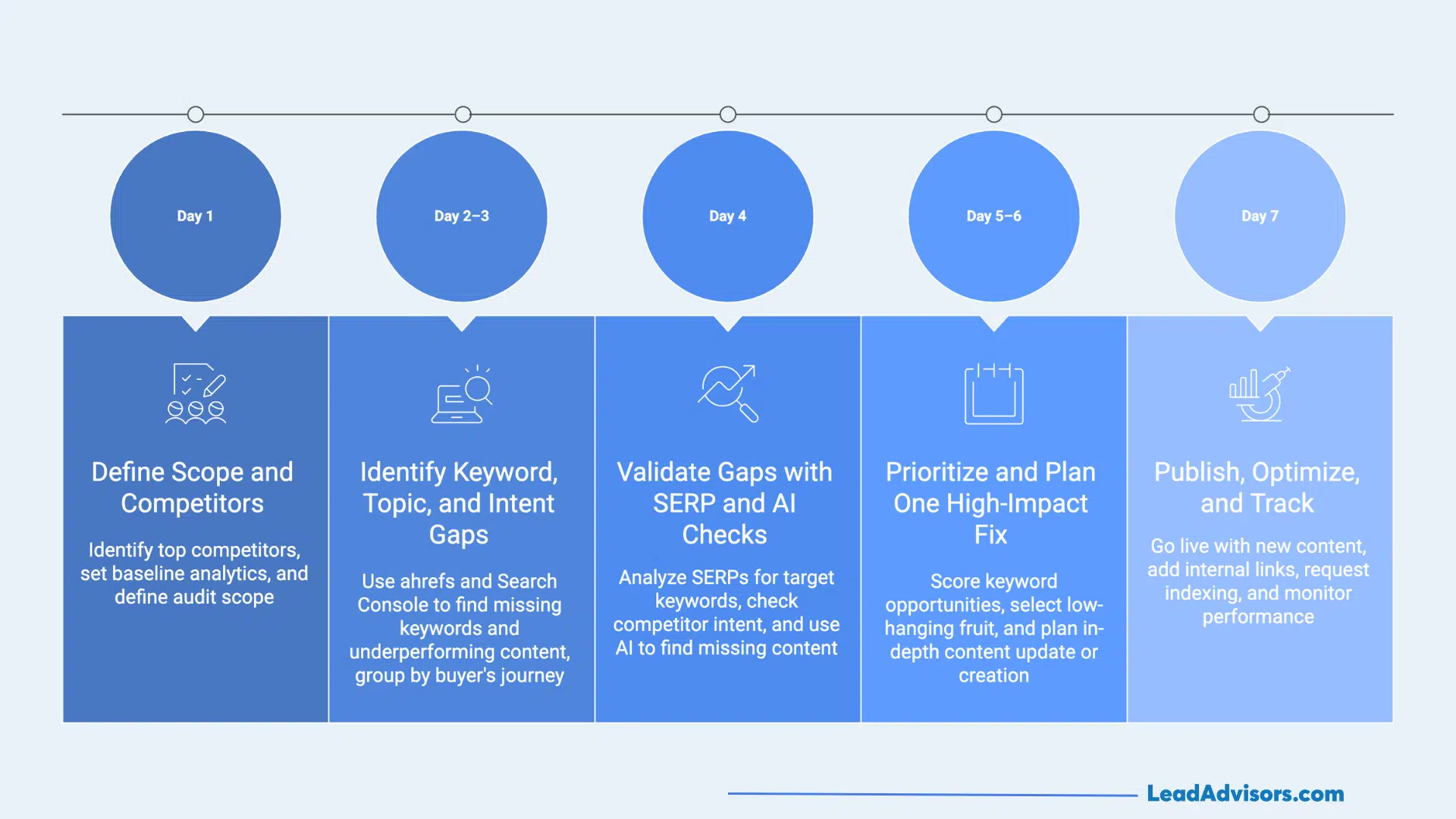
Execute this sprint to turn missed opportunities into organic traffic. This structured approach ensures your SEO strategy remains focused on high-quality content and more sales.
Day 1: Define Scope and Competitors
Identify your top competitors using SEO tools. Decide if you are auditing your entire site or a specific blog post category. Set your baseline in Google Analytics to track future organic traffic growth and benchmark your current search engine rankings.
Day 2–3: Identify Keyword, Topic, and Intent Gaps
Use the Ahrefs content gap tool to find missing keywords. Look for underperforming content in GSC that lacks topical authority. Group these into the target audience’s buyer’s journey to ensure you cover the consideration stage.
Day 4: Validate gaps with SERP and AI checks
Perform a SERP analysis for keywords. Check if competitor websites offer better search intent matches. Run AI prompts to find underperforming content that AI engines currently cite from rivals, ensuring you address pain points effectively.
Day 5–6: Prioritize and Plan One High-Impact Fix
Score your keyword opportunities by business value and search volume. Select one low-hanging fruit asset. Plan an in-depth update or create content that adds unique, valuable insights that your potential customers cannot find elsewhere.
Day 7: Publish, Optimize, and Track
Go live with your fresh content ideas. Add internal links from existing seed content to your new or updated pages. Use the search console to request indexing. Monitor your search engine performance to see your content strategy drive more traffic and results.