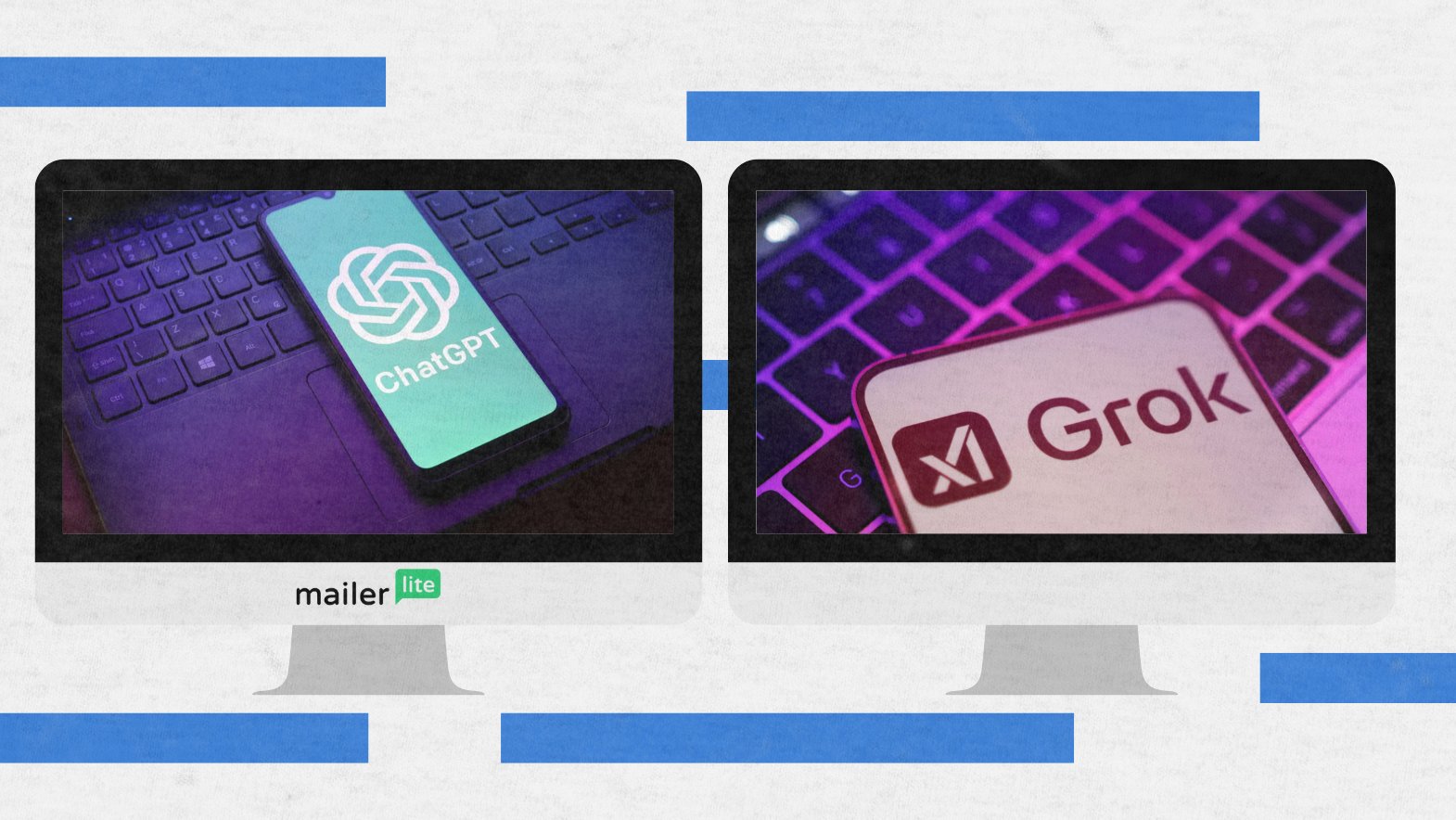
The AI chatbot landscape in 2025 is dominated by two heavyweights: OpenAI’s ChatGPT and xAI’s Grok. While ChatGPT remains the polished professional’s choice, Grok AI has emerged as the bold alternative, offering real-time data access and fewer filters.
This comparison cuts through the hype with actual benchmarks, hands-on tests, and feedback from real users. Whether you need structured problem-solving or real-time commentary on trending topics, this guide reveals which AI models truly deliver for your specific needs.

Quick Snapshot: ChatGPT vs Grok at a Glance
| Factor | ChatGPT | Grok |
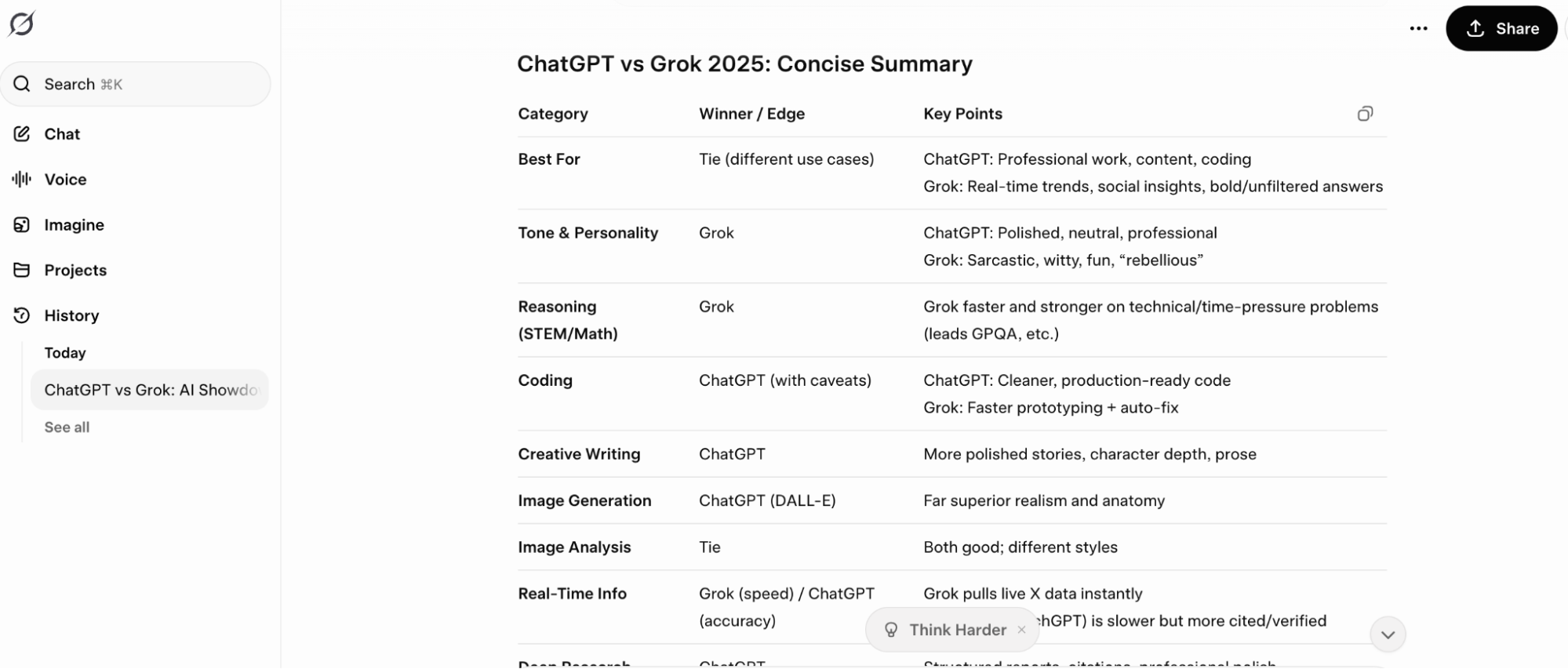
| Best For | Professional tasks, content creation, and coding assistance | Real-time data analysis, social trends, bold answers |
| Tone | Polished, neutral, structured | Sarcastic, witty, personality-driven |
| Reasoning | Excellent for logical reasoning | Superior technical reasoning under time pressure |
| Coding Quality | Production-ready, debuggable | Fast but needs refinement |
| Image Generation | High-quality (DALL-E integration) | Struggles with realism |
| Real-Time Data | SearchGPT (accurate, cited) | Pulls real-time data from the X platform |
| Safety Level | High filters, compliance-friendly | Minimal censorship |
| Integrations | Google Workspace, Microsoft, APIs | Limited (primarily X, formerly Twitter) |
| Free Plan | Yes (limited features) | Limited queries without Premium+ |
| Pricing | $20–$200/month | $30–$40/month (requires X subscription) |
Why These AI Tools Feel Completely Different
OpenAI’s ChatGPT: The Professional Powerhouse
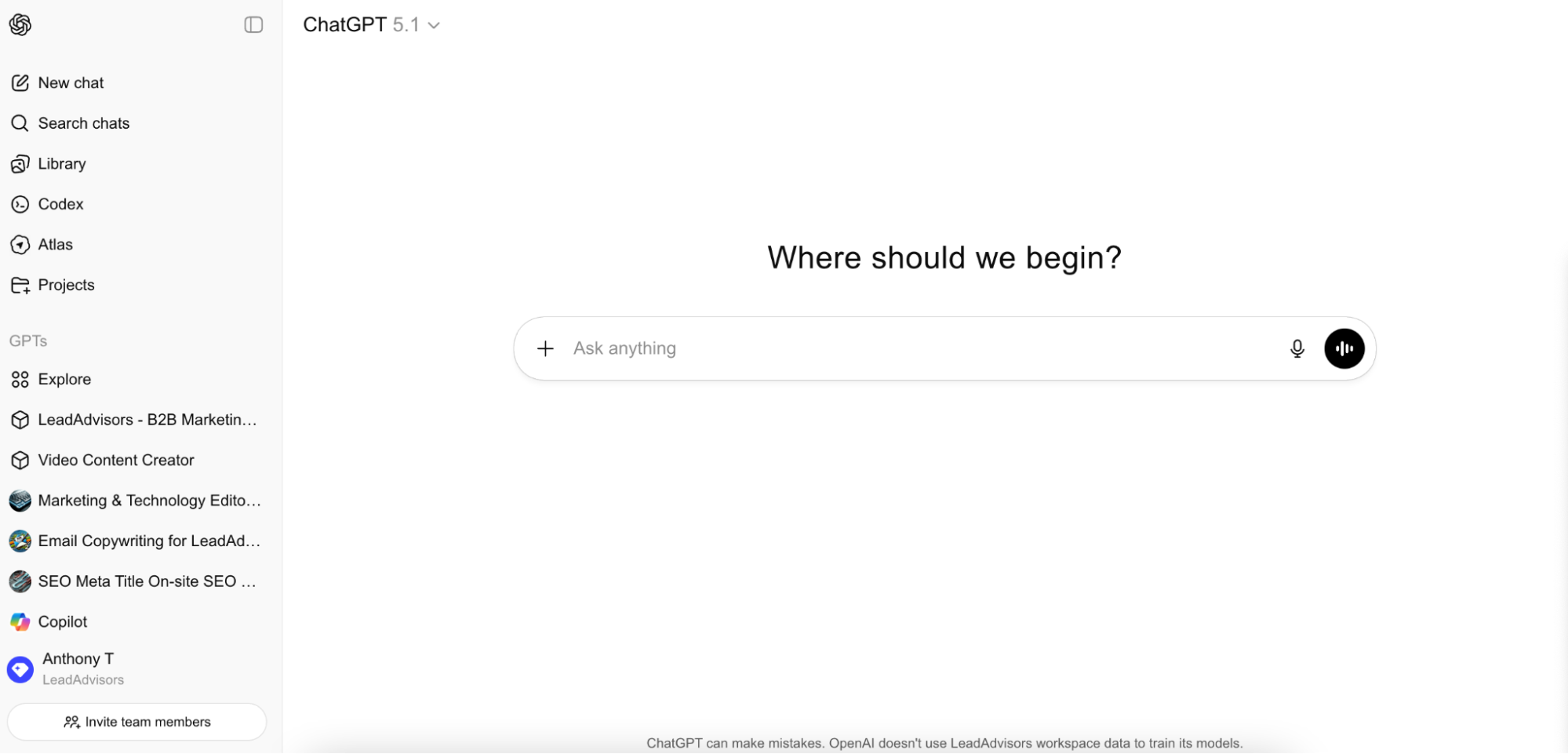
ChatGPT is built like a Swiss Army knife for productivity. As a generative pre-trained transformer, it’s designed for enterprise support, structured workflows, and consistent performance. The AI platform integrates seamlessly with Google ecosystem tools, generates human-like responses that feel neutral and professional, and offers advanced features like custom GPTs and memory functions.
According to OpenAI’s largest-ever study of consumer usage, approximately 30% of ChatGPT usage is work-related, while 70% supports personal tasks, with 800 million weekly active users as of late 2025—making it the most trusted AI assistant for professional tasks.
AI’s Grok: The Unfiltered Rebel
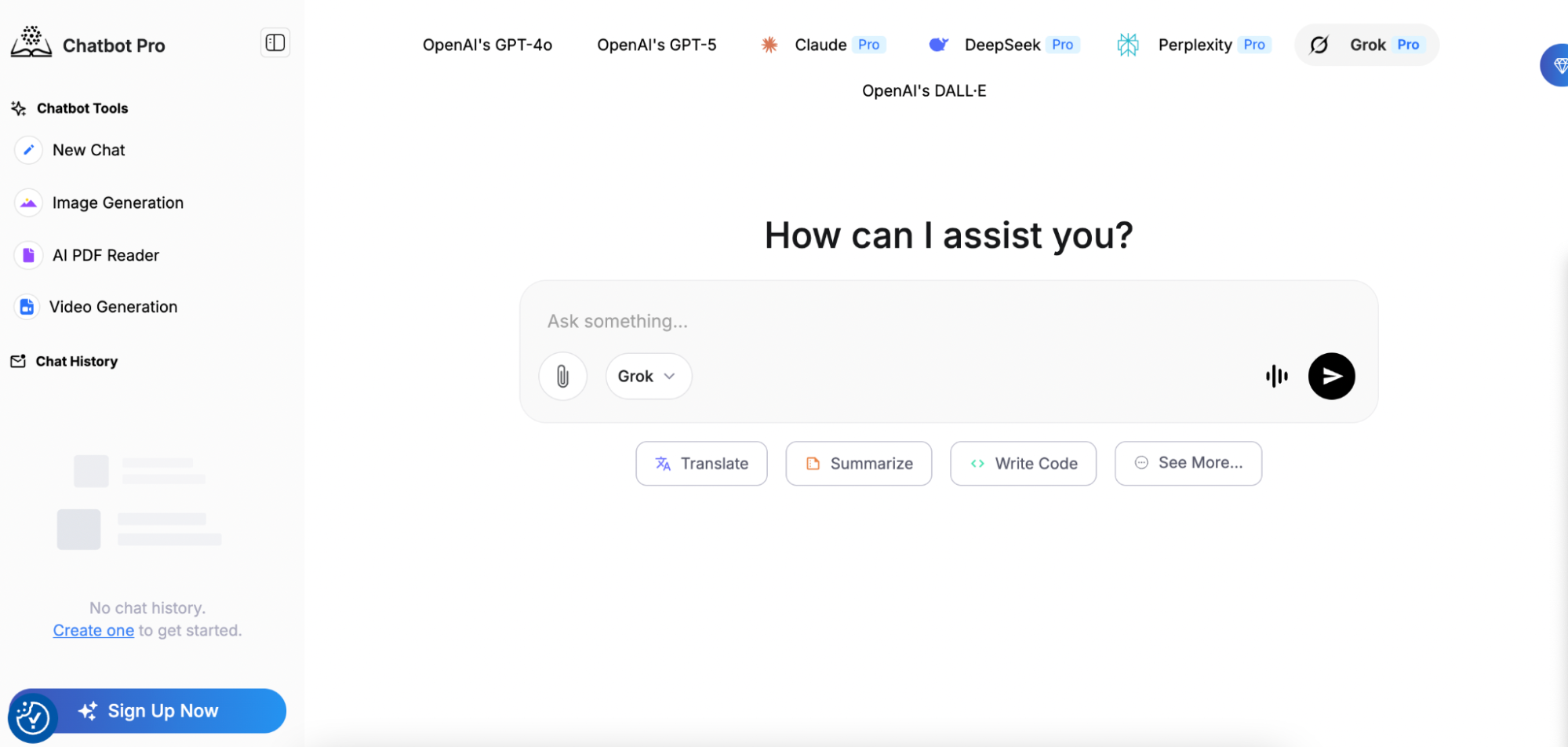
Inspired by The Hitchhiker’s Guide to the Galaxy, Grok nails personality. Created by Elon Musk’s own AI company, this large language model prioritizes real-time interaction with breaking news, has minimal content restrictions, and delivers responses with humor and edge that most AI assistants avoid.
Grok’s unique selling point? It resides within X (formerly Twitter), providing it with unmatched access to live data and current events as they unfold. Following the release of Grok 3 in February 2025, traffic surged 436% in a single month, reaching over 30 million monthly active users.
The philosophical divide: ChatGPT optimizes for accuracy and safety. Grok optimizes for speed and authenticity, even if that means less polish.
Technical Foundations: What’s Under the Hood
ChatGPT’s Architecture
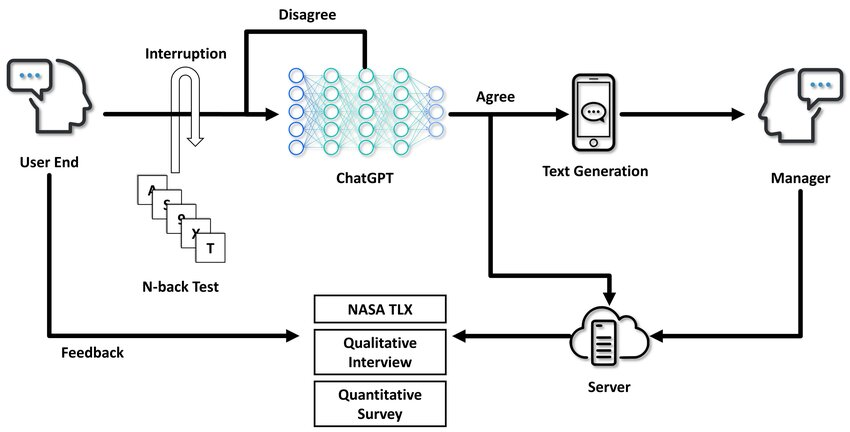
- Models: GPT-4o, GPT-4o mini, reasoning-enhanced Pro tier
- Strengths: Multimodal capabilities (text, images, code), tight integration across mobile apps and desktop
- Context: Handles complex problems across long conversations
- Training: Refined using human feedback for reliability
Grok 3’s Specifications
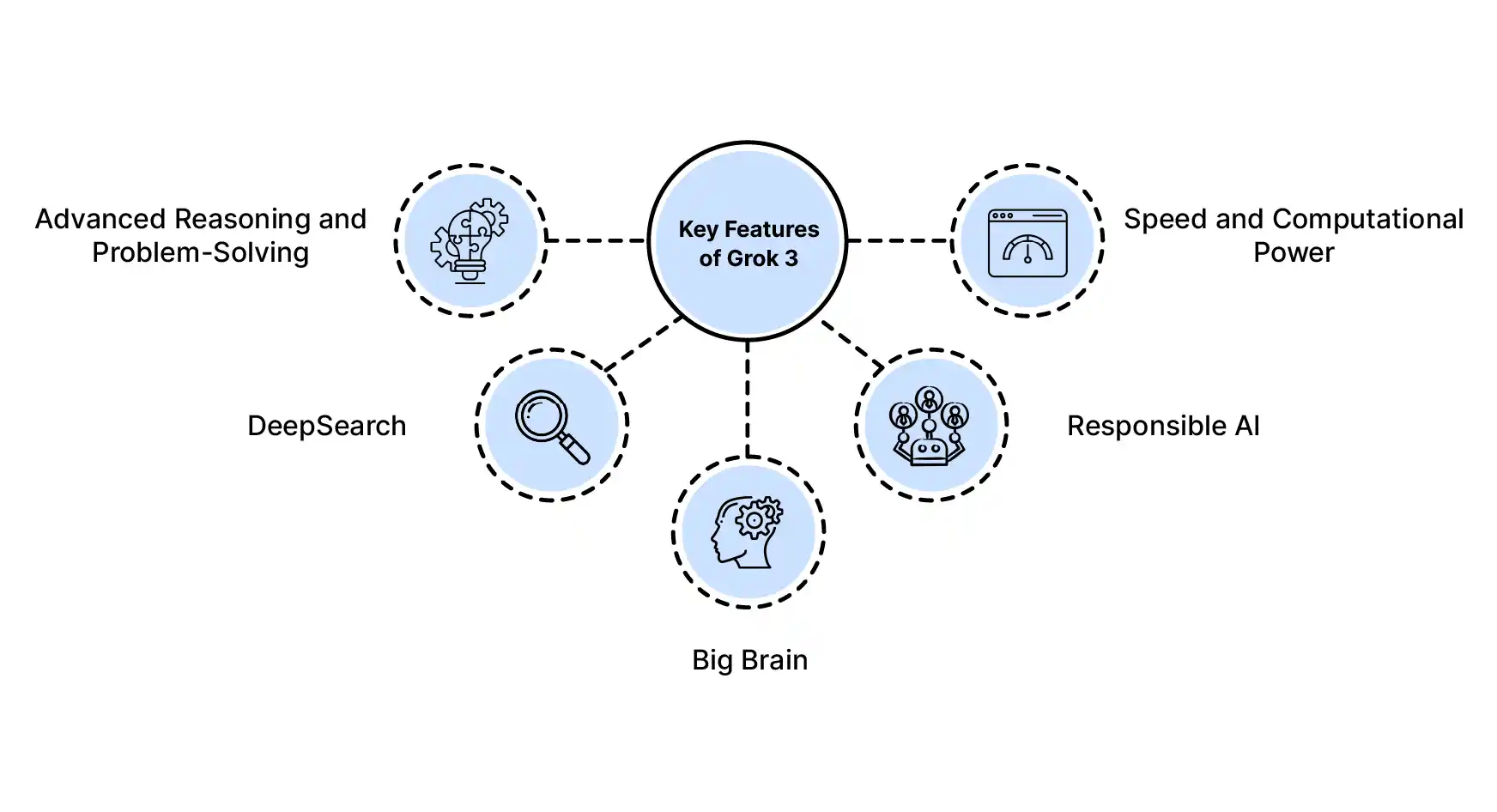
Grok 3 flexes impressive numbers: 2.7 trillion parameters trained on 12.8 trillion tokens with a 128,000-token context window. It features three distinct modes:
- Think Mode: Standard conversational AI
- Big Brain Mode: Enhanced for deep technical tasks
- DeepSearch: Exploratory research with real-time access to the X platform
Both ChatGPT and Grok represent cutting-edge AI tools, but their massive dataset sources differ fundamentally—ChatGPT draws from curated web content, while Grok pulls real-time data directly from social media streams.
Benchmark Showdown: Where Each AI Wins
STEM & Technical Reasoning
Winner: Grok
In standardized math and science tests, Grok vs ChatGPT results show Grok dominating. According to Stanford’s 2025 AI Index Report, performance differences on major benchmarks, such as MMLU and HumanEval, between U.S. and Chinese models decreased from double digits to near parity in 2024, with Grok 4 leading the GPQA Diamond (Scientific Reasoning) rating in October 2025.
For users tackling technical tasks that require rapid logical reasoning, Grok delivers faster and more accurate solutions to time-pressured problems.
Creative Writing & Storytelling
Winner: ChatGPT
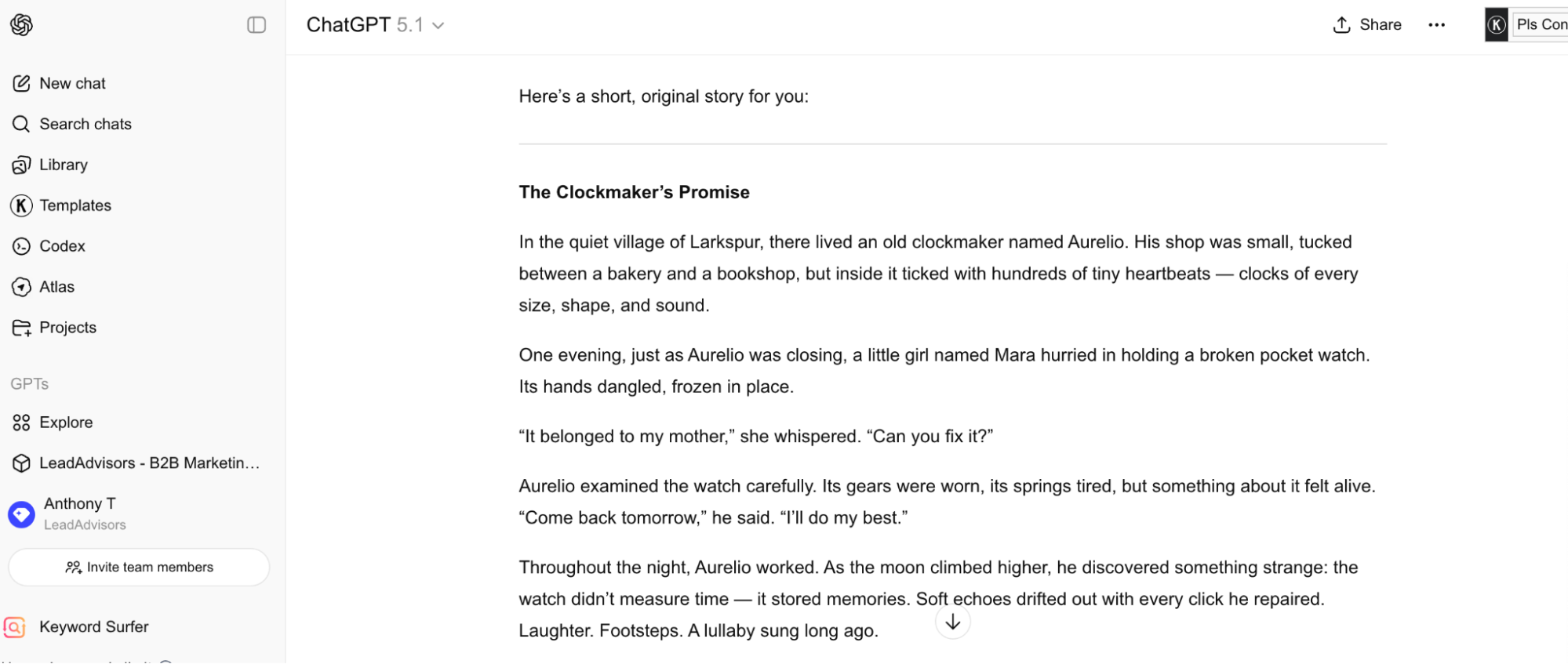
When testing creative writing abilities, ChatGPT excels at narrative structure, emotional depth, and character development. User feedback consistently highlights that ChatGPT delivers more polished prose with natural conversations and compelling story arcs. Grok’s creative output feels rushed and lacks the refinement that professional writers typically require.
Code Generation & Debugging
Winner: ChatGPT (with caveats)
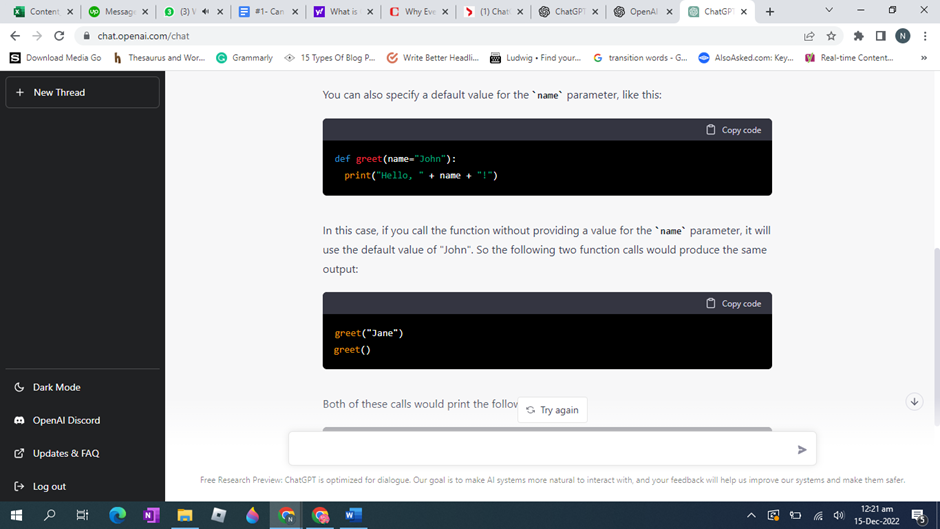
For coding assistance, ChatGPT produces cleaner, production-ready code with better documentation. However, Grok offers a unique auto-fix feature that helps debug code in real-time.
The verdict from developer communities? ChatGPT for building, Grok for rapid prototyping when you need to brainstorm ideas quickly. Research from Stanford’s AI Index indicates that by 2024, AI systems could resolve 71.7% of coding problems on the SWE-bench, up from just 4.4% in 2023—with ChatGPT consistently ranking among the top AI code generators.
Summarization Tasks
Winner: Grok (slightly)
Testing shows that Grok better follows length constraints and adheres to instructions. ChatGPT sometimes over-elaborates, although its summaries include more nuanced contextual information.
Image Generation

Winner: ChatGPT (decisively)
ChatGPT’s DALL-E integration produces photorealistic images with proper anatomy and lighting. Grok’s image generation struggles particularly with hands, faces, and complex compositions. For content creation involving visuals, there’s no contest.
Image Analysis
Winner: Tie
Both AI models perform equally well in image analysis. ChatGPT adds stylistic interpretation while Grok focuses on factual description. Both handle document scanning, chart reading, and visual data extraction effectively.
Real-Time Information Retrieval
Winner: Grok (for speed), ChatGPT (for accuracy)
This is where the Grok vs ChatGPT debate gets interesting:
- ChatGPT’s SearchGPT provides thoroughly cited, verified information ideal for research
- Grok’s live data feed excels at monitoring trending topics, breaking news, and social sentiment on X
The trade-off is clear: Grok is faster, but ChatGPT is more trustworthy for factual queries requiring structured data verification.
Deep Research Capabilities
Winner: ChatGPT
For comprehensive, deep research, ChatGPT produces structured, executive-ready reports with proper citations. Grok’s DeepSearch mode is exploratory and useful for discovering angles, but lacks the polish required for professional documentation.
Real-World Use Cases: Choosing Your Champion
When ChatGPT Is Your Best Bet
Choose OpenAI’s ChatGPT when you need:
- Professional workflows include drafting legal documents, creating business presentations, or building complex spreadsheets with structured data. ChatGPT benefits from deep integration with Google Workspace, making it ideal for enterprise support scenarios. With 92% of Fortune 500 companies already using ChatGPT, it’s become the de facto standard for corporate AI adoption.
- Content creation that demands polish. The AI assistant consistently handles high-quality long-form articles, marketing copy, educational materials, and technical documentation. ChatGPT offers memory features that maintain context across projects.
- Coding projects where reliability matters more than speed. From generating boilerplate code to explaining complex algorithms, ChatGPT supports multiple programming languages, producing output that is production-grade.
- Data analysis with charts and visualizations. Upload datasets up to 512MB and get actionable insights with visual representations.
- Teaching and tutoring where accuracy is non-negotiable. ChatGPT offers step-by-step explanations, making it an ideal tool for educational settings.
When Grok Takes the Lead
Choose Grok when you need:
- Real-time social intelligence. Monitoring what’s happening on the X platform right now—from viral trends to public sentiment on breaking news—is where how grok truly shines. Grok processed 134 million queries per day as of 2025, primarily for fact-checking and explaining posts on X.
- Unfiltered perspectives. When other AI assistants refuse to engage with controversial topics, both Grok and its “Spicy Mode” will tackle questions that other AI models avoid.
- Fast ideation. For rapid brainstorming ideas, especially in creative or chaotic projects, Grok’s personality-driven responses spark unconventional thinking.
- STEM problem-solving under pressure. When you need quick technical reasoning for math, physics, or logic puzzles, Grok’s big brain mode outperforms competitors.
- Social media management. Real-time commentary generation and trend analysis for marketing campaigns benefits from Grok’s native understanding of X (formerly Twitter) culture.
Safety, Filters, and Responsibility
ChatGPT’s Approach
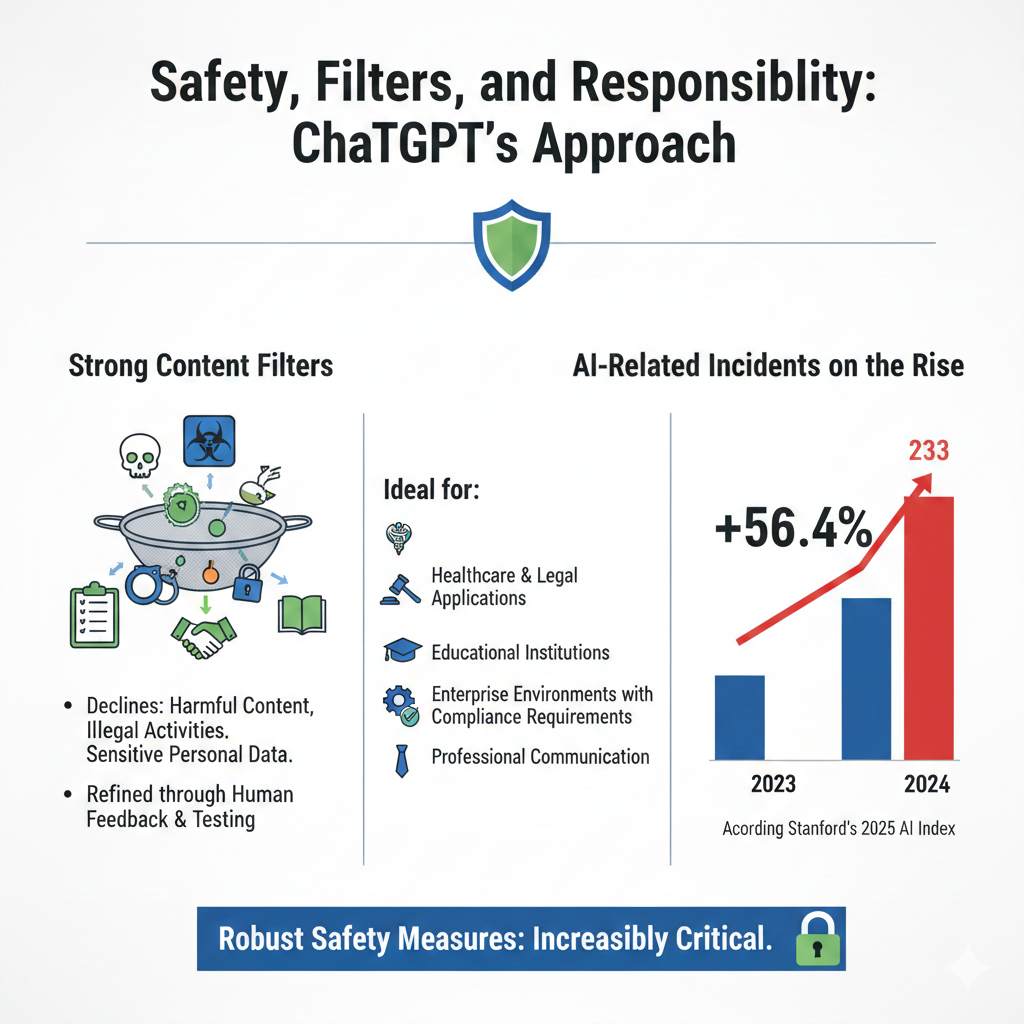
ChatGPT maintains strong content filters appropriate for regulated industries. It declines requests involving harmful content, illegal activities, or sensitive personal data. The training data includes extensive safety protocols that have been refined through human feedback and testing. This makes it ideal for:
- Healthcare and legal applications
- Educational institutions
- Enterprise environments with compliance requirements
- Professional communication
According to Stanford’s 2025 AI Index, AI-related incidents rose to 233 in 2024—a 56.4% increase over 2023—making robust safety measures increasingly critical.
Grok’s Philosophy
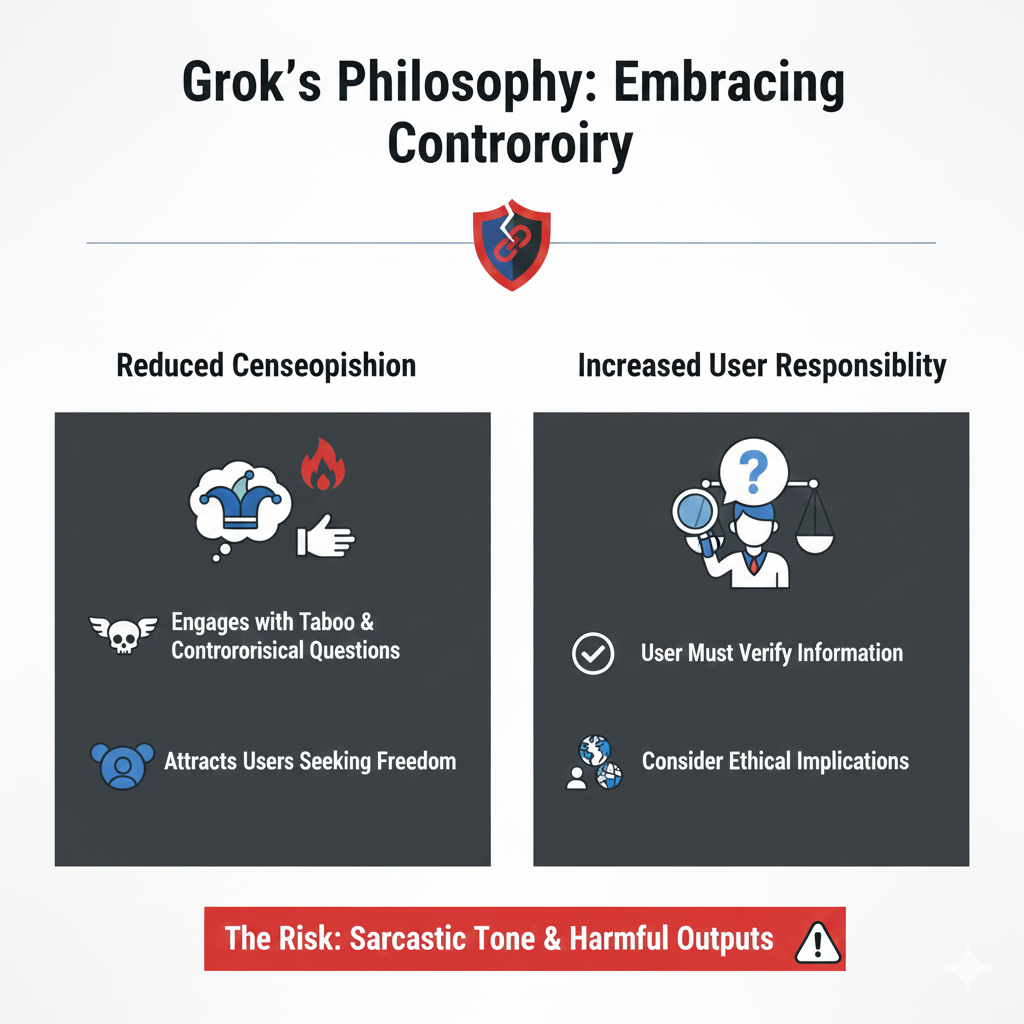
Grok deliberately reduces censorship, willing to engage with taboo or controversial questions. While this freedom attracts users frustrated by “overly safe” AI, it shifts more responsibility to the user to verify information and consider ethical implications.
The risk: Grok’s sarcastic tone can lead to misinterpretation, and its willingness to engage with sensitive topics increases the potential for harmful or misleading outputs.
Customization & Ecosystem Integration
ChatGPT’s Extensive Options
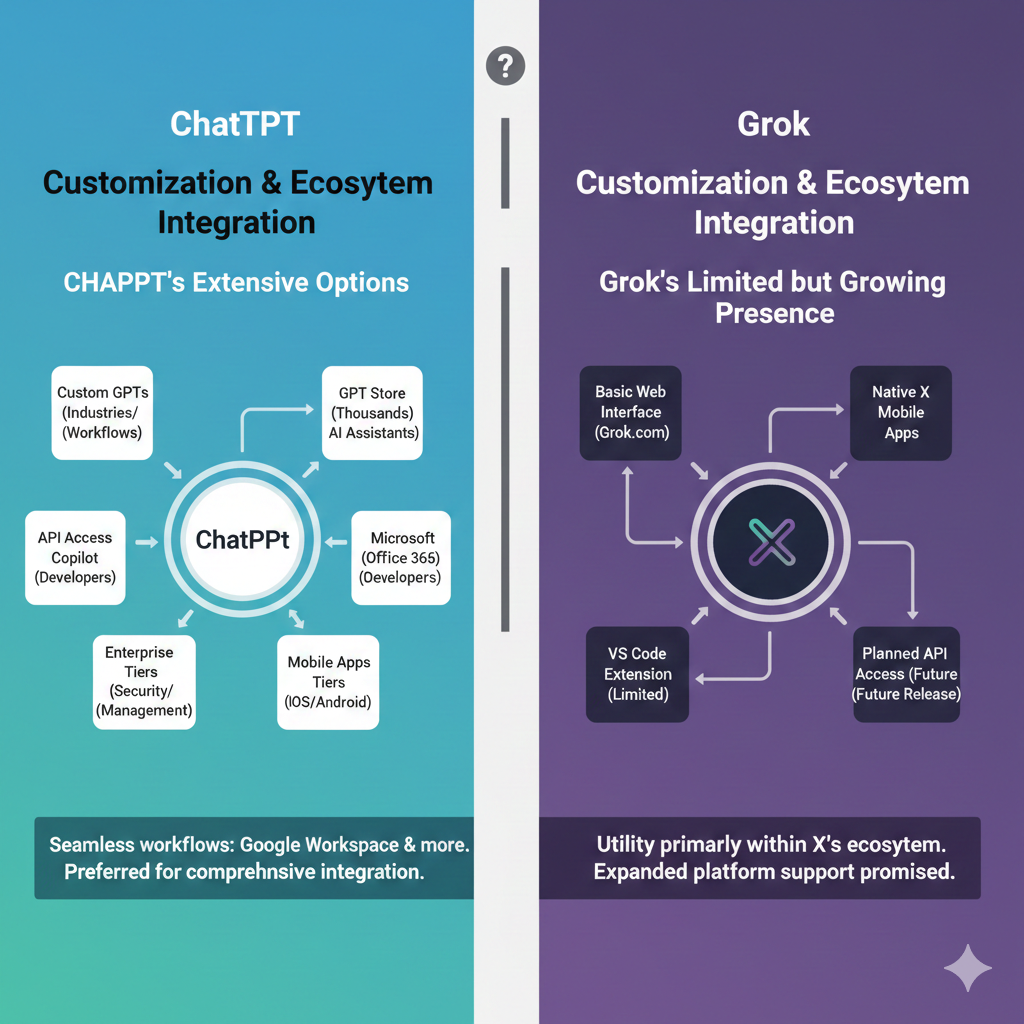
The ChatGPT ecosystem includes:
- Custom GPTs tailored to specific industries or workflows
- GPT Store with thousands of pre-built AI assistants
- API access for developers building AI platform solutions
- Microsoft Copilot integration for Office 365 users
- Mobile apps for iOS and Android with full feature parity
- Enterprise tiers with team management and advanced security
ChatGPT supports seamless workflows across Google Workspace and other productivity tools, making it the preferred choice for organizations that need comprehensive integration.
Grok’s Limited but Growing Presence
Currently, Grok exists primarily within X’s ecosystem with:
- Basic web interface at Grok.com
- Native integration in X mobile apps
- VS Code extension (limited availability)
- Planned API access (not yet widely released)
The AI company behind Grok promises expanded platform support, but for now, its utility outside X remains constrained.
Platform Access & User Experience
ChatGPT Accessibility
Access openai’s chatgpt through:
- Web browser (any device)
- Dedicated mobile apps (iOS/Android)
- Desktop applications (Mac/Windows)
- API integration for developers
- Team and enterprise portals
The experience remains consistent across platforms with cloud sync for conversation history. As of 2025, ChatGPT mobile apps had seen 64.27 million downloads.
Grok Availability
Access Grok via:
- X platform (integrated into social feed)
- Grok.com standalone interface
- X mobile apps with over 50 million downloads on the Google Play Store
- Requires Premium+ subscription ($30/month) or SuperGrok tier ($40/month)
The X integration is both Grok’s strength (real-time data) and limitation (platform dependency).
Pricing: What You Actually Pay
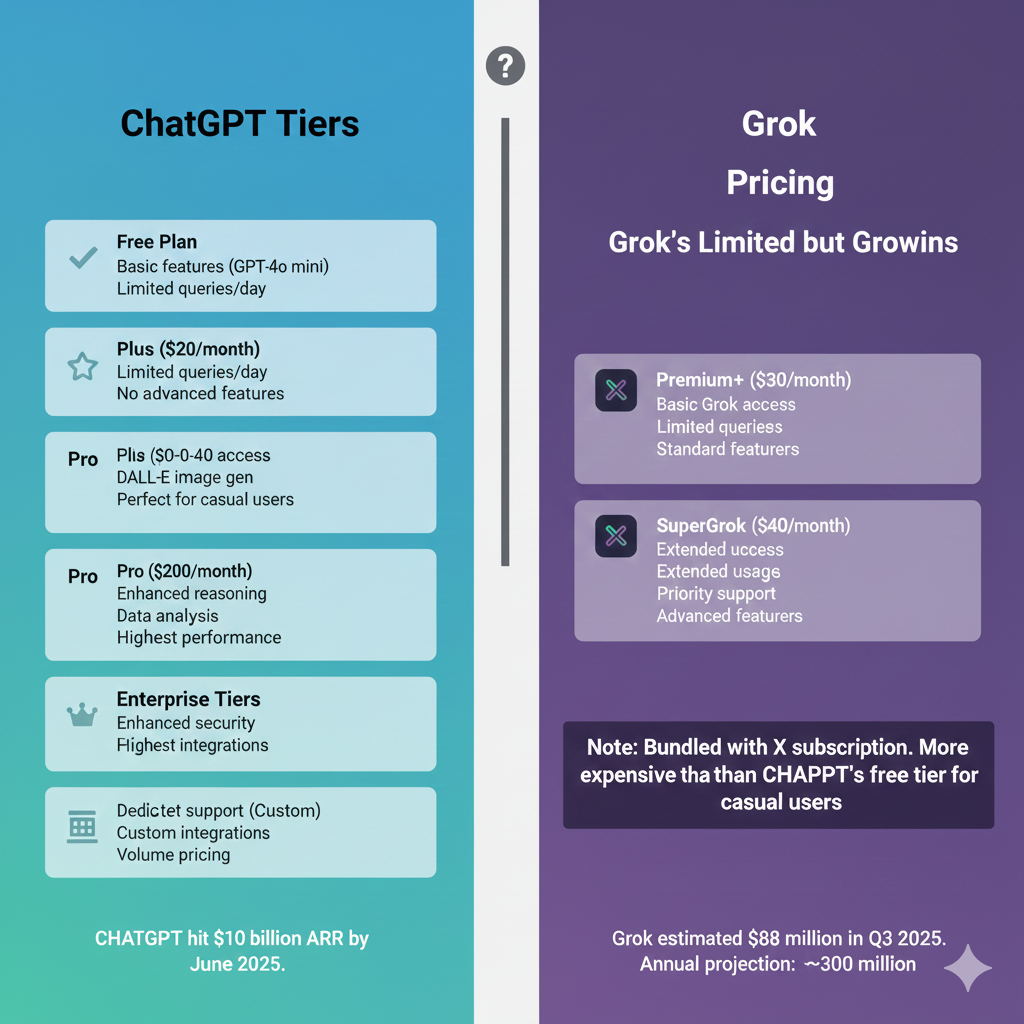
ChatGPT Tiers
Free Plan
- Basic features with GPT-4o mini
- Limited queries per day
- No advanced features or plugins
- Perfect for casual users testing the waters
Plus ($20/month)
- GPT-4o access
- Priority during peak times
- DALL-E image generation
- Advanced data analysis
- Custom GPTs
Pro ($200/month)
- Unlimited GPT-4o
- Enhanced reasoning models
- Priority support
- Highest performance tier
Enterprise (Custom)
- Dedicated support
- Enhanced security
- Custom integrations
- Volume pricing
ChatGPT hit $10 billion in annual recurring revenue by June 2025, demonstrating massive commercial success.
Grok Pricing
Grok is bundled with X subscriptions:
Premium+ ($30/month)
- Basic Grok access
- Limited queries
- Standard features
SuperGrok ($40/month)
- Extended usage
- Priority access
- Advanced features
Note: You cannot access Grok without an X subscription, making it inherently more expensive than ChatGPT’s free tier for casual users. Grok generated an estimated $88 million in Q3 2025, with projections indicating annual revenues of approximately $300 million.
Decision Matrix: Which AI Is Right for You?
By User Type
Developers & Engineers
- ChatGPT for production code, documentation, and debugging
- Grok for rapid prototyping, quick technical answers
Researchers & Academics
- ChatGPT for literature reviews, structured analysis, citations
- Grok for exploring emerging topics with real-world task context
Content Creators & Writers
- ChatGPT for polished articles, storytelling, and editing
- Grok for viral content ideas, social media angles
Social Media Managers
- Grok for trend monitoring, real-time engagement insights
- ChatGPT for content calendars, structured campaigns
Business Professionals
- ChatGPT for presentations, reports, and client communication
- Grok for quick market sentiment, competitive intelligence
Students
- ChatGPT for homework help, essay writing, and concept explanations
- Grok for current events context, STEM problem-solving
Enterprise Teams
- ChatGPT for workflow automation, knowledge management
- Grok currently lacks enterprise support features
The Final Verdict: A Balanced Perspective
Choose ChatGPT If You Value:
Accuracy over personality, professional polish, reliable coding support, structured workflows, compliance and safety, extensive integrations, superior image generation, and research credibility. ChatGPT remains the gold standard for professional tasks where consistency and quality are non-negotiable.
Choose Grok If You Value:
Real-time awareness, bold personality, minimal filtering, instant social insights, fast STEM solutions, and authentic human-like responses without corporate polish. Grok thrives in scenarios where speed and cultural relevance take precedence over formal accuracy.
The Power User Strategy
Most professionals benefit from a dual-tool approach:
Use ChatGPT for: Building, documenting, presenting, educating, and maintaining quality standards across real-world tasks.
Use Grok for: Monitoring, exploring, ideating, and engaging with live trends and current events.
The paid versions of both AI tools serve different masters—ChatGPT serves productivity, while Grok serves awareness. Your ideal choice depends on whether your work demands structured excellence or real-time adaptability.