Managing a website with 10 pages is a small job. Managing one with 10,000 pages is a whole different challenge.
For companies running outbound sales campaigns or paid lead generation, enterprise SEO is the inbound layer. It reduces dependence on paid sources over time. The goal is not just ranking on page one. It is building a content and authority system that brings in qualified leads. LeadAdvisors builds and runs that system as part of a full-stack digital growth engagement, not as a standalone SEO retainer.
By 2026, search has changed. AI-powered search engines like Google’s AI Overviews now show direct answers at the top of the page. Large organizations must adjust their SEO strategies to stay visible.
Gartner projects that traditional search volume will drop 25% by 2026. Users are moving to AI chatbots and answer engines. That does not mean SEO is dying. It means it is changing. For enterprise businesses, the new goal is to become the source that AI models cite.


Key Summary: The 2026 Enterprise SEO Framework
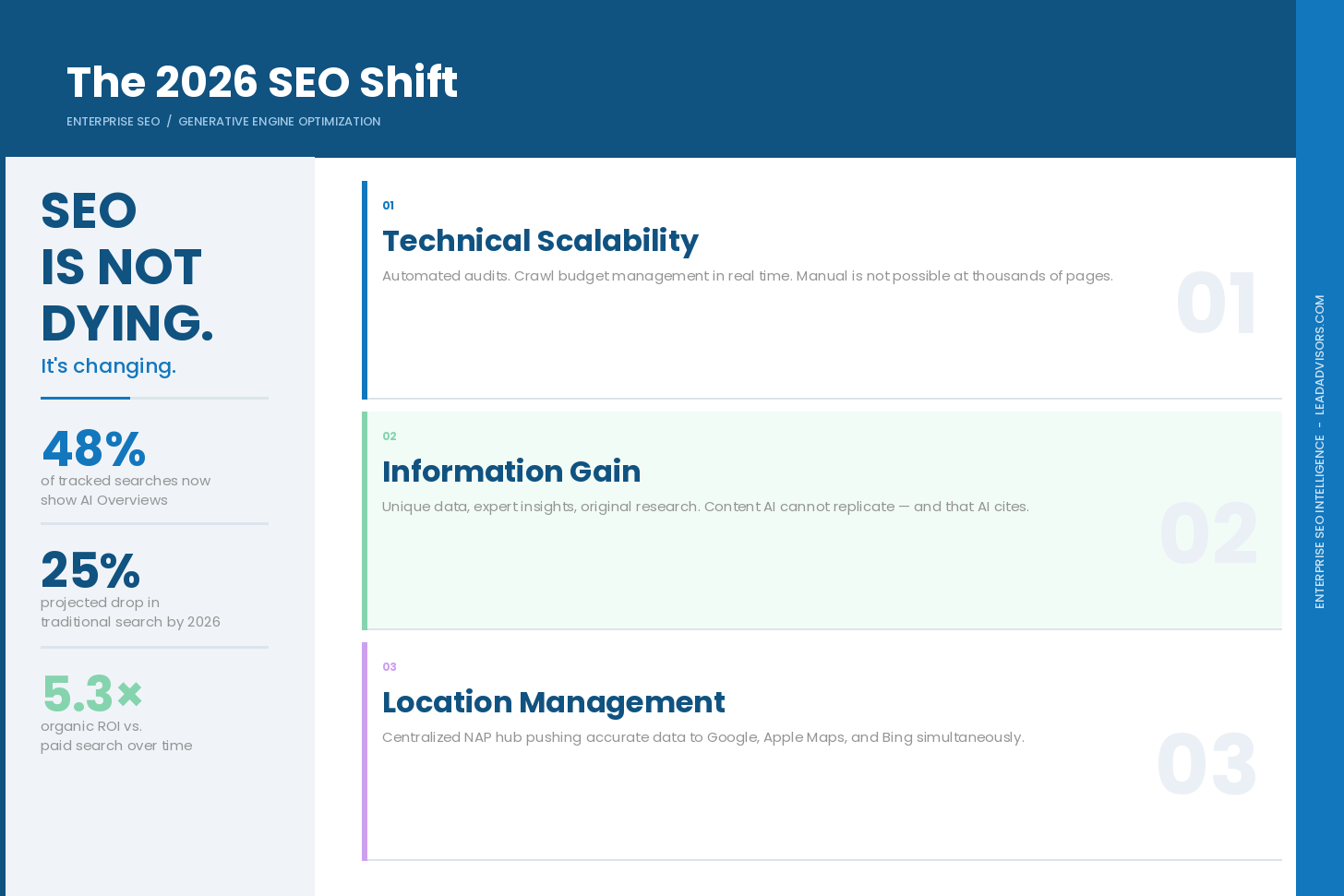
In 2026, enterprise SEO has shifted. It is no longer about manual keyword targeting. It is now about Generative Engine Optimization, or GEO. According to BrightEdge, AI Overviews now appear in up to 48% of tracked industry searches. Large companies must work to become a cited source in those results.
This requires three core areas: technical scalability, information gain, and location management.
First, technical fixes must be automated. Manual audits are not practical for sites with thousands of pages. Teams must use enterprise SEO platforms to find errors and manage crawl budget in real time.
Second, content must provide information gain. That means unique data, expert insights, or original research. AI models cannot replicate this type of content.
Third, for businesses with physical locations, local SEO must be managed from one central hub. This keeps name, address, and phone number data consistent across all AI search results.
What Are Enterprise SEO Services?
Enterprise SEO services manage a company’s organic search presence at a large scale. Traditional SEO deals with single-page changes. Enterprise SEO deals with entire page templates across thousands or millions of pages.
Definition and Core Concept
Enterprise SEO is about managing complexity at scale. It needs platforms capable of monitoring millions of data points. Every section of a large site must support the brand’s search visibility.
What Makes a Business “Enterprise-Level”?
A company usually needs enterprise SEO when it meets these criteria:
- Scale: Web properties with 1,000 to more than one million pages.
- Brand authority: High trust that can drop fast when search algorithms change.
- Organizational complexity: Adobe research shows enterprise marketers spend 60% of their time on internal coordination, not marketing.
Key Characteristics of Enterprise Websites
Enterprise websites are complex. They have layered navigation, multiple subdomains, and years of technical debt. The result is complex URL structures. These need special optimization to stay crawlable.
Why Standard SEO Does Not Scale for Enterprises
Manually fixing every meta tag on a 50,000-page website is not possible. Standard SEO is manual. Enterprise SEO is automated. It applies rules to change thousands of pages at once. The SEO function can then keep pace with the business.
How Enterprise SEO Differs From Traditional SEO
The core difference is size. A technical mistake on a small site might cost a few hundred visitors. The same mistake on an enterprise site can cost millions of dollars in one day.
Scale and Complexity (Thousands to Millions of Pages)
A standard SEO project may focus on 50 keywords. An enterprise project manages keyword clusters across many pages. Software is needed to track performance at a high level.
Higher Competition and High-Value Keywords
Enterprise companies compete for the most expensive keywords in paid search. A strong enterprise SEO strategy captures that same traffic through organic search. This produces a much higher return on investment over time.
Cross-Department Collaboration Requirements
At the enterprise level, SEO does not work alone. Any change needs sign-off from IT, Legal, and Brand. Enterprise SEO teams act as diplomats as much as they do as technical experts.
Comparison Table: Enterprise vs. Traditional SEO
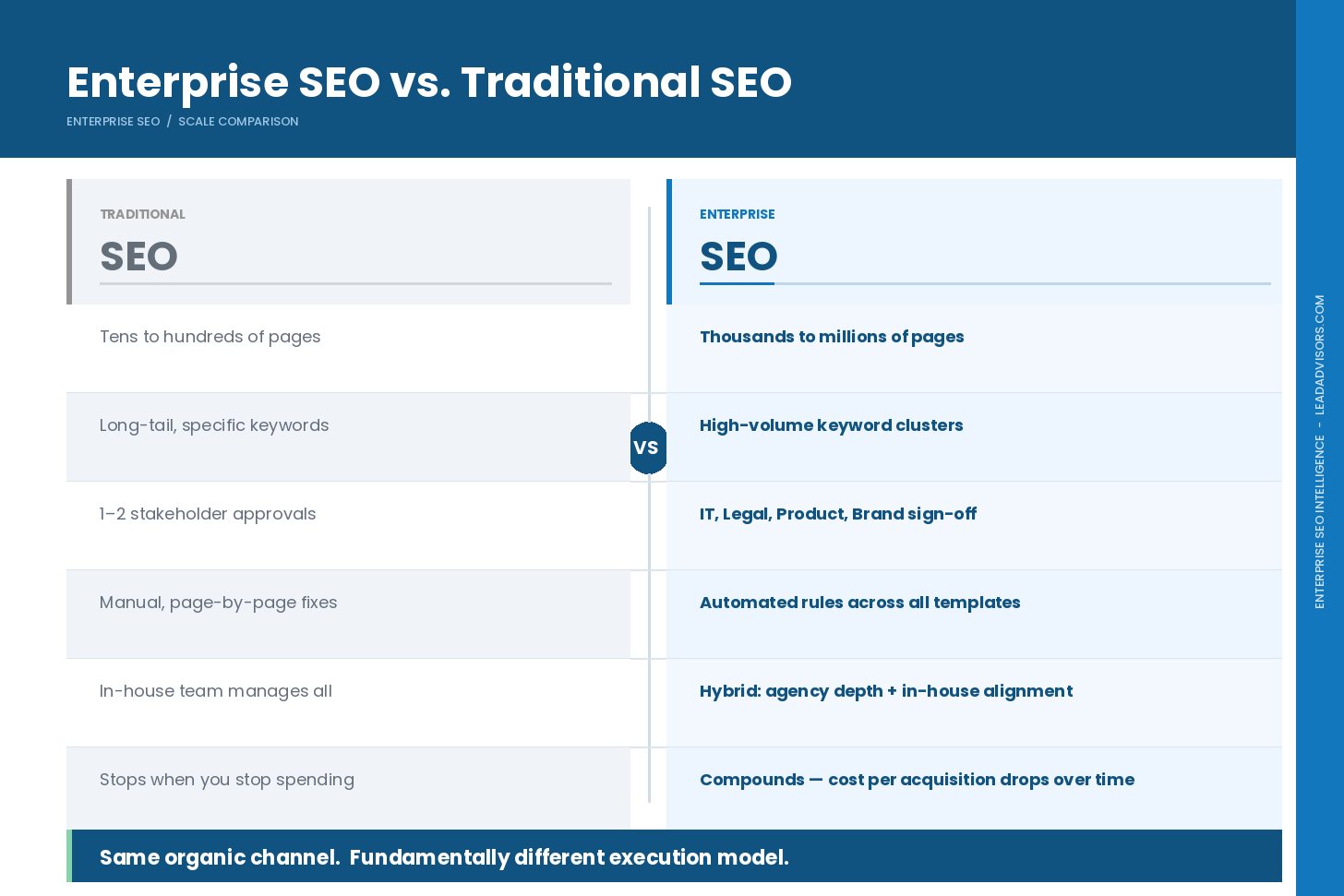
| Feature | Traditional SEO | Enterprise SEO |
| Website footprint | Tens to hundreds of pages | Thousands to millions of pages |
| Keywords | Long-tail, specific | High-volume and large clusters |
| Approval process | Short (one to two stakeholders) | Complex (IT, Legal, Product, Brand) |
| Median ROI | ~748% | ~689% (with 11-month breakeven) |
| Primary tools | Ahrefs, Semrush | Enterprise SEO platforms (BrightEdge, Botify) |
LeadAdvisors operates in the enterprise SEO space without requiring the client to build or manage an internal SEO team. The tooling, technical execution, content production, and reporting are all managed on the client’s behalf. The client sees the output: traffic, rankings, and inbound leads. They do not need to own the function internally.
Core Components of Enterprise SEO Services
A complete enterprise SEO strategy is built across several key areas. Each area needs its own tools and technical skills.
1. Technical SEO at Scale
Technical SEO is the foundation. Research from Backlinko confirms that site speed is a top ranking factor. For large sites, the bigger challenge is managing crawl budget.
- Crawlability: Making sure search engines do not get stuck in loops.
- Schema markup: Using JSON-LD to tell AI models what your products or locations are.
- Log file analysis: Reviewing server data to see how often Google visits your most important pages.
2. Enterprise Content Strategy
In 2026, content must provide information gain. Content with unique data, expert analysis, or original research performs best. It produces answers that AI cannot replicate.
The question-and-answer format works well for evergreen content. Structured content that directly answers complex questions is more likely to appear in AI summaries.
3. Enterprise Link Building
For large organizations, link building is about building authority. Authority is earned through original research, data-driven reports, and digital PR. Industry publications must want to reference your content.
4. Multi-Domain Management
Managing a global brand means managing multiple domains simultaneously. Think .com, .de, and .co.uk.
- International content: Content must be relevant to the local culture. Translation alone is not enough.
- Unified reporting: Use Google Analytics to keep a single view of all properties.
5. AI and Automation in Enterprise SEO
Competitive enterprise SEO requires AI tools. Leading enterprise SEO operations use AI for:
- GEO: Structuring data so AI search engines cite your brand.
- Predictive analytics: Using historical data to forecast performance and prioritize work.
Strategies for Managing SEO for Multiple Locations
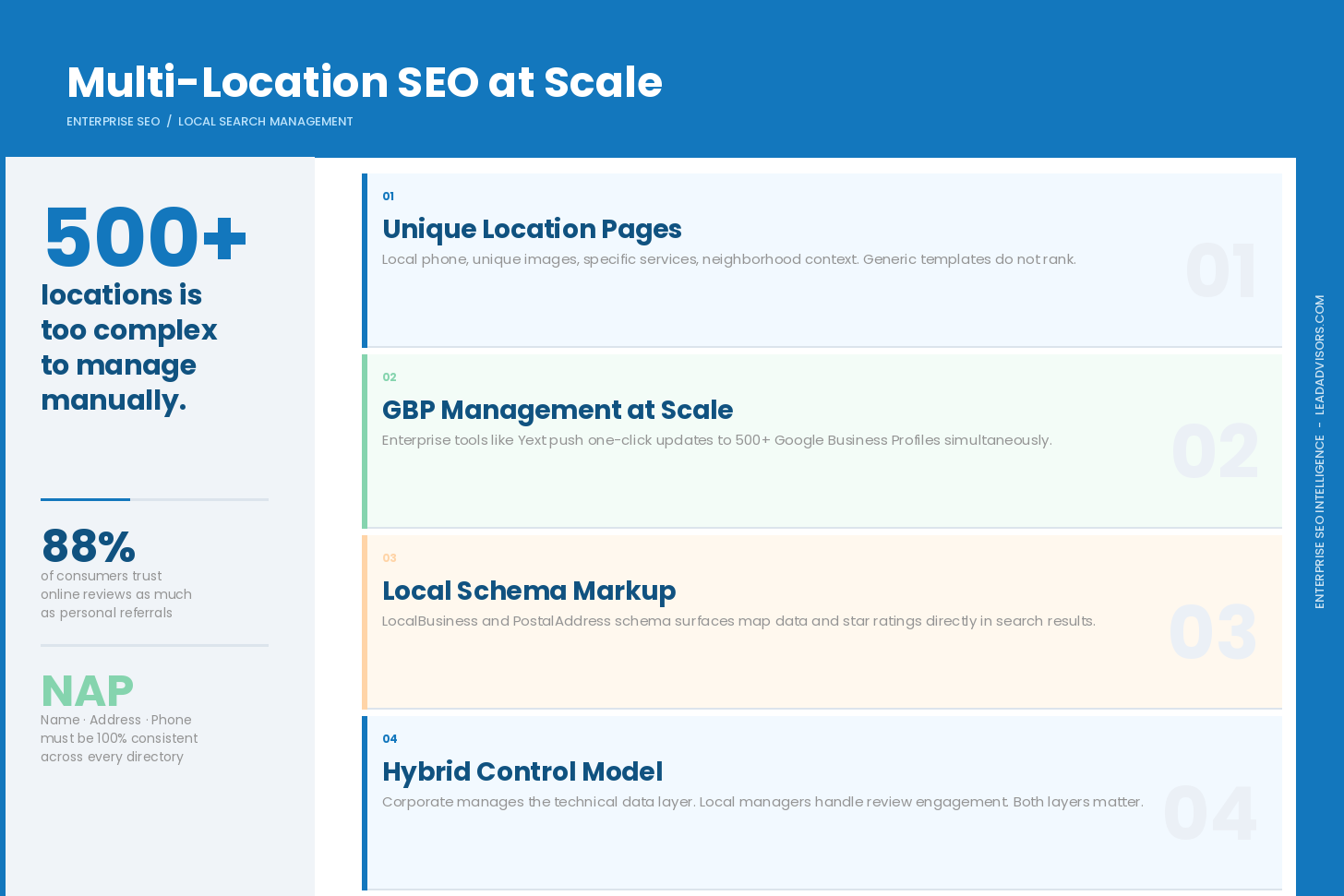
Multi-location SEO is its own discipline. When a brand has 500 or more physical locations, local SEO becomes too complex to manage manually. It needs to shift to centralized management.
What Is Multi-Location SEO?
Multi-location SEO makes sure each physical location appears in local search results. It makes your digital presence reflect your physical one. Users can find the nearest branch with accurate information.
The Challenge: Scaling Local SEO Across Hundreds of Locations
Keeping accurate information across every directory is the core challenge. Manually updating store hours across 200 locations is not practical. Enterprise SEO needs a central hub. This hub pushes updates to Google, Apple Maps, and Bing simultaneously. This keeps NAP data consistent.
Key Strategies for Multi-Location SEO
- Create unique location pages: Each location needs its own page. It should have a local phone number, unique images, and specific services. A generic template does not perform. Add local landmarks or community context to improve relevance.
- Google Business Profile (GBP) management at scale: Enterprise tools like Yext allow one-click updates to business hours across 500 locations.
- Local schema markup: Use LocalBusiness or PostalAddress schema. This helps search engines show your map data and star ratings in search results.
- Local link building: Reach out to local newspapers and neighborhood publications. This builds geographic ranking authority. A link from a local Chamber of Commerce carries real weight.
Centralized vs. Decentralized Approach
A centralized model means the corporate SEO team manages all store locations to maintain brand consistency. A decentralized model gives local managers some control over their individual profiles.
Most enterprise brands perform best with a hybrid model. The corporation manages the technical data layer. Local managers handle customer review engagement, which improves location-level engagement metrics.
Tools for Managing SEO for Multiple Locations
Spreadsheets do not scale beyond a small number of locations. A dedicated local SEO platform is required. BrightLocal, Yext, and Moz Local are the standard options. They track citations and manage reviews across multiple properties.
Common Multi-Location SEO Mistakes to Avoid
- Duplicate content across location pages: Pages that look the same across cities signal low quality. This reduces visibility across your entire location portfolio.
- Inconsistent NAP information: Variations in your business name, address, or phone number create conflicting signals. This reduces local rankings.
- Neglecting location reviews: According to Invesp research, 88% of consumers trust online reviews as much as personal recommendations. Unresolved negative reviews cause measurable drops in local ranking performance.
Benefits of Enterprise SEO Services
Enterprise-level SEO builds a lasting competitive advantage. It is not just a traffic channel.
Increased Organic Visibility and Traffic
Ranking on the first page for both high-volume and niche queries captures users at every stage. This ensures brand visibility across the full customer journey, from initial research to conversion.
Scalable, Sustainable Growth
Paid ads stop generating traffic the moment you stop spending. SEO builds value over time. A well-optimized enterprise website continues to attract visitors years after the original content was published. The cost per acquisition drops over time.
Cost Efficiency vs. Paid Media
Enterprise SEO costs more upfront. But the long-term cost per acquisition is much lower than paid search. According to data cited by Terakeet and sourced from Google, organic search delivers 5.3x the return on investment of paid search over time.
Competitive Advantage in Saturated Markets
In competitive verticals, technical execution is the differentiator. A site that is faster, more structured, and more accessible than its competitors will consistently outrank them.
Brand Authority and Trust Building
Consistent visibility across high-intent queries builds brand recognition at scale. When the brand appears in search results, AI citations, and editorial placements, trust builds in ways that ad impressions do not.
Common Challenges in Enterprise SEO
Enterprise SEO comes with unique friction for large organizations. Understanding these obstacles helps teams set accurate expectations.
Coordinating Across Departments (IT, Legal, Marketing, Content)
The most common obstacle in enterprise SEO is organizational rather than technical. Without a clear workflow system, a single redirect or a blog post legal review can take months.
Managing Technical Debt and Legacy Systems
Large sites often run on older platforms that are hard to update. Changes to these systems risk breaking functionality. SEO teams must work around limitations rather than fix them directly.
Keeping Content Fresh Across Thousands of Pages
Outdated content is a persistent problem at enterprise scale. AI-based content audit tools flag pages for refresh based on performance drops and publication age. This is the standard solution.
Algorithm Updates at Scale
When Google changes a ranking factor, the impact on a large site is immediate. Fast root cause analysis and coordinated fixes are required. Losses must be contained before they show up in revenue reports.
How to Choose an Enterprise SEO Agency
Selecting an enterprise SEO provider is a long-term decision. The right agency works within complex organizations.
Evaluate Scalability and Infrastructure
Ask whether the agency can crawl a million-page site. Access to an enterprise SEO platform is a basic requirement. An agency without it cannot operate at enterprise scale.
Review Case Studies and Industry Experience
Ask for examples of enterprise SEO results. Look for a brand with a similar site structure or vertical. Evidence of navigating complex technical challenges is the relevant proof of capability.
Understand Their Reporting Practices
Reporting should be built around business outcomes. Rankings alone are not enough. Reports must connect SEO activity to leads, sales, and market share movement.
Questions to Ask Before Signing
- “How do you coordinate with our internal IT and Legal teams?”
- “Which enterprise SEO platforms are included in your service?”
- “How are you adapting your strategy for AI-driven search?”
- “How do you handle transitions from legacy systems?”
Enterprise SEO Tools and Platforms
Enterprise SEO at this scale requires platforms that most in-house teams at mid-market companies lack access to. LeadAdvisors operates these tools on behalf of clients. Clients see the output, not the overhead.
All-in-One Enterprise SEO Platforms
- BrightEdge and Conductor: Used for content performance tracking and competitor analysis. These platforms show what is working and where to optimize.
- SEOClarity: Used for large-scale keyword tracking and data-driven insights across client sites.
- Botify: The primary platform for technical SEO. It identifies how search engines interact with site architecture. It surfaces structural issues before they affect rankings.
Keyword Research and Tracking
- Ahrefs and Semrush: Used for competitive keyword analysis and cluster development.
- Moz Pro: Used for keyword position monitoring and domain authority tracking.
Technical SEO and Site Audits
- Screaming Frog: Used for deep technical site crawls. It surfaces structural issues in architecture, metadata, and internal linking.
- DeepCrawl (Lumar): A cloud-based crawler used for large-scale site audits.
Analytics and Reporting
- Google Analytics 4 and Adobe Analytics: Used for traffic attribution, engagement measurement, and conversion tracking across all properties.
- Looker Studio: Used to build custom reporting dashboards that consolidate performance data for client review.
Local and Multi-Location SEO Tools
- BrightLocal, Yext, and Moz Local: Used to manage citation consistency, Google Business Profile updates, and local ranking performance across all client locations.
Building an Enterprise SEO Team
The strongest enterprise SEO combines in-house expertise with an agency’s capacity. By 2026, the best enterprise SEO operations are embedded in the product and development cycle.
Key Roles and Responsibilities
- SEO director: Manages strategy, secures budget approval, and ensures SEO has visibility at the executive level.
- Technical SEO specialists: Focus on site architecture, technical optimization, and schema. These are the engineering layer of the SEO function.
- Content strategists: Manage the production of high-quality content at enterprise scale.
- Link-building specialists: Run digital PR, editorial outreach, and authority-building campaigns.
- Analytics specialists: Focus on engagement metrics, attribution, and ROI measurement.
In-House vs. Agency vs. Hybrid Model
Most enterprise brands use a hybrid model. A small in-house team manages internal alignment and prioritizes the task queue. An enterprise SEO agency provides the tools, execution depth, and link-building capacity that in-house teams cannot sustain on their own.
Enterprise SEO Best Practices Checklist
- Technical: Site speed (LCP under 2.5 seconds), 100% HTTPS, and valid JSON-LD schema on all page templates.
- Content: Map all content to user intent. Refresh content every six to nine months.
- Link building: Run a monthly competitor backlink analysis to find new opportunities.
- Multi-location: 100% NAP consistency and a dedicated Google Business Profile for every branch.
- Reporting: Review a custom enterprise SEO dashboard monthly with C-suite stakeholders. Tie it to business outcomes.
How Long Does Enterprise SEO Take to Show Results?
Organic growth builds at a different rate than paid media. Paid media delivers results in 24 hours. Organic search builds value over months and years.
Typical Timelines by Goal
- One to three months: Quick wins from fixing technical errors. Results show up as better crawling and more indexed pages.
- Three to six months: New content begins to rank for mid-tier keywords. Engagement metrics improve.
- Six to 12 months and beyond: Competitive keyword rankings move. Market share shifts become measurable.
Factors That Affect Speed
Domain age, the volume of existing technical debt, and your IT team’s speed all affect how quickly results appear.
How LeadAdvisors Builds and Operates Enterprise SEO
Not all enterprise SEO providers operate the same way. Here is how LeadAdvisors approaches it and why the operator model produces different outcomes than a traditional agency relationship.
The Operator Difference
LeadAdvisors does not advise on enterprise SEO. It runs it. The client does not need to hire an internal SEO team or oversee content production. LeadAdvisors builds and operates the system. The client’s role is to approve direction and review results.
LeadAdvisors builds and scales the systems behind growth. It connects front-end organic growth with back-end execution.
Who This Is Built For
This service is built for operators already spending money on outbound lead generation. They want to cut dependence on paid sources. They want an organic inbound channel that works in parallel. Financial services companies, debt relief operators, and mortgage companies all operate in high-intent search verticals. Organic visibility directly supports the sales floor. Enterprise SEO here is not a brand awareness tactic. It is a pipeline infrastructure decision.
What LeadAdvisors Manages
As part of an enterprise SEO engagement, LeadAdvisors manages:
- Technical SEO audits and ongoing optimization: Site architecture, crawl budget, schema markup, and page speed across the full site.
- Content strategy and production: Pillar pages, cluster content, brand review articles, and editorial placements on external properties.
- Link building and authority development: Digital PR, affiliate editorial reviews, and outreach-based link acquisition.
- Reporting and performance management: Monthly reviews tied to organic traffic, inbound lead volume, and keyword movement.
Brand Review and Authority Content
LeadAdvisors publishes authoritative content on external properties, including sites like usa.inquirer.net. This builds the client’s link profile and brand presence simultaneously. This is part of the SEO engagement, not a separate product. Standard SEO agencies do not offer this capability. It directly supports visibility in high-intent financial and services verticals.
Start With a Site Audit
The engagement starts with a site audit and organic growth assessment. LeadAdvisors reviews the site’s current state, the keyword opportunity in the vertical, and the content and link gaps relative to competitors. Then it maps a campaign structure around those findings.
Talk to the LeadAdvisors team about an organic growth assessment.