The internet is drowning in AI-generated noise. Every search query returns dozens of recycled articles that sound identical, feel hollow, and offer zero original insight. In 2026, the importance of content marketing has never been higher—but the rules have changed fundamentally.
Buyers aren’t looking for more content; they’re seeking truth, expertise, and brands they can genuinely trust. This shift transforms content marketing from a promotional tactic into a critical business infrastructure. If your marketing strategy still treats content as disposable campaign material, you’re already falling behind.
TL;DR:
- Human experience beats AI volume: In 2026, authenticity and original insights outperform generic AI-generated content—first-party data, contrarian perspectives, and real expertise are the only defensible competitive moats.
- Evergreen content compounds, campaigns don’t: Smart brands prioritize durable, timeless assets that generate ROI for years over disposable promotional content that peaks and dies within days.
- Content is pre-purchase insurance: Buyers are 70% through their journey before contacting sales—strategic content reduces perceived risk, accelerates decisions, and builds trust that traditional advertising can’t match.
- Quality over quantity wins: Publishing 10 exceptional, well-maintained articles outperforms 100 mediocre posts—focus on depth, information gain, and strategic topic clusters rather than volume metrics.
- Treat content as infrastructure, not expense: Evergreen content is a permanent business asset that strengthens your entire digital marketing stack, from SEO and social to sales enablement and customer retention.

The 2026 Reality: Trust Beats Reach Every Time
The AI Slop Problem (And Why Human Experience Wins)
We’re living through the largest content explosion in human history. Generative AI tools churn out thousands of blog posts daily, flooding search engines with derivative content that answers nothing and teaches little. The result? Sameness is now a competitive liability.
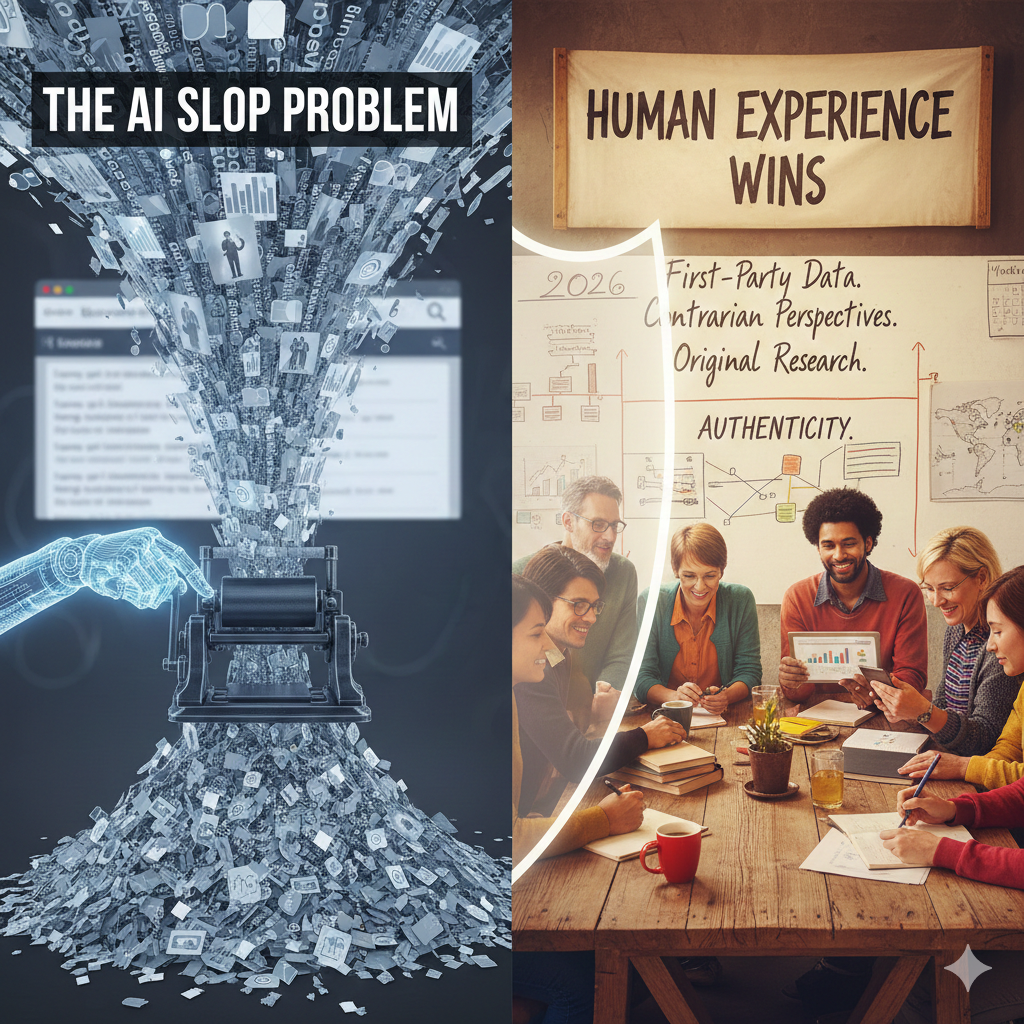
What matters in 2026 isn’t how much you publish—it’s whether your target audience can tell you’ve actually experienced what you’re writing about. Traditional marketing techniques like interruptive ads and generic promotional messaging are losing effectiveness because buyers have developed a cognitive ad-blocker against anything that feels manufactured.
Human experience has become the last defensible moat. First-party data, contrarian perspectives, and original research are the only ways to stand out. When everyone has access to the same AI tools, authenticity becomes the ultimate differentiator.
Budget Consolidation Around Fewer, Better Assets
According to the American Marketing Association, 86% of global decision-makers plan to maintain or increase their content budgets in 2026. But here’s the twist: they’re spending smarter, not just more. Companies are consolidating resources around fewer, higher-impact assets rather than churning out daily social media posts that disappear within hours.
This strategic pivot recognizes that evergreen content—durable, compounding assets designed for long-term performance—delivers exponentially better ROI than disposable campaign material. A well-researched pillar article can generate organic traffic for years while serving as a source of fuel for email campaigns, social media platforms, sales enablement, and digital marketing campaigns simultaneously.
What Content Marketing Really Means in 2026
Beyond Blogging: Content as Trust Infrastructure
Let’s clear up a dangerous misconception. Content marketing isn’t just writing blog posts and hoping people stumble upon them. It’s a designed system for profitable action—the strategic creation and distribution of information that reduces buyer risk, accelerates decision-making, and builds institutional credibility over time.
Think of it this way:
- Traditional advertising interrupts people to push a message.
- Content marketing attracts people by answering the questions they’re already asking.
The difference is profound. While ads create resistance, valuable educational content bypasses skepticism entirely because it helps before it sells. This is why content marketing plays a critical role in modern digital marketing strategies—it’s the foundation that enables everything else to work more effectively.
Evergreen vs Campaign Content: Know the Difference
| Evergreen Content | Campaign Content |
| Timeless value that compounds | Time-sensitive amplification |
| Answers recurring buyer questions | Promotes specific offers or events |
| Optimized for search equity | Optimized for immediate conversions |
| ROI grows over the years | ROI peaks then declines |
| Examples: How-to guides, frameworks, tutorials | Examples: Product launches, seasonal promotions |
Smart brands in 2026 prioritize evergreen assets first, then use campaign content to amplify them. This creates a compounding system where every piece of quality content strengthens the entire library.
Why Audiences Crave Content (The Psychology of Pull)
The Visual Processing Advantage
Here’s a statistic that should shape your entire content strategy: 90% of information transmitted to the brain is visual, and people process visuals 60,000 times faster than text (according to research by the 3M Corporation). This is why video marketing and video content have exploded—they accelerate trust-building and comprehension in ways written content simply can’t match alone.
But visuals don’t just mean video. Infographics, interactive tools, data visualizations, and even thoughtfully designed blog posts with strategic imagery all tap into this processing advantage. When you create content that respects how humans actually consume information, engagement skyrockets.
Content as Pre-Purchase Insurance
Buyers don’t fear price—they fear regret. The real barrier to conversion isn’t cost; it’s uncertainty. Will this product actually solve my problem? Can I trust this company to deliver? What if I choose wrong?
Relevant content functions as pre-purchase insurance. Every case study, tutorial, comparison guide, and educational resource reduces perceived risk and moves potential customers closer to confident action. This is especially critical in B2B contexts, where purchase decisions involve multiple stakeholders and carry significant career risk. One poorly researched vendor choice can derail projects and damage reputations, so buyers self-educate extensively before ever contacting sales.
In fact, buyers are now 70% through their buyer’s journey before engaging a sales rep. Your content needs to support that invisible research process, or you won’t even make the consideration set.
10 Strategic Reasons Content Marketing Is Mission-Critical in 2026
1. Compound Search Equity (SEO + AEO)
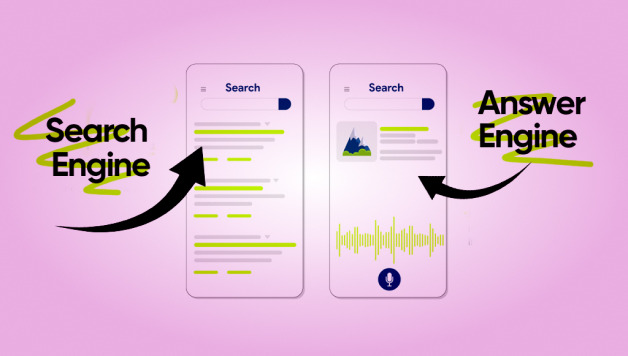
Search engine optimization isn’t just about ranking on Google anymore. In 2026, you also need to optimize for AI Engine Optimization (AEO)—making your content citation-worthy for ChatGPT, Gemini, Perplexity, and other AI answer engines.
The compound advantage is real. Every optimized article you publish strengthens your domain authority, improves internal linking pathways, and increases the likelihood that AI systems will reference your expertise. This creates a flywheel effect where high-quality content attracts links, which improves rankings, drives more traffic, and generates more engagement signals—all feeding back into stronger search equity.
2. Zero-Click Authority (Winning Before the Click)
Featured snippets, knowledge panels, and AI-generated summaries mean users often get answers without clicking through to your site. Is this a problem? Only if you’re not earning that visibility.
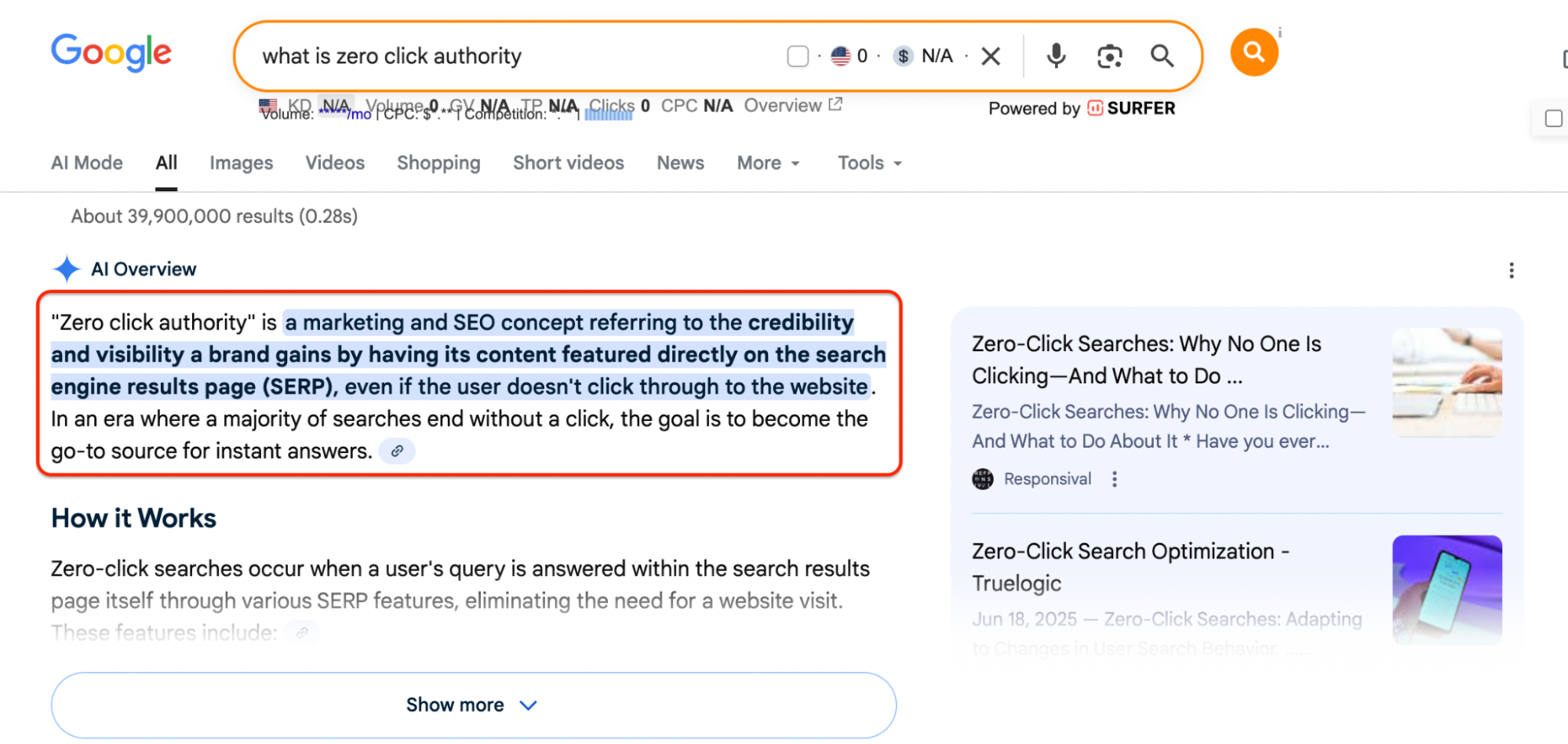
Zero-click results are actually authority amplifiers. When your brand consistently appears in these prime positions, you build brand awareness even without direct traffic. Users mentally bookmark you as a credible source, making them far more likely to choose you when they’re ready to make a purchase.
3. The Non-Linear Sales Funnel
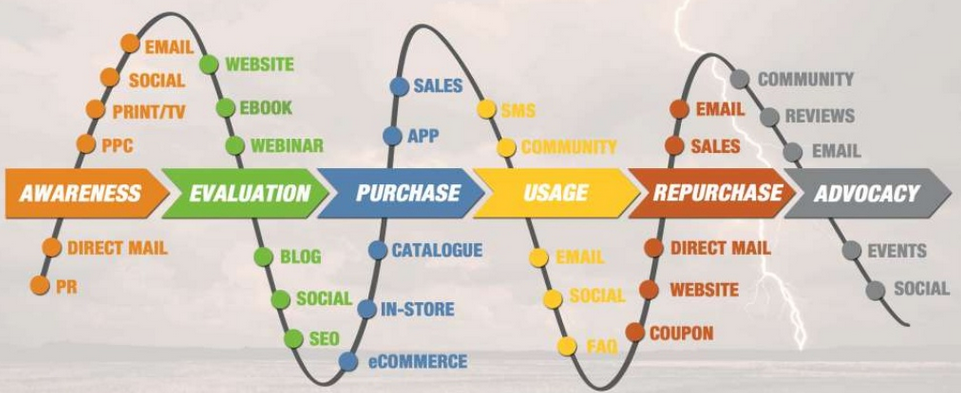
Forget the clean, orderly funnel diagrams from marketing textbooks. Today’s buyer’s journey looks more like a chaotic web:
- Potential customers discover you through a podcast mention
- They research competitors via a comparison of blog posts
- They watch a YouTube tutorial you created
- They ask colleagues for recommendations
- They revisit your landing page three times over two months
- They finally request a demo after reading a case study
Your content marketing efforts must support this complex reality by providing valuable touchpoints at every stage of the process. Linear funnel thinking can lead to gaps in coverage, resulting in lost deals.
4. The Glue of Your Entire Digital Stack
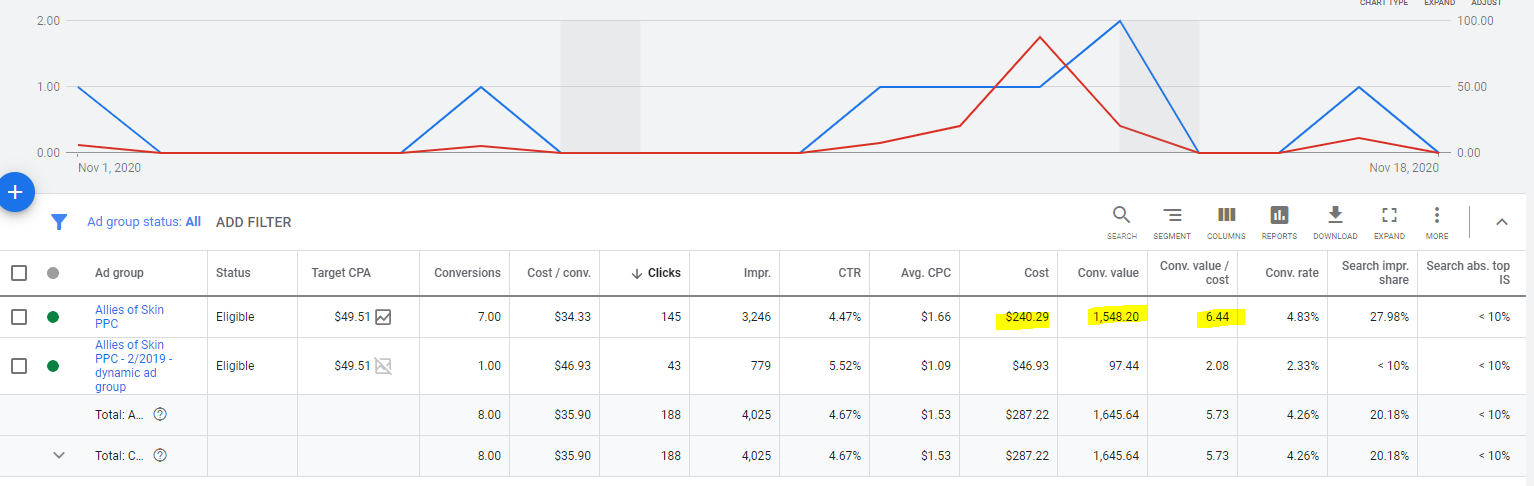
Quality content doesn’t just drive direct conversions—it multiplies the effectiveness of every other channel:
- PPC campaigns perform better when ads lead to helpful content instead of hard-sell landing pages
- Social media engagement increases when you have meaningful articles to share instead of promotional spam
- Email nurture sequences convert at higher rates when packed with educational content
- Sales teams close faster when they can share credibility-building resources during conversations
Without strong content, your entire digital marketing strategy operates at half capacity.
5. B2B Credibility Moats
In complex B2B buying environments, long-form, engaging content that genuinely simplifies difficult decisions creates a massive competitive advantage. When you publish the definitive guide to evaluating enterprise software, comparing implementation approaches, or calculating total cost of ownership, you become the authoritative voice buyers turn to.
This is especially powerful when competitors continue to publish generic “5 Tips for Better X” articles. Depth and originality win credibility wars.
6. Unrivaled Cost Efficiency
Content Marketing Institute research consistently shows that content marketing generates approximately 3 times as many leads as traditional advertising while costing 62% less. The ROI gap only widens over time as evergreen assets continue to perform without additional spending.
A $5,000 pillar article that ranks for five years delivers fundamentally different economics than $5,000 in Facebook ads that stop working the moment you turn off the budget. This cost-effective advantage is why smart CFOs are reallocating budgets toward content infrastructure.
7. Institutional Authority (E-E-A-T Defense)

Google’s E-E-A-T framework (Experience, Expertise, Authoritativeness, Trustworthiness) is designed to reward original insights and penalize generic AI-generated content. Brands that demonstrate real experience through first-party research, proprietary data, and expert perspectives will dominate search results.
This requires shifting from “SEO-optimized content” to “genuinely valuable content that happens to be well-optimized.” The difference is subtle but critical.
8. Repurposing Velocity (The 1:100 Rule)

One hero asset can power 100+ distribution touchpoints:
- A comprehensive guide becomes a 10-part email course
- Key sections convert into social media posts across LinkedIn, Twitter, and Instagram
- Statistics and quotes fuel thought leadership content
- Visual elements transform into standalone infographics
- Core frameworks become workshop materials and webinar presentations
This repurposing velocity means your content creation investment compounds across channels without proportional increases in production costs.
9. Frictionless Conversions
Educated buyers convert faster with less sales pressure. When potential customers arrive already understanding your solution, believing in your expertise, and trusting your brand, sales cycles shrink dramatically.
This self-service education model doesn’t eliminate the need for sales teams—it makes them exponentially more effective by eliminating the need for basic objection-handling and positioning time.
10. Sustainable Asset Growth
Unlike advertising spend that disappears when budgets dry up, your content library is a permanent asset. Each article adds incremental value to your content strategy, creating a compounding knowledge base that generates higher-quality leads year after year.
This is business infrastructure, not marketing expense.

Building Your Evergreen Content Engine
What Makes Content Truly Evergreen?
Not all topics age gracefully. Truly evergreen content meets three criteria:
- Timeless intent → The question buyers ask doesn’t change year-to-year
- Stable SERPs → Rankings aren’t dominated by news sites or constantly shifting
- Recurring value → The answer helps people solve enduring problems
Topics that seem evergreen but aren’t: industry trend predictions, platform-specific tutorials for fast-changing tools, and content tied to temporary regulations or economic conditions.
The Evergreen Lifecycle: Publish → Compound
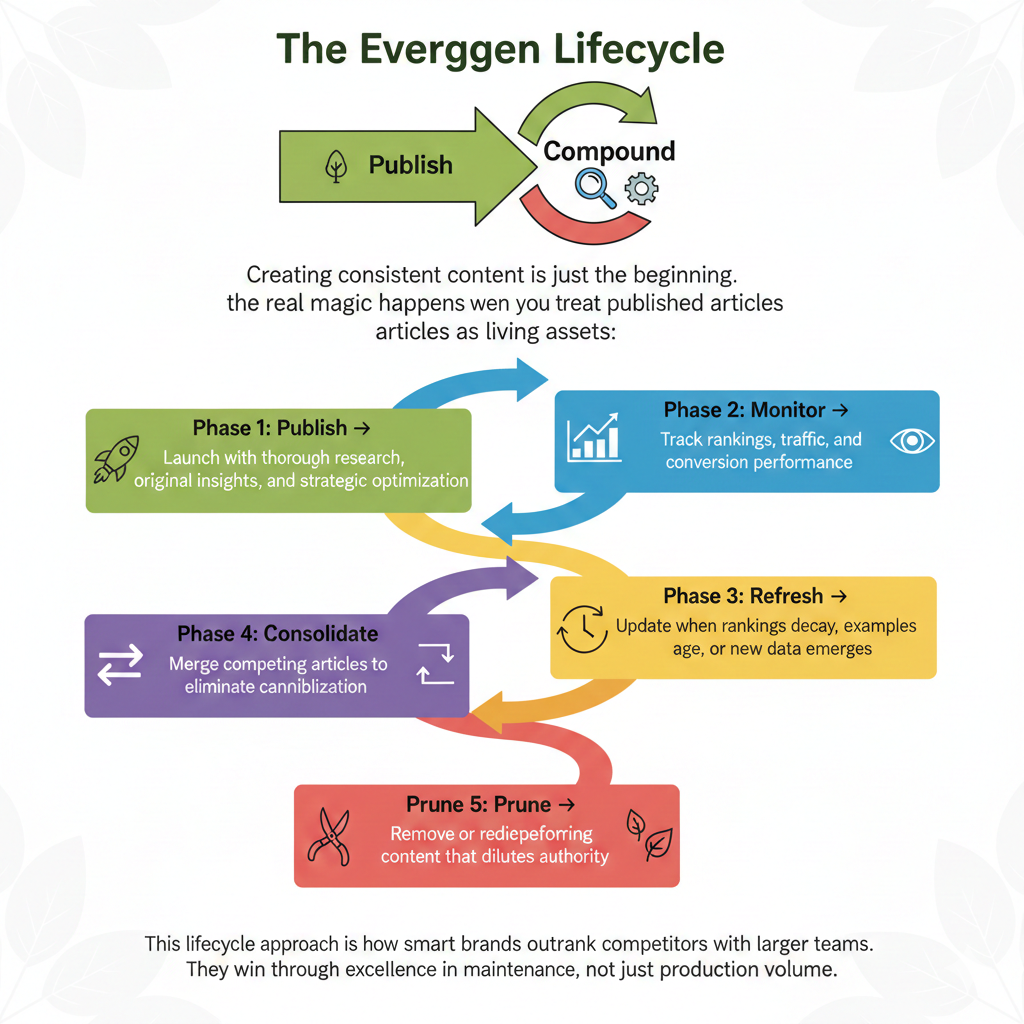
Creating consistent content is just the beginning. The real magic happens when you treat published articles as living assets:
Phase 1: Publish → Launch with thorough research, original insights, and strategic optimization
Phase 2: Monitor → Track rankings, traffic, and conversion performance
Phase 3: Refresh → Update when rankings decay, examples age, or new data emerges
Phase 4: Consolidate → Merge competing articles to eliminate cannibalization
Phase 5: Prune → Remove or redirect underperforming content that dilutes authority
This lifecycle approach is how smart brands outrank competitors with larger teams. They win through excellence in maintenance, not just production volume.
Topic Clusters: Your Authority Architecture
Random blog posts don’t build authority—strategically linked topic clusters do. The pillar-and-spoke model organizes your content library into:
- Pillar content → Comprehensive guides on broad topics (e.g., “Complete Guide to Email Marketing”)
- Cluster content → Specific deep-dives that support the pillar (e.g., “Best Subject Line Formulas,” “Segmentation Strategies”)
Each cluster article links back to the pillar, and the pillar links out to clusters. This internal linking architecture signals topical authority to search engines while creating intuitive navigation paths for readers.
Mapping Content to the Modern Buyer Journey
Awareness Stage: Catching Attention
Goal: Make potential customers aware of problems they might not know they have
Content types:
- Short-form video content explaining industry challenges
- Trend-aware blog posts that connect current events to enduring solutions
- Social media content that sparks curiosity
Key principle: Focus on problems, not products. Earn attention through genuine helpfulness.
Consideration Stage: Building Trust
Goal: Establish your solution as the credible choice worth evaluating
Content types:
- ROI calculators and interactive assessment tools
- Comparison guides that honestly evaluate alternatives
- Podcast interviews with customers and industry experts
Key principle: Demonstrate expertise while respecting buyer intelligence. Don’t manipulate—educate.
Decision Stage: Removing Friction
Goal: Provide final validation that choosing you is the safe, smart decision
Content types:
- Customer case studies with specific results
- Original research demonstrating solution effectiveness
- Video testimonials from relatable buyers
Key principle: Social proof and proof of concept beat sales pitches every time.
Retention & Delight: Maximizing Lifetime Value
Goal: Turn customers into advocates while reducing churn
Content types:
- Onboarding tutorials and knowledge bases
- Exclusive content for customers (advanced guides, community resources)
- User-generated content campaigns that celebrate customer success
Key principle: Customer retention is cheaper than acquisition, and advocates generate leads through referrals.
The Execution Edge: How to Outrank the Giants
Information Gain Strategy
Google’s latest algorithm updates heavily reward “information gain”—content that adds something genuinely new to the conversation. This means:
- Contrarian insights that challenge conventional wisdom (when backed by evidence)
- First-party data from original research, surveys, or proprietary analytics
- Expert perspectives competitors can’t replicate because they don’t have your specific experience
If your content could have been written by any of your competitors, it doesn’t provide information gain. Rewrite it.
AEO-First Structuring
Optimize for AI citation by making your content easily parsable:
- Use schema markup to help machines understand content structure
- Include clear FAQ sections with direct answers
- Define entities explicitly (don’t assume the AI knows industry jargon)
- Structure with descriptive headers that work as standalone statements
When ChatGPT or Gemini can easily extract and cite your expertise, you win distribution in AI-mediated search.
Accessibility = Competitive Advantage
Creating quality content means nothing if people can’t consume it. Accessibility improvements boost both user experience and SEO:
- Mobile-first responsive design (over 60% of searches are mobile)
- ADA-compliant color contrast and navigation
- Readability optimization (short paragraphs, subheaders, bullet points where appropriate)
- Fast load times and clean page structure
These aren’t nice-to-haves—they’re ranking signals that compound over time.
Measuring What Matters: Evergreen Content KPIs
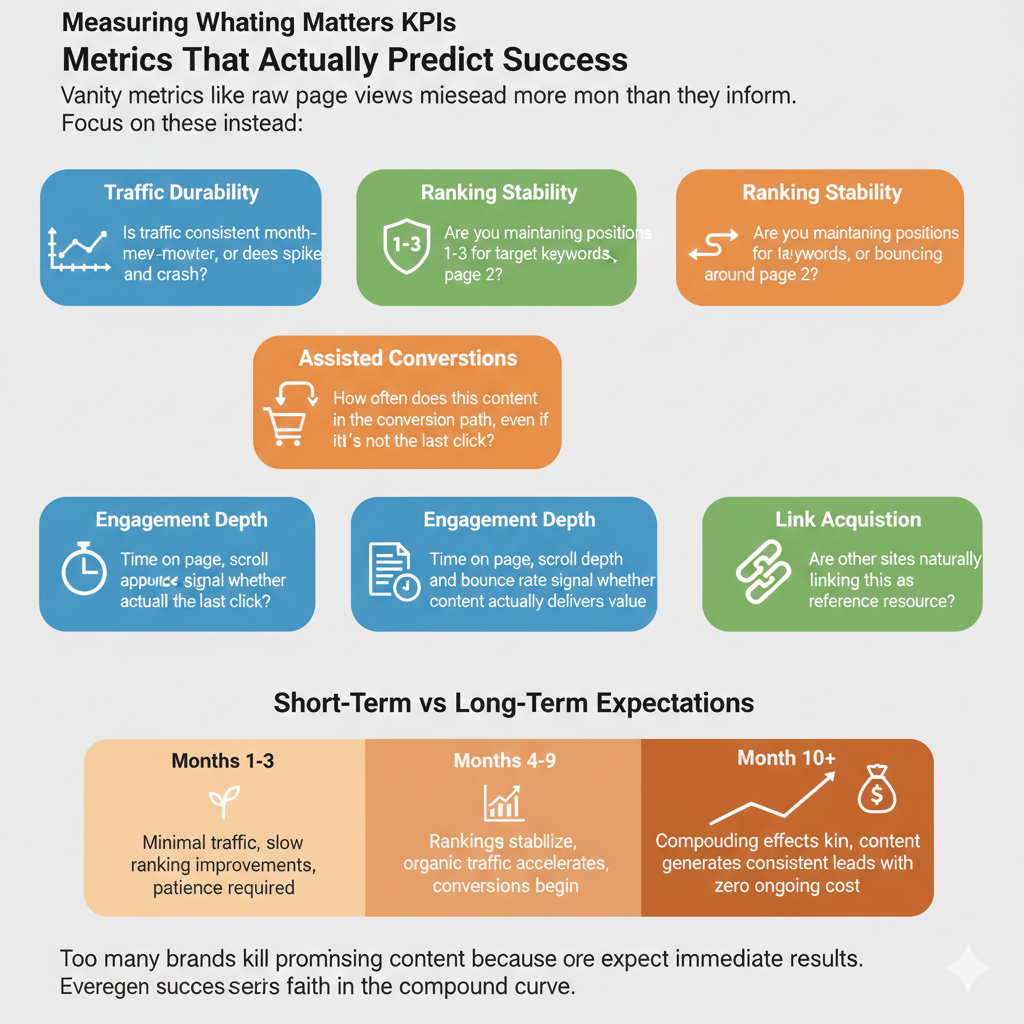
Metrics That Actually Predict Success
Vanity metrics like raw page views mislead more than they inform. Focus on these instead:
Traffic Durability
→ Is traffic consistent month-over-month, or does it spike and crash?
Ranking Stability
→ Are you maintaining positions 1-3 for target keywords, or bouncing around page 2?
Assisted Conversions
→ How often does this content appear in the conversion path, even if it’s not the last click?
Engagement Depth
→ Time on page, scroll depth, and bounce rate signal whether content actually delivers value
Link Acquisition
→ Are other sites naturally linking to this as a reference resource?
Short-Term vs Long-Term Expectations
Here’s what realistic evergreen content performance looks like:
- Months 1-3: Minimal traffic, slow ranking improvements, patience required
- Months 4-9: Rankings stabilize, organic traffic accelerates, conversions begin
- Month 10+: Compounding effects kick in, content generates consistent leads with zero ongoing cost
Too many brands kill promising content because they expect immediate results. Evergreen success requires faith in the compound curve.
ROI Attribution Beyond Last Click
Last-click attribution models systematically undervalue content marketing. A buyer might interact with 10 pieces of your content before converting, but if they finally click a PPC ad, traditional analytics gives 100% credit to paid search.
Utilize multi-touch attribution models that account for how content supports conversions throughout the buyer’s journey. This reveals the true benefits of content marketing and justifies continued investment.
Fatal Mistakes That Kill Content ROI
Even with a successful content marketing strategy, these common errors sabotage results:
Publishing Without a Maintenance Plan
Creating quality content is half the work—maintaining it is the other half. Articles without update schedules decay, lose rankings, and waste the original investment. Build refresh cycles into your workflow from day one.
Chasing Volume Over Durability
Publishing 100 mediocre articles won’t outperform 10 exceptional ones. In 2026’s content marketing landscape, depth beats frequency. Focus your content marketing efforts on assets worthy of long-term maintenance.
Ignoring Internal Linking
External links get all the attention, but strategic internal linking might be more valuable. Every new article should strengthen your existing ecosystem by linking to related content and driving readers deeper into your library.
Treating Content as a Campaign
Campaigns have expiration dates. Infrastructure lasts decades. The moment you shift mental models from “content marketing campaigns” to “knowledge infrastructure,” your entire approach transforms.