Consider the last time you went looking for something. Did you click on the first blue link that appeared? I think not. You probably read an AI summary, reviewed a “People Also Ask” box, or watched a short video.
In 2026, the definition of SERP Visibility has changed. It’s not just about being #1 anymore; it’s about owning as much “space” on the screen as possible. If you only track rankings, you are missing the larger picture.
What is SERP Visibility? SERP Visibility is a measure of the extent to which your brand is visible on all elements of the search results page, such as AI Overviews, videos, and more.” A more relevant definition for 2026 is: “The percentage of total potential clicks you are able to capture on all available space.”

Redefine SERP Visibility So Rankings Are Just One Signal
I want to assist you in changing your perspective. For the past few years, Rankings have been the buzzword. But what good does it do to know how many places you are ahead or behind in the queue? What good does it do to know if someone is looking at you or not?
In the age of AI and Advertisements, being #1 doesn’t mean much. You need to think in terms of impact, not just the numbers.
What Is SERP Visibility (and How Tools Calculate It)
The SERP visibility meaning is much deeper than just tracking the position of the SERPs. It is actually a score, measured by how many times your brand is actually viewed by people.
The majority of the optimization tools use this formula to compute this data:
Visibility = Search Volume × CTR (Click-Through Rate) of your position.
To better understand this, let’s say you fall from the #1 spot to the #3 spot. This is actually devastating for you, but why? Well, according to recent click study data for 2024-2025, the #1 spot actually gets 27.6% of clicks, while the #3 spot only gets 11%. This is actually a 60% loss of traffic, considering this is just a slight change in the SERPs rank tracking.
SERP Feature Visibility vs. Classic Rank Tracking
Old-school SERP rankings were “blind” to the modern search page. Google is now a “Blended SERP.” If you use a SERP analyzer tool, you’ll find that a given keyword has a dozen or more different “trigger” possibilities.
For example, search for “best email marketing tools,” and you might see:
- AI Overviews with citations (the new king of the hill).
- Featured snippets (the “position zero” box).
- People Also Ask sections.
- Knowledge Panels and Video carousels.
If your competitor has three of these positions and you have only one “blue link” at #2, your actual visibility is very low. You’re being “drowned out” by your competitor’s “real estate.”
Why You Can “Rank” and Still Be Invisible
It’s crazy, but it’s true: You can rank #3 and still get almost zero clicks. The only explanation is that it all depends on the “context” of the page.
- Scenario A: You rank #3 on a “clean” page with just 10 blue links. You’ll get fantastic traffic!
- Scenario B: You rank #3, but you’re stuck underneath a massive AI Overview, a competitor’s snippet, a Reddit thread, and a row of YouTube videos.
This is why it’s so important to use a SERP visibility audit tool check: so you can see the “walls” standing between you and your customers.
To increase your SERP visibility, you must optimize for the “surfaces” (AI, snippets, videos), not just the ladder of blue links.
Optimize for Visitor Quality, Not Vanity Impressions
Having massive visibility on search engines is like having a billboard on a highway—good and all, but only if you can get people to exit and buy something from you.
A famous study done at Stanford showed that 75% of users never even bother to look beyond the first page of results. But let’s get to the harsh reality of things: being on page one is a complete waste of time if you are getting the wrong kind of traffic.
Visibility Only Counts If It Drives Action
Don’t get distracted by “big numbers” in your search engine optimization overview. Instead, connect your higher visibility SERP goals to metrics that actually impact your bank account.
Business Type | Key Metrics to Track (Beyond Rankings) |
B2B Companies | Demo requests, trial signups, and Marketing Qualified Leads (MQLs). |
Ecommerce SEO | Add-to-cart rates, actual sales, and Average Order Value (AOV). |
Service Businesses | Phone calls, booked appointments, and contact form hits. |
The Big Win: If you experience a flat traffic pattern but a 40 percent increase in revenue generated per session, then you are a winner. This is a sign that your SEO optimization is finally reaching those with “commercial intent,” i.e., those who are ready to reach into their pocket and grab their credit cards.
How to Turn Your “Views” Into Revenue
To understand the true connection between SEO SERP visibility and money, you need to dive deeper into your data. I suggest using Google products such as Google Analytics 4 (GA4), which allows for traffic segmentation by:
- Landing Page Performance: Which landing pages are generating money and which are just generating “hollow” traffic?
- Search Intent: A user looking for “how to bake a cake” (informational intent) is less likely to buy than someone looking for “best cake pans for sale.”
- SERP Surface: Are users finding your content through snippets, AI Overviews, or just good old-fashioned links?
Create a basic dashboard using the best SEO tools to track your Visibility Score along with your Cost Per Acquisition (CPA). This will turn all the “vague SEO talk” into something your boss will care about.
Finding Your “Problem Pages” (Low-Hanging Fruit)
To find low-hanging fruit, you can use Google Checkers like Search Console to look for these common issues:
- High Impressions + Low CTR: You have high visibility SERP presence, but your SEO title or snippet is boring. You are getting seen, but you are not getting clicks.
- High CTR + Low Conversion: Your snippet is like a bait and switch. You are promising something, but delivering something completely different. This kills trust and ranks.
Pro Tip: Look for pages with over 10,000 monthly impressions but less than a 2% click rate. This is where you can find the biggest low-hanging fruit. By using a snippet tool to improve your titles, you can increase SERP visibility and traffic without having to move up a single spot.
Own More SERP Real Estate on Blended, Multi-Feature Results
Let’s rethink your objective: instead of aiming for one “blue link,” aim to own as much of the screen as possible.
What does it mean to own the screen? In 2026, it means “real estate” on the SERP. If you have only one listing, you’re a little shop on a busy street. If you have a featured snippet, an AI citation, and a video, you’re the entire department store.
Why Blended SERPs Make Single Rankings Less Meaningful
For example, if you’re searching for “project management software for agencies,” you’re not going to find websites anymore. You’re going to find:
- AI Overviews: A summary of the best tools with clickable citations.
- Featured Snippets: A comparison table of features and pricing.
- People Also Ask (PAA): Questions like “Is Jira good for agencies?”
- Video Carousels: Quick product demos from YouTube.
The 2026 Reality: The day of having only one #1 ranking is essentially over if the competitor has the AI Overview and Featured Snippet above you. Studies have proven that if an AI Overview appears, the click-through rate of the #1-ranked page can drop by as much as 34.5%. You must be present in three or four different spots at once to win.
Mapping the SERP Layout for Your “Money Topics”
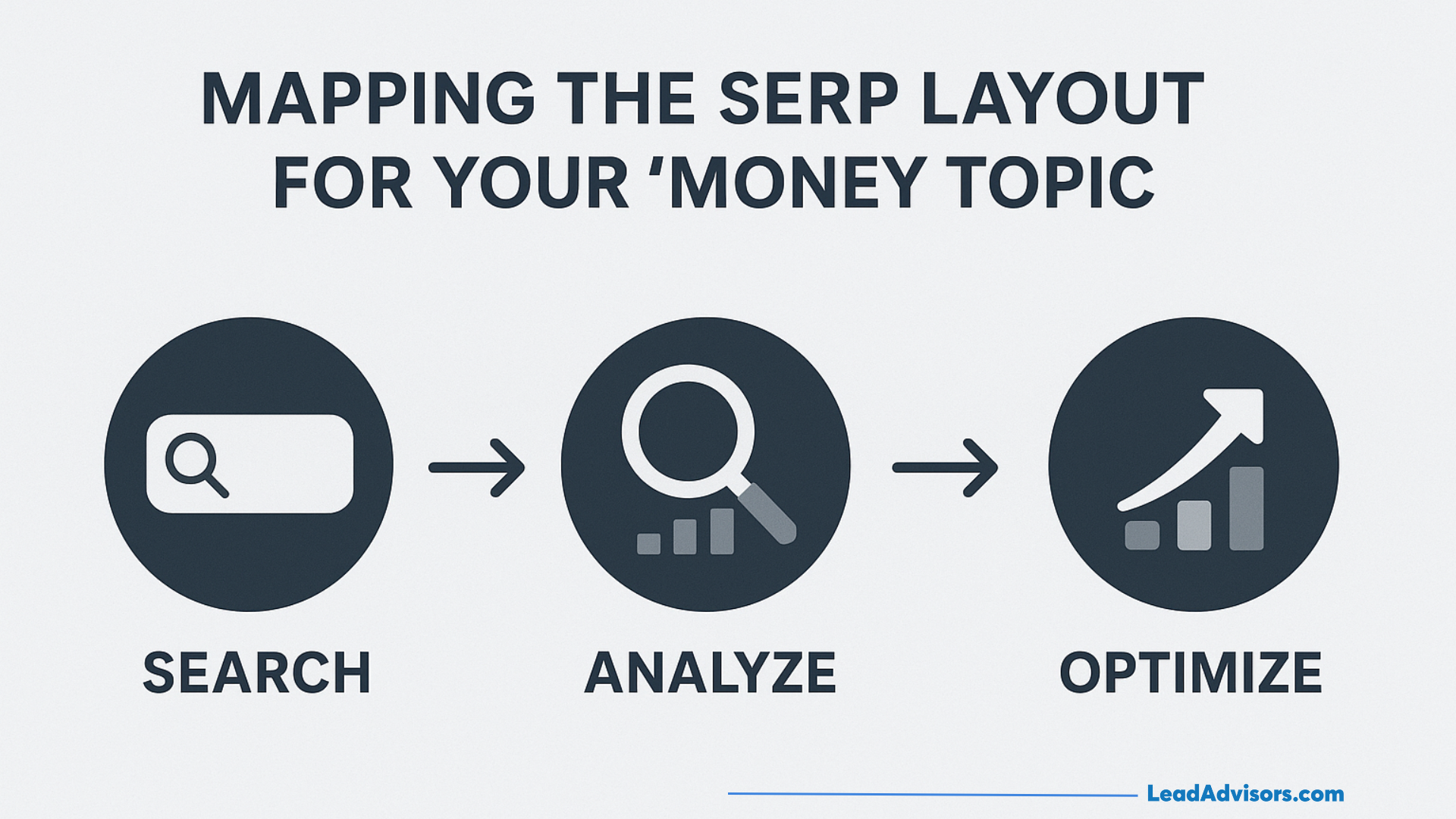
To free up more space for us to work with, I propose a simple search-analyze-optimize approach:
- Search: Simply review your top 50 revenue-generating keywords and use Google tools to see what types of features (such as images, videos, or local packs) tend to appear most often.
- Analyze: Where do we fall short? Is it that our competitors dominate all of the top SERP features for content visibility, and we’re relegated to “blue links”?
- Optimize: For example, to achieve a featured snippet answer box, do we simply need better formatting (such as tables or lists), and to achieve an AI SERP visibility citation, do we need better “fact blocks”?
Choosing Which Features to Chase for Each Intent
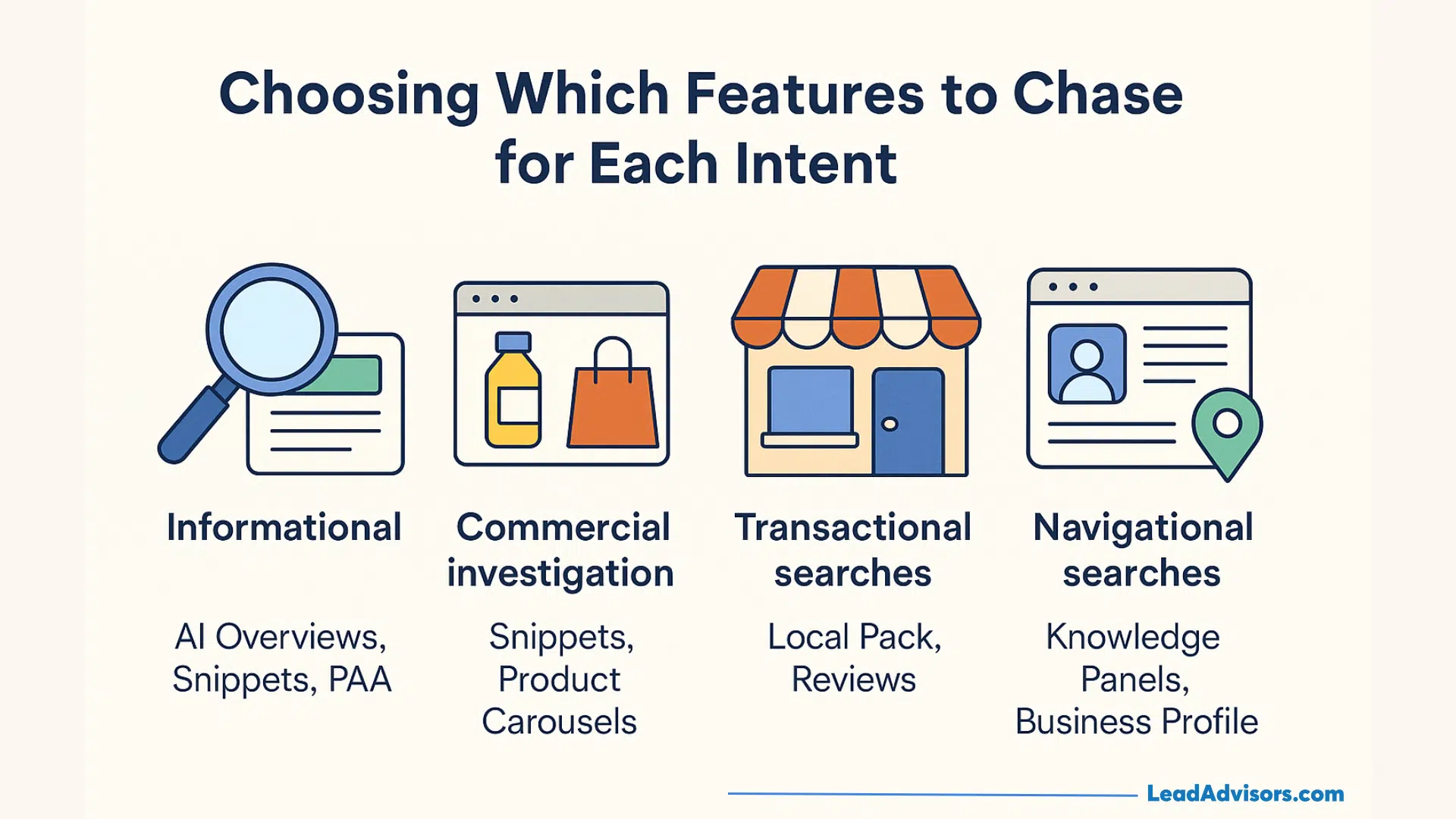
Stop chasing all shiny objects. Scale your efforts to what the user is really trying to accomplish:
- Informational (The “Learners”): Target AI Overviews, Featured Snippets, and People Also Ask boxes.
- Latest Stat: AI Overviews appear in 16-30 percent of all searches in the US for informational queries.
- Commercial (The “Researchers”): Target Featured Snippets for comparison tables and Review Rich Snippets for star ratings.
- Transactional (The “Buyers”): Target Product Carousels and Local Pack results. If you are an ecommerce brand, make sure to include ecommerce SEO with high-quality images to trigger Image Packs.
- Navigational (The “Loyalists”): Target your Knowledge Panel and Google Business Profile. You should own the entire right side of the screen for a brand-name search.
Design Titles and Snippets That Win the Click on Crowded SERPs
Being at the top of a page is not enough anymore. On a modern 2026 SERP, your organic link has to compete for a user’s attention with AI Overviews, ads, Reddit threads, and video carousels.
A “mini-landing page” is a great way to think of your SEO title and meta description. The only reason for their existence is to entice a busy user to click your link by stopping their scroll.
Why Snippet UX Matters More in an AI-Heavy SERP
However, the “click window” is getting smaller. In fact, recent data from 2026 revealed that when an AI Overview is present, the CTR of the #1 organic result can drop as much as 34.5%. To counter this, you need “emotional” and “benefit-driven” titles.
- The “Power Word” Edge: Studies of over 5 million results revealed that “emotional” titles that include words like “Proven,” “Free,” “Secret,” or “Instant” can increase CTRs by as much as 13.9% compared to boring and neutral titles.
- The AI Citation Boost: When you are able to get a citation in the AI Overview, your AI SERP visibility increases dramatically, with cited brands receiving up to 35% more organic clicks compared to those that are not cited.
Pixel-Safe Titles and Descriptions in Practice
Google doesn’t count characters; it counts pixels. If your title is too wide, it gets cut off with a messy “…” (ellipsis).
Element | Desktop Limit | Mobile Limit | Best Practice |
Title Tag | ~600 pixels | ~800 pixels | Keep it between 50–60 characters. |
Meta Description | ~920 pixels | ~680 pixels | Aim for 120 characters for the most important info. |
Pro Tip:If you want to test out what your title is going to look like, try using a SERP analyzer or a snippet tool. Just keep in mind that letters like “W” use more pixels on a page than letters like “i,” so it is more accurate to use a title checker rather than counting letters.
Tips for Crafting High-Click Snippets
- Front-Load the Benefit: Place your most important keywords, and the ‘solution,’ within the first 40 characters.
- Use “Freshness” Markers: Adding the year to your title, like ‘Best CRM Software 2026,’ helps users perceive the content as more timely and thus more relevant than other, older content.
- The 120-Character Rule: Since mobile devices comprise over 63% of U.S. organic search traffic, it is imperative to ensure the meta description delivers the ‘hook’ within the first 120 characters, before mobile truncation begins.
- Avoid Template Fatigue: While this may not be applicable to all industries, in ecommerce SEO, unique descriptions for the top categories can have a drastic effect on SEO performance.
Where to Prioritize Your Tests
You don’t have to fix all of your pages at once. You should prioritize your “Low Hanging Fruit”:
- The “3-7” Strategy: Target pages that are currently in positions 3-7 with a low CTR. A simple change to your title could increase your traffic by 20 percent without you having to improve your actual ranking.
- High-Volume, Low-Conversion: If you have a page with 10,000 impressions but no sales, it is possible that your snippet is attracting the wrong user. Realign your title to better match the user’s intent.
Optimize for AI Overviews and LLMs, Not Just Classic SERPs
SEO is about ranking high in the “blue links,” but GEO is about becoming the first source that AI models (like Gemini, ChatGPT, and Perplexity) trust and cite.
If you are not featured in the AI summary, you are becoming invisible to the 25% of users searching and seeing an AI Overview.
SEO vs. GEO: A Tale of Two Strategies
Think of it this way: SEO gets you into the library. GEO gets the librarian to pick up your book and read it out loud to the person asking a question.
Feature | Traditional SEO | GEO (Generative Engine Optimization) |
Primary Goal | Rank #1 and get the click. | Get cited/mentioned in the AI answer. |
Success Metric | Click-Through Rate (CTR). | AI SERP visibility & Share of Voice. |
Key Tactic | Keywords and backlinks. | Entity clarity, facts, and structure. |
Impact | Clicks dropped 61% recently. | Cited pages get 35% more clicks. |
The 2026 Reality: AI referral traffic is increasing by 1%. But more importantly, AI referral traffic converts at a rate of 14.2%, which is almost 5x higher than traditional searches because they are “pre-sold” by the AI.
How AI Overviews Choose Their “Winners”
AI overviews don’t look for “keywords.” They look for “Semantic Completeness.” To get into an AI SERP visibility tracker, you need to:
- Direct and Scannable: AI overviews love “semantic units,” which are paragraphs of 100-300 words that answer a question.
- Multimodal: Pages that use a combination of “text + images + videos” are 317% more likely to be selected by AI overviews than text-only pages.
- Factual and Verified: Pages that use specific “stats” and “tier-1” sources like .gov, .edu, and top-notch research are 132% more likely to be selected by AI overviews.
- Lightning Fast: Pages that load in under 0.4 seconds are 3x more likely to be selected by AI overviews than slower websites.
Simple “GEO Wins” You Can Do Today
You don’t need a lot of team members to start winning AI SERP visibility. These are simple, high-leverage “GEO Wins” you can start with today:
- The “40-Word Answer”: Start each section with a simple, clear, and concise “fact block” that an AI can easily cut and paste into their summary section.
- Use “Natural Language” Headers: Instead of “Pricing,” use “How much does [Product] cost in 2026?” This mimics how humans speak to AI models.
- Add FAQ Schema: Using optimization tools, add FAQ schema to your website. This is a massive “trust signal” for AI models.
- Cite Your Stats: Don’t say “most people.” Say, “According to a 2026 Statista report, 81% of users…” and link to the source.
- Build Your “Entity”: Get mentioned in industry news and review sites (e.g., G2, or even just on Reddit). AI models use “brand mentions” to determine if you’re a real authority or not.
Read more: LLMO vs. GEO vs. AEO: How to Win Mentions, Citations, and Conversions from AI
Use Trendspotting to Capture Visibility While Competition Is Low
The biggest mistake you can make in 2026 is to wait for a keyword to show high volume in a traditional SERP checker before creating content on the topic. By then, the “big players” will already be there, and the AI search visibility spots will be occupied.
Low-volume, rising topics are your “visibility gold.” Content created during the early adopter phase of a trend has 7.2x more sustained engagement than content created after the trend has gone mainstream.
Where to Find Your Next High-Leverage Topic
You don’t need a crystal ball; you just need to look at the right data. Trends start as “whispers” on social media and support tickets before they become “roars” on Google.
- External Signals: Use Google Trends’ “Trending Now” page. It updates every 10 minutes and shows “Breakout” terms (topics increasing by more than 5,000%).
- Social Listening: Check out Reddit or industry forums. If people are complaining about a new issue, that is your next SEO title.
- Internal Intelligence: * Google Search Console: Check “new queries” with low clicks and increasing impressions.
- Site Search: What are people searching for on your site if there are no results? That is an “opportunity void.”
A Simple Sprint Workflow for Trend-Led Content
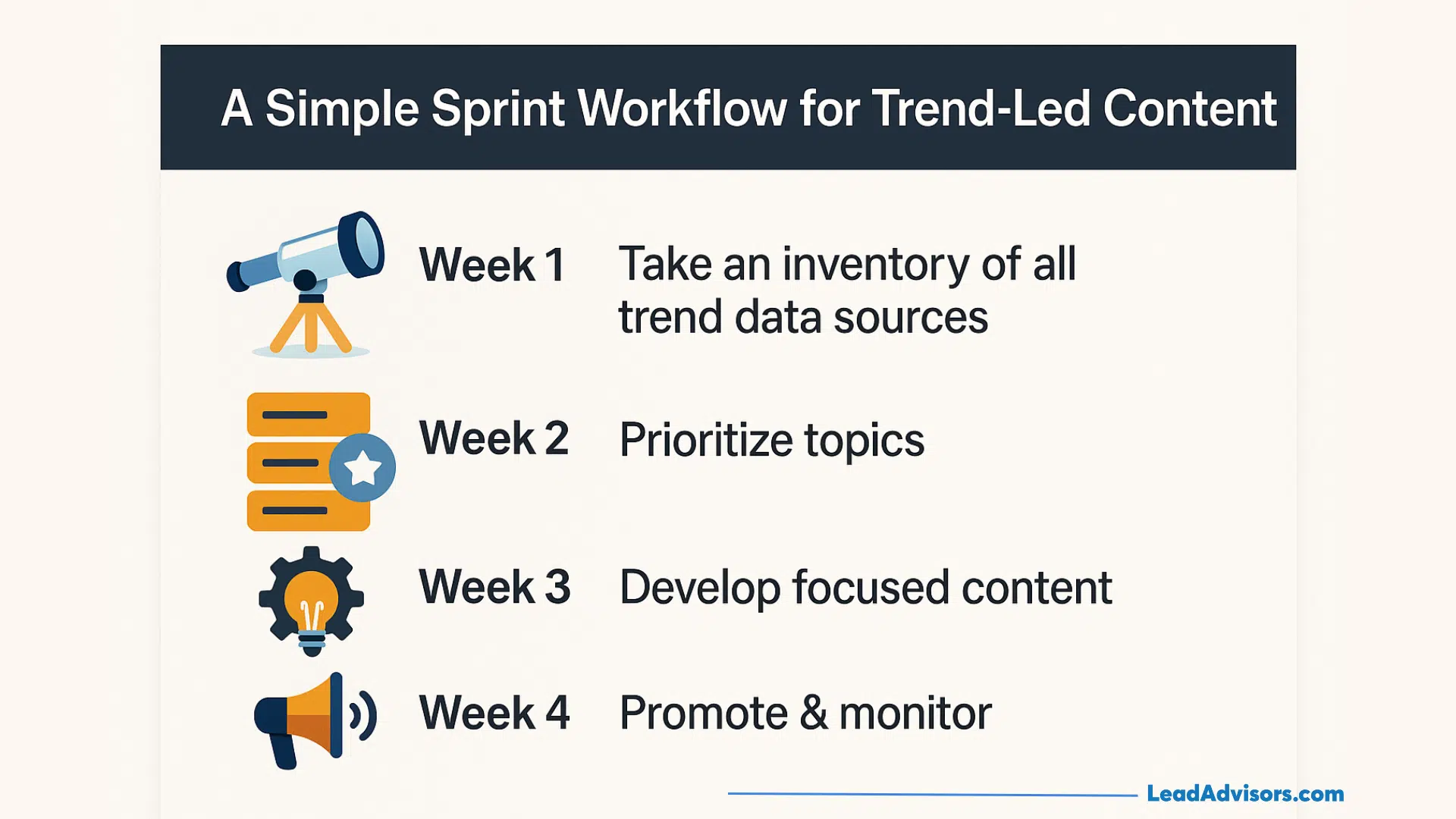
Most teams move too slowly. In 2026, “velocity” is a ranking factor. I recommend this lightweight monthly sprint to increase SERP visibility without burning out:
Phase | Goal | Action |
Week 1: Discover | Identify 5–10 topics. | Check Google Trends and GSC for “rising stars.” |
Week 2: Prioritize | Pick the top 2. | Score them on: Product alignment (1–5) and Ranking difficulty (lower is better). |
Week 3: Create | Ship the content. | Write 1,500 words focusing on “Information Gain”—add a unique stat or a personal take. |
Week 4: Amplify | Build the signals. | Post to LinkedIn, answer a related Reddit thread, and track your SERP rankings. |
How to Keep Trend Content Updated Without Burning Your Team Out
The “Publish and Pray” approach is over. If you want to maintain your “SERP” status, you need to keep your “Trend” content updated.
Spend just 30 minutes per quarter:
- Add 2026 stats: AI search engines prioritize “freshness.”
- Include recent examples: Did a new tool launch? Mention it.
- Refresh the “Answer Box”: Update the summary at the top of the page to keep it perfect for AI SERP visibility.
The “Pivot” Rule: If it “dies,” pivot this content to another more “evergreen” topic. If it “explodes,” pivot this content into a “Content Cluster” with 3-5 smaller “sub-articles”: This creates “topic authority” and keeps your “SERP Position Checker” looking “glowing green.”
Grow Visibility Across AI, Social Search, Marketplaces, and UGC
If 90% of your traffic comes from Google, your brand is one algorithm update away from a crisis. In 2026, discovery is “fragmented.” People aren’t just “Googling” anymore; they are “Gemini-ing,” “TikTok-ing,” and “Redditing.”
Why Google-Only Visibility Is a Business Risk
While Google still handles the majority of total searches, younger and more “action-oriented” audiences have shifted elsewhere.
- Social Discovery: 41% of Gen Zs look to social media first for information, compared to 32% who look to Google first.
- The Power of Video: 67% of 18-24-year-olds look to Instagram to find local businesses, and 62% look to TikTok. If you are not there, you don’t exist to them.
- The AI Shift: 14% of all consumers now say they are more likely to use ChatGPT than Google for their daily searches.
The 4 Pillars of Non-Google Visibility
To maximize SERP visibility beyond Google, you must be present where the conversation is happening:
- AI Search Engines: (ChatGPT, Gemini, Perplexity, etc.) These are search engines that favor conversational responses. ChatGPT alone processes over 2 billion queries per day.
- Social Search: (TikTok, Instagram, YouTube, etc.) TikTok has seen a 19.5% increase in search adoption since 2024. TikTok is the “king” of “How-To” and product discovery.
- UGC Ecosystems: (Reddit, Quora, etc.) Google now offers massive SERP rankings boosts to Reddit threads. If you are not being talked about in “best of” threads, you are missing out.
- Review Platforms: (G2, Trustpilot, Yelp, etc.) In 2026, 85% of users trust social and review sites as much as personal recommendations.
How to Pick Your Top 2-3 Non-Google Surfaces
Don’t try to be everywhere. Here is a strategic filter to use:
- Step 1: Survey Your Data. Look at your referral traffic in Google tools like GA4. Where are your best customers coming from?
- Step 2: Match the Intent. Prioritize LinkedIn and AI Search. Ecommerce SEO? Prioritize TikTok and Instagram Reels.
- Step 3: Quarter-by-Quarter Focus. Choose two platforms to prioritize. Master them for 90 days before adding a third.
Tracking Non-Google Discovery Without Getting Lost in Data
You don’t need perfect data to know if it’s working. Use this 2026 “Health Dashboard”:
Platform | What to Track | Success Indicator |
AI Search | Citations & Mentions | Are you being named in the “Sources” list? |
Social | Share of Voice | Are people tagging your brand in “recommendation” videos? |
UGC/Forums | Sentiment | Is the conversation about you positive on Reddit? |
Review Sites | Review Velocity | Are you getting at least 5-10 new reviews a month? |
Total Mix | Non-Google Traffic | Goal: 30%+ of your discovery traffic should come from outside of Google. |
The Bottom Line: In 2026, having higher visibility for SERPs like this is actually a “blended” metric. When you are mentioned on Reddit, cited in Gemini, and are trending on TikTok, Google’s main algorithm views you as a massive “Entity” and rewards your main site even further.
Turn Your Brand Into an Entity That Dominates Branded and Comparison Searches
In 2026, Google and AI models don’t just “read” your website, they “map” it. To Google and AI models, you are not just a website, you are an Entity – a unique “thing” (a person, place, business, etc.) that is linked to many other concepts in a huge virtual web called the Knowledge Graph.
Having strong entity signals provides you with a “compounding advantage.” When AI models like Gemini or ChatGPT are tasked with suggesting a product to a user, they don’t just look for keywords – they look for the most recognized and trusted entity in that space.
The Compounding Benefits of Entity Strength
Creating your “knowledge footprint” on the internet has several high-visibility effects:
- Knowledge Panels: Having control over the large information box on the right side of the SERP.
- AI Brand Bias: AI is more likely to reference “recognized” sources to avoid “hallucinations” (or “making things up”). In 2026, being referenced in searches generates 35% more organic clicks than not being referenced.
- Trust at First Sight: Searches for “Brand vs. Competitor” have conversion rates 4.4 times higher than generic searches because the user is already “deep into” the “consideration phase”.
A 30-Minute Entity & Review Audit
Want to see how the “digital brain” views your brand? Try this quick exercise:
The “Branded Plus” Test: Search for [Your Brand] reviews, [Your Brand] pricing, and [Your Brand] vs [Top Competitor].
Goal: Do you control the narrative, or do review sites and competitors dominate searches for your brand?
Consistency Check: Is your brand’s ‘NAP’ (Name, Address, Phone) and mission statement the same across your website, Google Business Profile, LinkedIn, and Crunchbase?
Pro Tip: Use sameAs schema markup to inform search engines that your LinkedIn profile and website are the same entity!
Review Velocity: Look at your reviews from the last 90 days. AI systems are biased toward recency. If your last review was in 2024, you have a ‘recency problem’ and are viewed like a ‘dormant entity’!
How to Bake EEAT Into Your Content
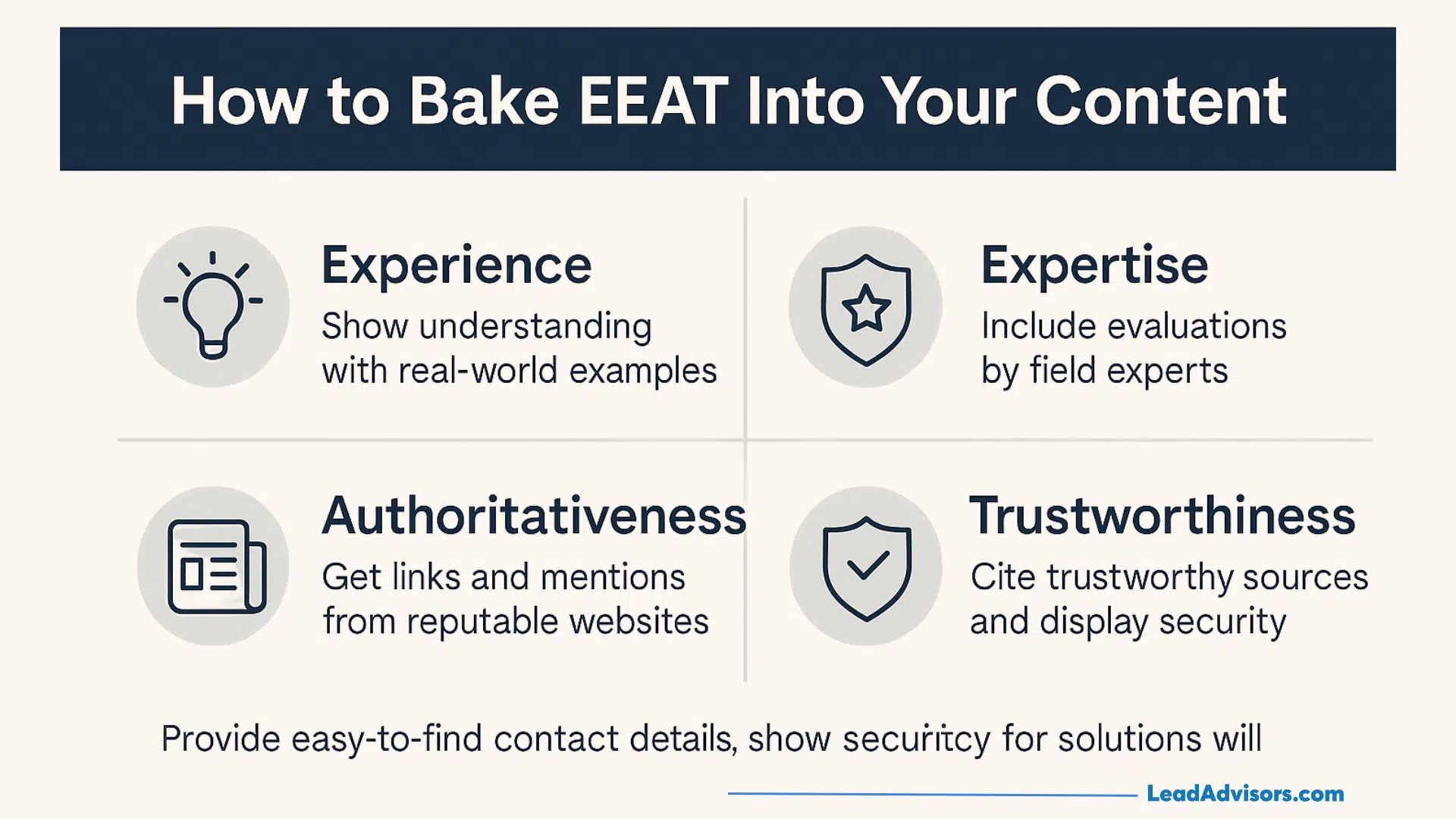
Google’s E-E-A-T framework is the “grading rubric” for entities. Here is how to hit the high marks in 2026:
- Experience: Provide evidence that you’ve done the work. Use “I” and “we” statements. Include original images, not stock images. Provide real-world examples.
- Expertise: Provide Author Bios that include links to the authors’ social profiles.
- Authoritativeness: Strive for “Brand Co-occurrence.” If your brand name appears frequently in articles alongside other industry leaders, the AI algorithms will learn that your brand is part of the inner circle.
- Trustworthiness: This is the most important factor. Make sure your “About Us” and “Contact” pages are robust and easily accessible. These are the safety signals that AI algorithms look for before referring your brand to the user.
Measure SERP Visibility as One Portfolio Across SEO, AI, and Ads
The C-suite in 2026 doesn’t care which department gets the credit for the sale; they care about the Efficiency of the Search Portfolio. So, if the Google AI Summary answers the user’s question, and then the user clicks on the Paid Ad to buy, that’s a win for the brand, even if “Organic Traffic” appears to be down on paper.
The KPIs That Actually Define SERP Visibility Today
Rank tracking is dead. To prove the efficacy of your strategy, you need to report on Signal rather than Sessions:
- AI Share of Voice (SoV): The number of times your brand is mentioned in an AI Overview and LLMs like ChatGPT.
- Latest Data: AI Referral Traffic (GEO) now has a 14.2% conversion rate, which is nearly 5x higher than traditional organic search.
- Blended Search CAC: This is the combined CAC of your SEO and paid search teams divided by total search-driven customers.
- Branded Search Lift: When users see your brand mentioned in an AI Overview, they tend to go back to Google and search specifically for your brand. The rising “Branded Query” trend is the #1 signal of successful AI SERP Visibility.
- Zero-Click Influence: Calculating “Impressions to Branded Search” ratio. If 75% of AI sessions end without a click, then impressions are influenced.
Sample Dashboard Layout Your C-Suite Will Understand
Create a one-page summary that translates “SEO jargon” into “Business Growth.”
Metric Category | KPI | 2026 Benchmark |
Business Impact | Total Search-Driven Revenue | Goal: 40% of total company revenue. |
Efficiency | Blended Search CAC | B2B Goal: Below $900 (Industry avg: $1,200). |
AI Status | AI Citation Rate | Goal: Citations on 25%+ of priority keywords. |
Diversification | Non-Google Traffic Share | Goal: 30% of search traffic from AI/Social/UGC. |
How Often to Review and Iterate on Your Visibility Strategy
Critical Action Items (Monthly):
- What’s Working: “Our AI citations for ‘Money Topic A’ have doubled, resulting in a 20% surge in direct brand searches.”
- What Needs Attention: “Organic CTR for ‘Topic B’ fell by 60% due to new AI Overviews; we must optimize for the citation spot.”
The 2026 Strategic Rhythm
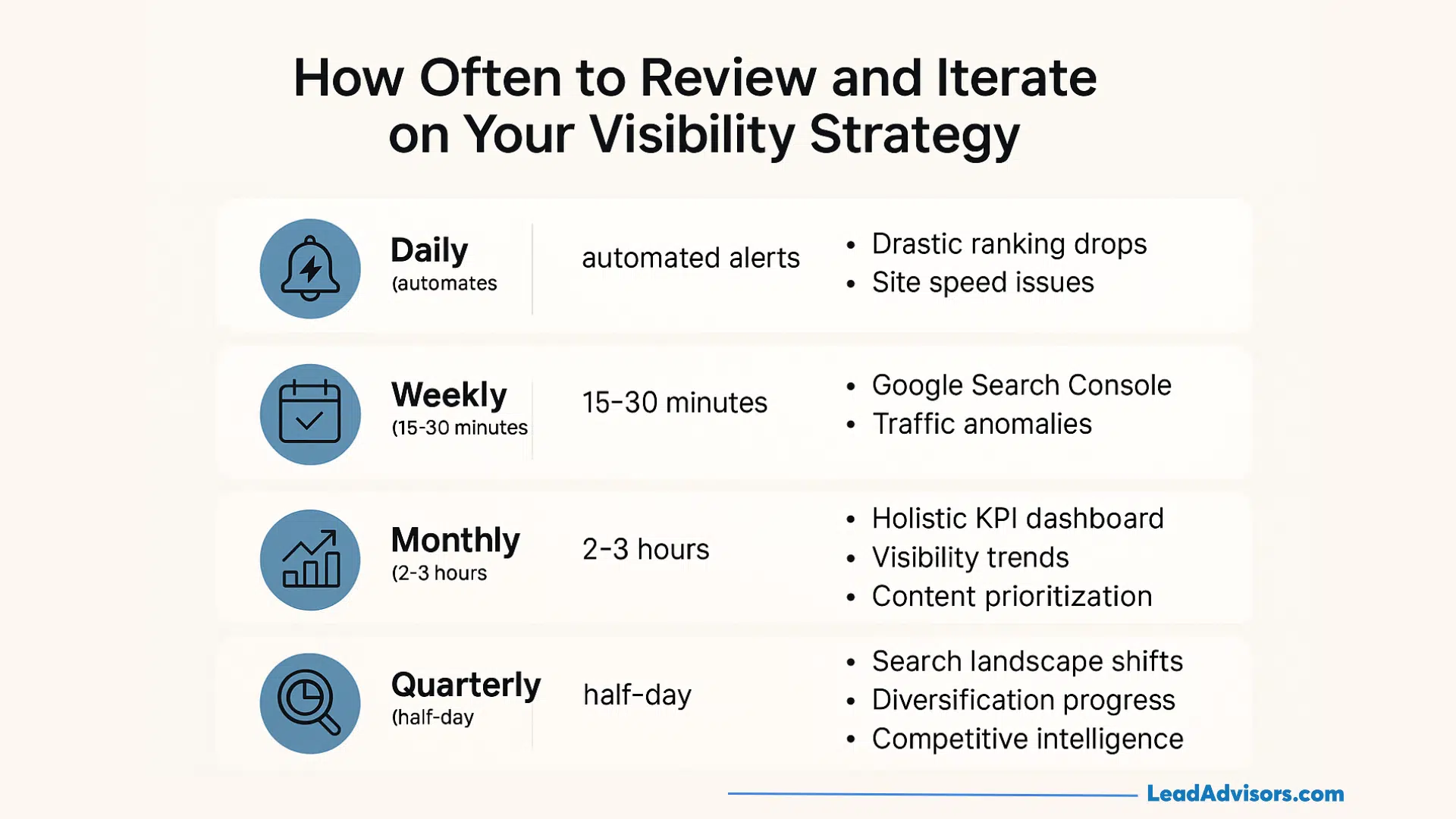
Keep your strategy fresh and not stale. This is a suggested schedule to stay ahead of the AI SERP visibility curve:
- Daily (Automated): Set up notifications for “AI Overview Loss” for your top 10 revenue-generating keywords. If you lose the citation, you’ll lose traffic in 24 hours.
- Weekly (Execution): Scan “New AI Queries” in Google Search Console. This is a growing trend you can exploit before your competitors realize it.
- Monthly (Performance): Present to your management team a copy of the Blended Portfolio Report. Pivot your budget from high CAC-paid keywords to low CAC-organic content themes.
- Quarterly (Strategy): Conduct an audit of your “Platform Mix.” If you are still 90 percent dependent on Google, use this time to launch your Social Search pilot.