Medical SEO is a highly targeted strategy that helps a doctor get found by patients who are ready to book, for example, “specialist near me.” By optimizing SEO keywords for doctors and building E-E-A-T, a medical SEO agency helps providers satisfy Google’s strict YMYL standards.
In 2026, the patient journey begins with a “digital handshake.” Whether searching via Google Maps or AI summaries, 72% of users look online for care. Consequently, this shift makes healthcare search engine optimization vital for survival. As a result, from local SEO for doctors in Miami to advanced SEO for doctors in Houston, you must prove credibility instantly.
To help you navigate this, this article elucidates the components of a tried-and-tested SEO method for doctors. Ultimately, these strategies can help you beat your competition, gain the trust of patients, and be a pro in medical search engine marketing to get your practice to grow.


Why Medical SEO for Doctors is a High-Stakes Game
While healthcare SEO is usually about branding the facility, medical SEO for doctors is distinctly personal. Specifically, it promotes you: your NPI, verified identity, specialty, and your unique bedside manner. Indeed, by the year 2026, patients will hardly ever look up a generic “best clinic.”
Instead, they will be using highly specific and intent-based queries, such as “best orthopedic surgeon in Dallas” or “[condition] specialist near me.”
The YMYL Standard: Your Money or Your Life
Crucially, Google classifies physician content as YMYL (Your Money or Your Life). Because low-quality medical advice can cause physical harm, search engines demand the highest level of E-E-A-T. As a result, you aren’t just chasing SEO keywords for doctors; rather, you are proving to an algorithm that your expertise is clinically sound and safe to recommend.
What Patients (and AI) Expect Before Booking
According to a University of Kansas study, 67.2% of millennials read reviews before choosing a physician. To convert this traffic, your medical website SEO must highlight:
- Board Certifications & Credentials: Essential for “Doctor Entity” signals.
- Patient Reviews: Specifically, those mentioning your name and the condition treated.
- Procedure-Specific Outcomes: Proving you handle their specific problem frequently.
“Marketing a Clinic” vs. “Marketing a Doctor”

While clinic marketing covers logistics like parking and hours, SEO for medical practices thrives when the physician is the focal point.
| Strategy Focus | Clinic Brand | Physician Entity |
| Search Intent | “Medical center open late.” | “SEO for orthopedic doctors“ |
| Trust Signal | Facility accreditation | Board certifications & NPI |
| Content Type | General service list | “How I treat [Condition]” videos |
Key Takeaway: By 2026, your provider page is your primary conversion tool. A generic clinic bio is no longer enough to rank in a competitive healthcare SEO industry.
Building the Doctor’s Digital Identity (Entity SEO for Physicians)
In fact, in 2026, Google doesn’t just crawl keywords; it instead maps Entities. Specifically, a “Doctor Entity” is a unique profile the algorithm builds by connecting your NPI number, board certifications, and affiliations across the web. Consequently, when these signals are consistent, your authority rises; conversely, when they conflict, your rankings drop.
The “Same Everywhere” Checklist
Foundational website optimization for doctors requires strict NAP (Name, Address, Phone) consistency. If your Healthgrades profile says “MD” but your website says “Medical Doctor,” you create friction for the algorithm.
- Name Format: Dr. Jane Doe, MD (Use this exact string everywhere).
- Primary Specialty: Be consistent with the way you list your specialty on the NPI registry.
- Digital Footprint: Make sure Zocdoc, Doximity, WebMD, and LinkedIn have the same information.
- Visual Continuity: By using the same professional headshot, both users and AI facial recognition will more easily recognize you across platforms.
Structured Data: Using Physician Schema
In order to dominate medical search engine optimization, you must speak the search engine’s language. Specifically, implementing the Physician and MedicalSpecialty schema is like handing Google a digital business card that it simply cannot misread. By doing so, you translate your clinical credentials into a structured format that search engines can instantly verify and display.
A high-performance schema setup includes:
- Physician: Your primary identity.
- Medical Specialty: Linked to specific ICD-10 or clinical categories.
- worksFor: Linking the doctor to the medical practice brand.
- sameAs: Direct links to your authoritative profiles (Board of Medicine, Hospital bio).
Why Entities Win in the AI Era
In this new landscape, AI answer engines and “Zero-Click” summaries pull from the most reliable data clusters.
Consequently, by building a strong entity through healthcare SEO services, you ensure that when a patient asks an AI, “Who is the best cardiologist in Austin?”, your name is cited with accurate credentials and booking links. As a result, your practice becomes the definitive answer provided by the AI rather than just another search result.
Local SEO for Doctors: Winning “Near Me” and “Best Doctor” Searches
Ultimately, local SEO for doctors offers the fastest ROI primarily because it captures patients at the peak of “immediate intent.” As a result, whether it’s local SEO for doctors in Miami or the best SEO for doctors in Houston, your strategy must carefully balance the clinic’s physical location with the physician’s individual reputation. By doing so, you ensure that both the facility and the provider are visible exactly when the patient is ready to book.
Practice vs. Provider Listings
Google allows for both Practice (Medical Business) and Practitioner (Individual) listings. Navigating this is a core part of advanced SEO for doctors.
| Feature | Practice Listing | Provider Listing |
| Best For | Location intent (e.g., “Urgent care near me”) | Name intent (e.g., “SEO for orthopedic doctors”) |
| Primary Goal | General brand visibility & directions | “Best [Specialty] Doctor” queries |
| Key Risk | Incorrect categories | Duplicate listings during job moves |
Optimizing for Geo-Specific Queries
To rank for local SEO for concierge doctors or surgeons, your page titles must follow high-conversion patterns.
- Board-Certified [Specialty] in [City] | Dr. [Name]
- [Procedure] Consultation in [Neighborhood] | [Practice Name]
SEO Pro Tip: Instead of listing only your city, give some nearby landmarks, suburbs, and neighborhoods. It will help to prove “Hyper, Local” relevance, which is a key factor of Google Maps SEO for doctors.
Scaling Multi-Location Practices
Large groups often struggle with duplicate content. A scalable local SEO plan for doctors uses a “Hub and Spoke” internal linking structure:
- Unique Location Pages: One per physical address.
- Unique Provider Pages: One per physician, listing all locations they serve.
- Cross-Linking: Link providers to their respective offices and vice versa to help search engines crawl your hierarchy.
Insurance & Network SEO
Insurance is a primary search filter. To improve conversion, integrate insurance details on every provider page. This reduces “bounce rates” from patients who discover too late that you are out-of-network, a common pitfall in medical SEO for doctors.
Reputation and Review Strategy Built Specifically for Doctors
Furthermore, in 2026, reviews are more than just “stars”—they are effectively proof language. Specifically, while clinic reviews often focus on logistics like parking, doctor-specific reviews focus on bedside manner and clinical thoroughness.
Consequently, to dominate local SEO for doctors, you must leverage these reviews as high-conversion trust signals.
Where Doctor Reviews Matter Most
Millennials and Gen Z rely heavily on third-party validation. To improve your medical SEO marketing, prioritize:
- Google Business Profile: The primary driver for the “Map Pack.”
- Healthgrades & Vitals: These often outrank individual practice sites for “best doctor” queries.
- Niche Directories: Sites like Doximity or Zocdoc provide high-authority backlinks.
HIPAA-Safe Review Response Tactics
Many physicians inadvertently risk privacy violations when responding to feedback. The AMA warns that even acknowledging a person was a patient can breach HIPAA.
The “Safe Response” Framework:
- Generalize: “We appreciate you taking the time to share your feedback with our team.”
- Speak to Values: “Our goal is always to give every visitor clear communication.”
- Take it Offline: “You can reach out directly to our office manager at [Number] if you want to talk about your experience more.”
Strategic Review Placement
Don’t hide your praise on a “Testimonials” page. For the best SEO for medical practices, embed review excerpts where decisions are made:
- Provider Bio Pages: Use reviews that mention the doctor by name.
- Procedure Pages: Pick out reviews that talk about positive results after a specific treatment (e.g., “My knee pain is gone after surgery”) and show them as quotes.
- Booking CTAs: To help potential clients not hesitate, show a 5-star score snippet right next to your “Schedule Now” button.
SEO Pro-Tip: Prompting patients to mention the specific condition they were treated for helps you rank for most searched health keywords without looking “spammy.”
Content Strategy for Doctors: From “About” Pages to Authority Hubs
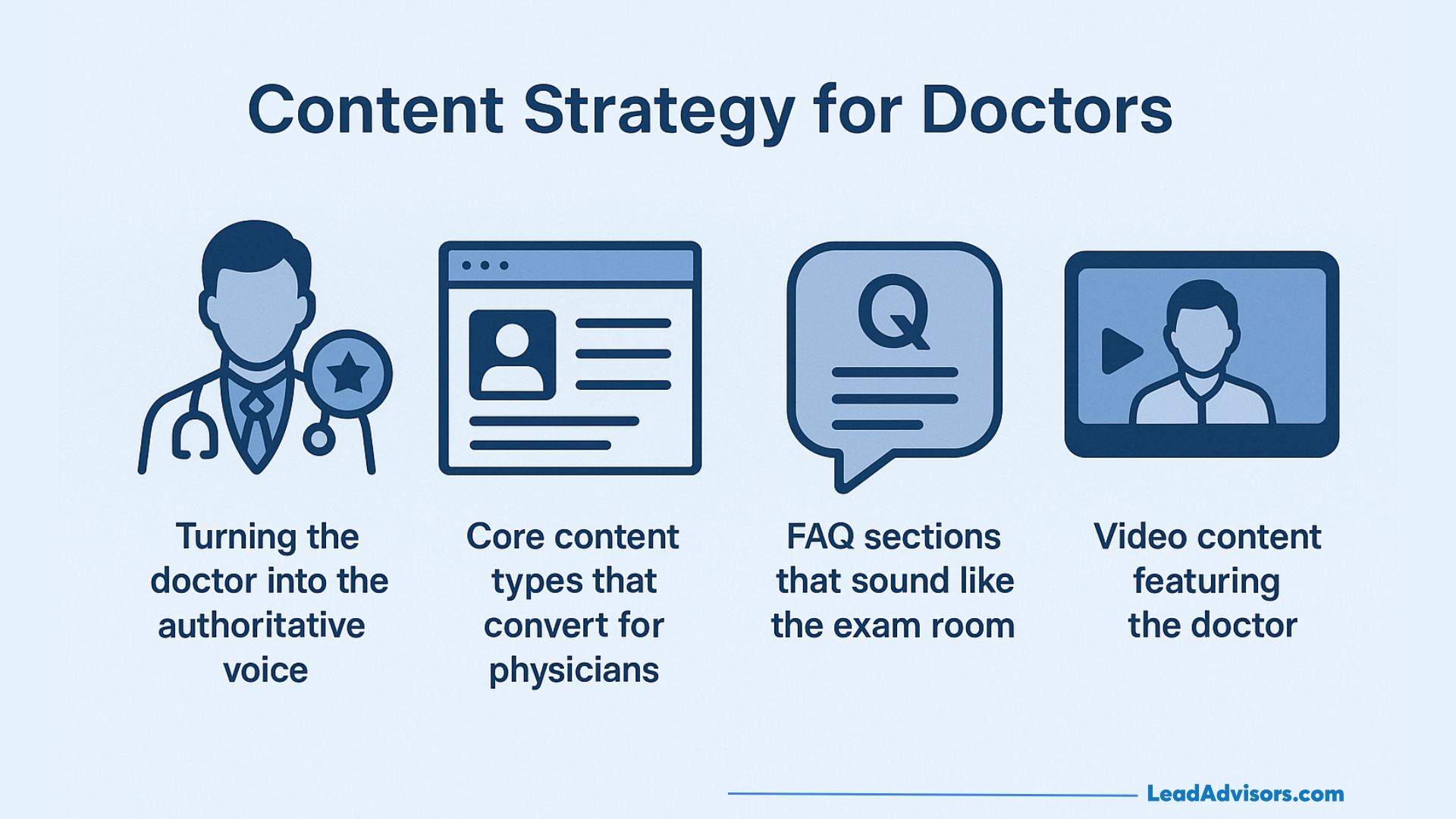
As a result, in 2026, medical SEO will no longer be about the sheer number of blog posts. Instead, it will be about the depth and “Information Gain” of those posts.
Moreover, Google has updated its algorithms in such a way that they now favor content that results in the resolution of a specific patient problem and is backed by clinical authority. Therefore, to get a good ranking, you have to turn the generic blog into a well-structured healthcare SEO authority hub.
Turning the Doctor into the Authoritative Voice
To satisfy the “Expertise” in E-E-A-T, your medical website SEO must prove that a human professional—not an LLM—is behind the information.
- Byline Transparency: A “Medically Reviewed By” or a “Written By” tag linked to the doctor’s credentialed bio should be featured on every medical page.
- Clinical Citations: When making medical statements, back them up with links to authoritative sources such as NIH, PubMed, or specialty boards.
- Risk Transparency: Discussing honest limits and potential complications builds more trust with search engines than purely “marketing” copy.
The High-Conversion Content Stack
A successful SEO strategy for doctors focuses on three core page types:
1. The Power Bio (Provider Page)
Ultimately, this is not just a resume, but essentially a landing page. As a result, it should directly respond to the patient’s primary question: “Is this the right doctor for me?”
To accomplish this, make sure it features your NPI number and board certifications prominently. Furthermore, include easy-to-understand internal links to the exact locations where you practice. By doing so, you provide a seamless path for the patient while reinforcing your local entity for search engines.
2. Condition Pages (Symptom-First Intent)
These pages get the highest ranks for most of the searched health keywords. It is quite natural that patients look for “why does my hip hurt at night” even before they look for a surgeon.
- Structure: Definition → Symptoms → When to See a Doctor → Evaluation Process → Treatment Options.
3. Procedure Pages (The Decision Stage)
Educate the patient on the “how” and “who.” Cover candidacy (who is not a fit), recovery timelines, and realistic expectations. This is advanced SEO for doctors that doubles as a patient education tool.
FAQ Sections: Winning the “Answer Engine”
To win Featured Snippets and AI Overviews, use the “Inverted Pyramid” format:
- The Direct Answer: A 1–2 sentence clear definition.
- The Details: Bulleted lists of symptoms or steps.
- The Action: A “When to call” section with a CTA.
SEO Expert Tip: Record the doctor answering these FAQs in 60-second clips. Embed the video with VideoObject Schema to dominate the “Video” and “Perspective” tabs in Google Search.
Specialty SEO: Playbooks by Medical Field

This is because generalized content rarely converts in the healthcare SEO industry. Instead, to dominate your niche, you need a local SEO plan for doctors that targets specific “Red Flag” symptoms and high-intent medical keywords.
To help you get started, this section provides plug-and-play ideas to build topical authority.
SEO for Dermatologists
- Typical High-Intent Queries: Acne dermatologist in [City], skin cancer screening near me, eczema doctor [City].
- Red-Flag Symptoms: Mole has changed shape, bleeding spot, persistent rash.
- Pages to Build: Different acne treatments, the process of evaluating eczema, and what to expect during a skin cancer screening.
- Proof Elements: Credentials, emphasis on a subspecialty, and compliant before and after photos.
SEO for Orthopedic Surgeons
SEO for orthopedic doctors lives and dies by pain, function, and timing.
- Typical High-Intent Queries: Knee pain doctor near me, rotator cuff tear treatment, hip replacement recovery timeline.
- Red-Flag Symptoms: Cannot bear weight, numbness after injury, knee locks up.
- Key Procedures: Arthroscopy consultation, joint replacement care, sports injury evaluation.
- Proof Elements: Realistic recovery timelines, success metrics, and reviews mentioning pain improvement.
SEO for ENT / Otolaryngologists
- Typical High-Intent Queries: “Sinus infection doctor near me”, “tonsil removal recovery”, “hearing test [City].”
- Red-Flag Symptoms: “Difficulty swallowing”, “ear pain with fever”, “sinus pressure for weeks.”
- Proof Elements: Thorough evaluation, clear follow-up expectations, and easy booking.
SEO for OB-GYNs
- Typical High-Intent Queries: “OB-GYN accepting new patients”, “IUD insertion [City]”, “prenatal care near me.”
- Red-Flag Symptoms: “Bleeding during pregnancy”, “intense pelvic pain”, “heavy menstrual bleeding.”
- Proof Elements: Mention hospital affiliations, provide clear scheduling, and have reviews that highlight communication and comfort.
SEO for Pediatricians
- Typical High-Intent Queries: “Pediatrician near me, ” “same day pediatric appointment, ” “fever in a toddler when to worry.”
- Proof Elements: Clear instructions on when to call for help, a friendly care approach, and guidance for after-hours situations.
SEO for Cardiologists
- Typical High-Intent Queries: “Cardiologist near me,” “chest pain evaluation,” “heart palpitations doctor.”
- Proof Elements: Straightforward risk explanations, testing workflow overview, and strong provider page trust signals.
SEO for Behavioral Health and Psychiatry
- Typical High-Intent Queries: “Psychiatrist near me,” “anxiety treatment options,” “ADHD evaluation adult.”
- Proof Elements: Clear boundaries, telehealth availability, and privacy reassurance.
SEO for Aesthetic and Medspa Physicians
- Typical High-Intent Queries: “Botox doctor near me,” “chemical peel recovery,” “laser treatment [City].”
- Proof Elements: Before-and-after galleries, candidacy guidance, and reviews mentioning professionalism.
Read more: SEO for Dentists: Rank Higher, Build Trust & Get Featured Where Patients Search
AI SEO for Doctors: Getting Cited in AI Overviews and Answer Engines
Looking ahead, by 2026, AI will be integrated into every stage of the patient journey. Consequently, your goal is no longer to simply “game” these systems; rather, it is to establish yourself as the most consistent and credible option for healthcare search engine optimization. In doing so, you ensure that your practice remains the top recommendation as these AI algorithms evolve.
Where AI Appears in the Patient Journey
AI tools now act as a digital concierge, summarizing your reputation across several touchpoints:
- AI Overviews (SGE): Direct clinical summaries at the top of Google search results.
- Chat-based Queries: Patients asking ChatGPT or Gemini for “the best SEO for orthopedic doctors in my area.”
- AI-Enhanced Map Packs: Suggestions driven by semantic relevance between your reviews and the user’s specific medical problem.
What Makes AI Engines Trust a Doctor’s Content
Google’s algorithms give a high rank to content that is helpful, reliable, and made for people first. It is very important that your medical SEO pages are able to prove the following in the AI, first world:
- Clear, Direct Answers: Get straight to the point without any unnecessary details; explain the patient’s problem right in the first paragraph.
- Structured Headings: A set of well-organized H2 and H3 tags that clearly show the topic hierarchy.
- Visible Credentials: Show your NPI numbers, board certifications, and clinical affiliations that are verified.
- Consistent Entity Data: Matching facts across your website, GBP, and medical directories.
- Aggregated Sentiment: AI models “read” reviews to determine your reputation.
Content Structure that Works for AI and Humans
To rank in AI-driven medical SEO, you must prioritize scannability. Use these local SEO tips for doctors to structure your pages:
- “Short Answer First”: Provide a 45-word summary of the topic at the top of the page.
- Bullets and Tables: Use these to organize symptoms, recovery timelines, or insurance lists for easy AI parsing.
- Consistent Definitions: Use standard medical terminology to help AI categorize your medical keywords.
- FAQ Blocks: Structure these to mirror real-world “exam room” questions.
Expert Insight: Connect your condition pages to your provider pages via internal links. This helps both users and AI crawlers understand the direct relationship between a specific health problem and your clinical expertise.
Optimizing the Doctor’s Website Experience
A high-performance medical SEO strategy fails if the user experience is confusing. Patients can find you through search, but they will “bounce” to a competitor if the booking process is cumbersome.
Must-Have Pages for Doctor-Focused Medical Websites
To maximize your medical website SEO, your site architecture should be patient-centric. Ensure you have dedicated pages for:
- Provider Pages: Individual bios for every physician in the group.
- Specialty & Condition Pages: Hubs for symptom-based queries.
- Procedure Pages: Detailed guides on what to expect during treatment.
- Location Pages: Essential for local SEO for medical practices.
- Telehealth & Appointment Portals: Clear paths for patient intake.
UX Details That Convert Visitors into Patient Inquiries
Conversion Rate Optimization (CRO) is just as important as healthcare search engine optimization. Ensure these elements are highly visible:
- Mobile-First “Call Now” Buttons: Essential for patients in urgent need.
- Request Appointment CTAs: Use high-contrast buttons in the header.
- Insurance Summary: A quick list of accepted networks.
- New Patient Instructions: Clear steps on what to bring to the first visit.
Technical SEO Priorities for Doctors
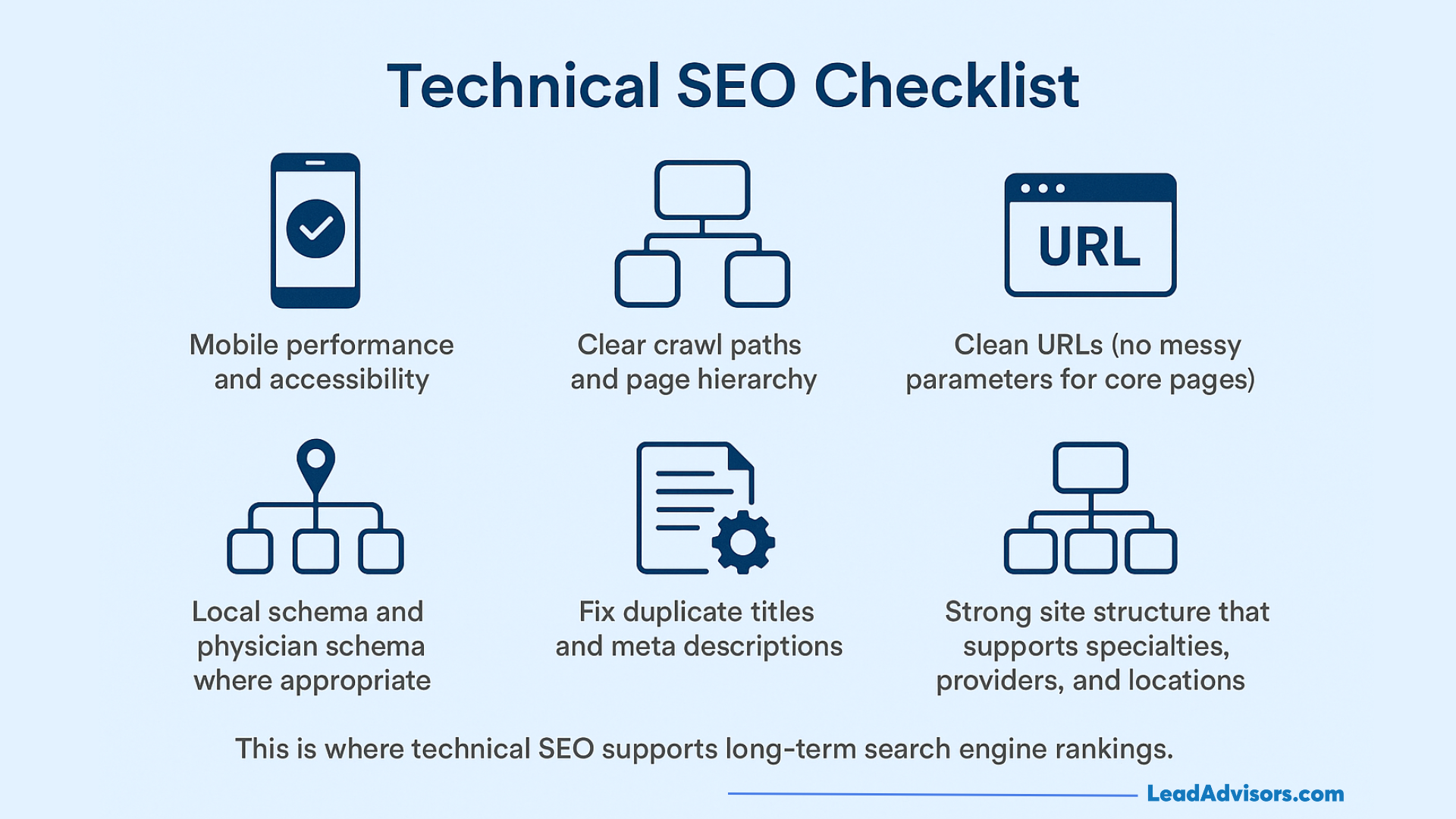
You don’t need “hacks”—you need a stable foundation. A medical SEO specialist’s team focuses on these technical essentials:
- Mobile Performance: Fast-loading pages are a primary ranking factor in 2026.
- Clean Crawl Paths: A logical hierarchy that connects specialties to providers.
- Clean URLs: Descriptive slugs like /doctors/dr-jane-doe/ instead of messy parameters.
- Schema Markup: Implementing Physician and MedicalSpecialty schema to help Google categorize your practice.
Protect Patient Data While Tracking Results
Marketing measurement must never compromise HIPAA compliance. When working with a medical SEO company, ensure your tracking follows these guardrails:
- No PHI in Analytics: Never store sensitive patient data or names in event tracking.
- Secure Intake: All forms must be encrypted and HIPAA-compliant.
- Privacy-First Call Tracking: Avoid recording calls where protected health information might be shared.
- Access Control: Limit analytics and Search Console access to essential staff only.
Key Takeaway: The goal is to grow your patient base while maintaining the highest standards of data security. Technical stability and patient privacy are the dual pillars of advanced SEO for doctors.
Authority and Backlinks for Doctors Beyond the Practice Brand
Furthermore, in 2026, medical search engine optimization relies heavily on digital PR and clinical authority. This is because authority is no longer just about the clinic’s domain; rather, it is about high-quality backlinks that mention the doctor by name. Ultimately, these “Entity-level” links prove to Google that you are a recognized expert in the healthcare SEO industry.
How Doctors Earn Authority Links
The most valuable links come from earned media and clinical contributions. A medical SEO agency often focuses on these “white-hat” strategies:
- Media Quotes: Providing expert commentary for health columns or local news.
- Speaking Engagements: Links from medical webinars, CME talks, or industry conferences.
- Research & Case Reports: Citations in medical journals or university repositories.
- Community Leadership: Involvement with local nonprofits or health-focused organizations.
Leverage Existing Authority Sources
Many physicians overlook powerful links they already have access to. Start with these foundational medical SEO specialists’ favorites:
- Hospital & University Profiles: Often the highest-authority links in your profile.
- Specialty Societies: Profiles on sites like the American Board of Medical Specialties (ABMS).
- Board Directories: Verified listings that reinforce your board-certified status.
A Practical Outreach Listicle for Doctors
Building a robust SEO strategy for doctors involves targeted outreach. Avoid “spammy” link-building; instead, aim for these credible targets:
- Hospital News Pages: Mentions of new staff or clinical achievements.
- University Faculty Profiles: If you teach or have an adjunct role.
- Specialty Member Directories: Ensuring your listing is complete and links back to your provider page.
- Local News Quotes: Acting as the “on-call” expert for health segments.
- Podcast Appearances: Bio pages from medical or local community podcasts.
- Chamber of Commerce: Speaker listings for local business wellness talks.
SEO Pro Tip: Ensure these links use your name (e.g., “Dr. First Last”) as the anchor text. This strengthens your “Doctor Entity” and helps you rank for the most searched health keywords related to your specialty.
Measuring SEO Success at the Doctor Level
Rankings feel good, but in the healthcare SEO industry, outcomes pay the bills. To ensure your investment is working, you must track the metrics that move the needle for your practice.
Core KPIs Tied to Doctors
A medical SEO specialist doesn’t just look at traffic; they look at patient acquisition. Track these metrics monthly:
- New Patients per Doctor: The ultimate measure of a successful SEO strategy for doctors.
- Provider Page Conversions: Calls and bookings originating directly from individual physician bios.
- Specialty-Specific Leads: Form submissions from high-intent condition or procedure pages.
- GBP Actions: Total calls, direction requests, and website clicks from your Google Business Profile.
- Page-Level Performance: Which specific medical keywords are driving patients to your “Contact Us” page?
Tools and Reporting Views
By 2026, data attribution is key to medical search engine optimization. Utilize these primary tools:
- Google Analytics 4 (GA4): Focus on “Key Events” to track conversion paths and patient behavior.
- Google Search Console (GSC): Use the Performance report to see which queries drive impressions. It’s vital to break this down by device, as mobile users searching for a “doctor near me” behave differently than desktop researchers.
- HIPAA-Compliant Call Tracking: Attribute phone leads to specific local SEO for doctors‘ campaigns or location pages.
How to Read Data Like a Practice Owner
Don’t get lost in the weeds. Each month, ask these four questions to refine your medical SEO marketing:
- Which provider pages drive the most inquiries? (Double down on what works.)
- Which procedure pages convert best? (This tells you where your “money pages” are).
- Which location pages get directions but no calls? (This may indicate a friction point in the office or on the page.)
- Which queries suggest new opportunities? (If patients are searching for a treatment you offer but don’t have a page for, build it.)
Key Takeaway: Measuring success at the doctor level ensures your medical website SEO remains focused on appointments, not just “vanity” traffic.
Common SEO Mistakes Doctors Make (And How to Fix Them)
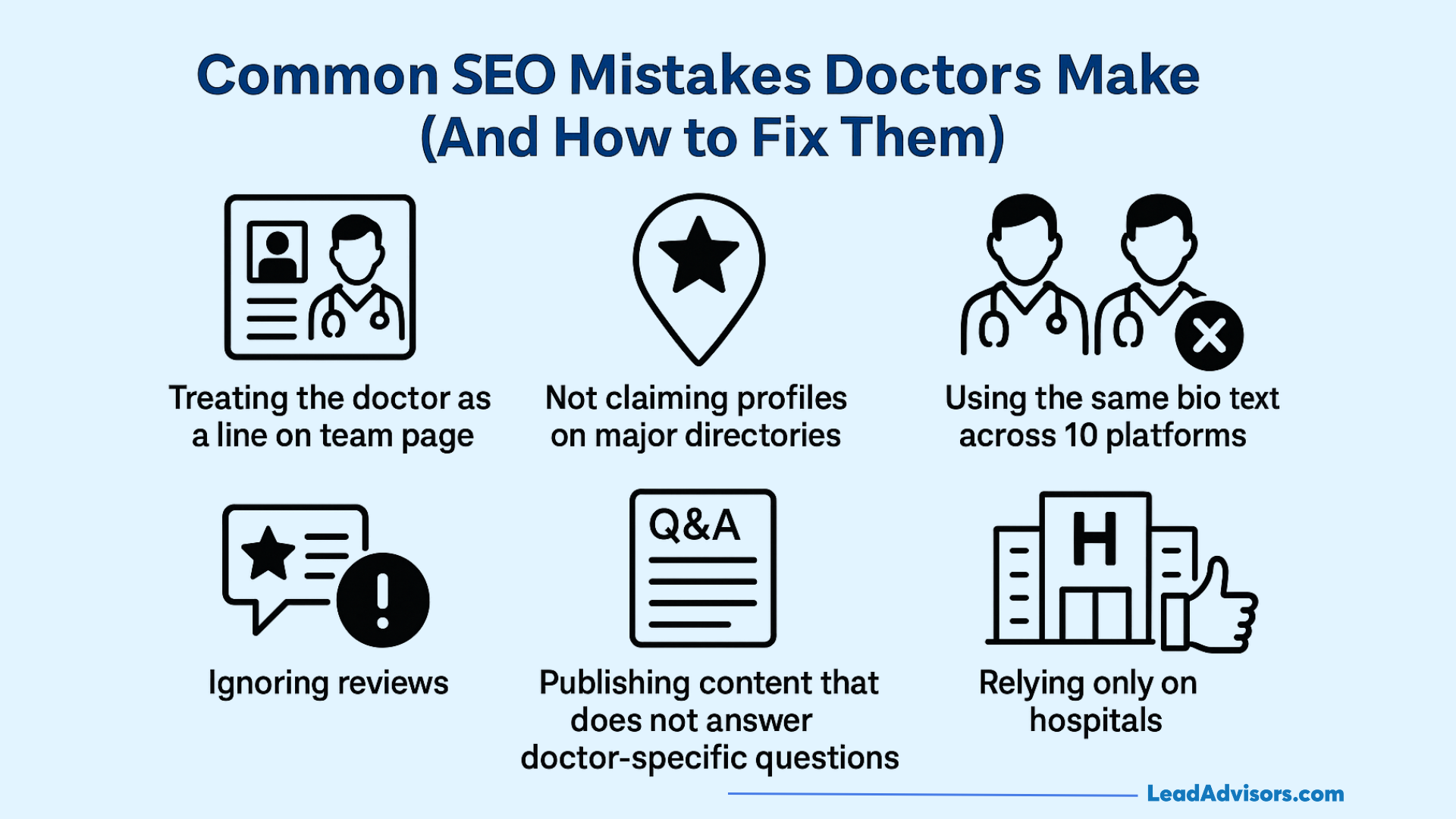
Even a well-funded medical SEO marketing campaign can fail if these foundational errors aren’t addressed. As a healthcare SEO expert, I frequently see these six pitfalls draining a practice’s ROI.
1. Treating the Doctor as a “Line” on a Team Page
Many practices list all physicians on a single “Our Doctors” page. This prevents Google from indexing individual “Doctor Entities.”
- The Fix: Give each physician a dedicated provider page. Use unique content, physician schema, and direct links to the specific locations where they see patients.
2. Neglecting Major Directories and Listings
Leaving your reputation to chance on third-party sites is a mistake.
- The Fix: Claim and update your profiles on Healthgrades, Zocdoc, and Doximity. Ensure your NAP consistency (Name, Address, Phone) matches your website exactly to boost local SEO for doctors.
3. Using “Copy-Paste” Bios Across Platforms
In fact, Google devalues duplicate content. Consequently, if your bio is the same on your website, LinkedIn, and the hospital portal, you aren’t providing any “Information Gain.” Instead, you are simply signaling to the algorithm that your pages are redundant.
- The Fix: Keep the clinical facts consistent while varying the narrative. For instance, you should use your private website bio to demonstrate deep expertise, whereas your directory bios should focus on high-level patient summaries. By doing so, you satisfy the algorithm’s need for unique value while maintaining a professional and cohesive brand.
4. Ignoring Reviews or Responding Unsafely
Unanswered reviews signal neglect of patients and search engines. However, responding incorrectly can lead to HIPAA violations.
- The Fix: Establish a monthly review workflow. Never confirm a person was a patient; instead, speak generally about your care philosophy and invite them to speak privately offline.
5. Publishing Generic “Blog” Content
Many practices publish articles that don’t answer real patient questions, such as “How to stay healthy in winter.”
- The Fix: Pivot to advanced SEO for doctors by answering “exam room” questions. Add FAQs about first-visit expectations, recovery timelines, and specific clinical workflows.
6. Relying Solely on Word-of-Mouth or Hospital Portals
Crucially, hospitals often own the data on their portals. Consequently, if you leave that hospital, you lose your digital footprint entirely.
The Fix: Treat your independent website as your “Home Base.” In other words, it should be the central hub that connects your reviews, authority links, and scheduling tools. By doing so, you maintain complete ownership of your professional reputation regardless of your current affiliation.
90-Day SEO Action Plan for Doctors

If you are looking to outpace the competition, you need more than just a list of medical keywords. This 90-day roadmap is designed to move your practice from “invisible” to an authoritative “Entity” in search results.
Month 1: Build the Foundation
Focus: Identity, Listings, and Structure. The first 30 days are about cleaning up your digital footprint to ensure a medical SEO company or AI bot can verify your credentials.
- Audit Doctor Profiles: Clean up individual listings on Healthgrades, Vitals, and Doximity.
- Fix NAP Inconsistencies: Ensure your Name, Address, and Phone details are identical across all platforms to boost local SEO for doctors.
- Upgrade Provider Pages: Move beyond simple bios. Add unique content, NPI numbers, and board certifications to each physician’s page.
- Optimize Site Architecture: Improve internal links between providers, physical locations, and clinical specialties.
- Claim Google Business Profiles: Ensure every practitioner and location listing follows current Google guidelines for medical search engine optimization.
Month 2: Content and Reviews
Focus: Pages that Match High-Intent Searches. With the foundation set, start building the “Experience” and “Trust” signals patients look for before booking.
- Publish Condition & Procedure Pages: Target most searched health keywords with in-depth guides (e.g., “Knee Replacement Recovery Timeline”).
- Build the FAQ Engine: Draft FAQ sections based on real patient questions from your front desk or portal messages.
- Launch Review Workflows: Start a systematic, HIPAA-safe request process to reinforce doctor-level proof.
- Strategic Social Proof: Place review excerpts and patient testimonials (where compliant) directly next to your booking CTAs.
Month 3: Authority and AI Visibility
Focus: Credibility Signals and Answer Engine Optimization (AEO). In the final month, focus on the “Advanced” signals that help you get cited in AI summaries.
- Earn High-Authority Mentions: Pursue 1 to 3 media quotes, podcast appearances, or association links to build medical SEO equity.
- Refine Schema Markup: Add or audit your Physician and MedicalSpecialty schema to make your data “machine-readable.”
- Optimize for AI Answers: Rewrite key sections using the “short answer first, detail below” method to win Featured Snippets.
- Close the Conversion Loop: Finalize internal linking between symptom pages, provider bios, and the final booking page.
Key Takeaway: This structured approach ensures you aren’t just “doing SEO”—you are building a sustainable healthcare search engine optimization asset that grows with your practice.