Modern SEO requires a change in focus from targeting one specific keyword to gaining topical authority. By 2026, search engines will not just be matching words; they will be looking at entities and context. AI-powered answer engines and intricate voice queries give preference to websites that show comprehensive knowledge of the wider topic through a sophisticated content marketing strategy.
Most of the brands stumble by releasing numerous blog posts with no site structure coherence. Such a disorganized approach to content creation confuses not only users but also Google search bots.
The following article explains the concept of the topic cluster strategy. Besides, you will be able to design the main pages that will be the anchor of your keyword strategy and bring you organic traffic.

Pillar Content vs Cluster Content: The Core Difference
Grasping the difference between pillar content and cluster content is crucial for any content marketing plan. A pillar page serves as the main source of information for a wide topic. On the other hand, cluster pages are pinpointed pieces that focus on specific questions and go into a lot of detail.
The two of them together make up a topic cluster that indicates authority on the subject to search engines.
Pillar Content (The Authority Hub)
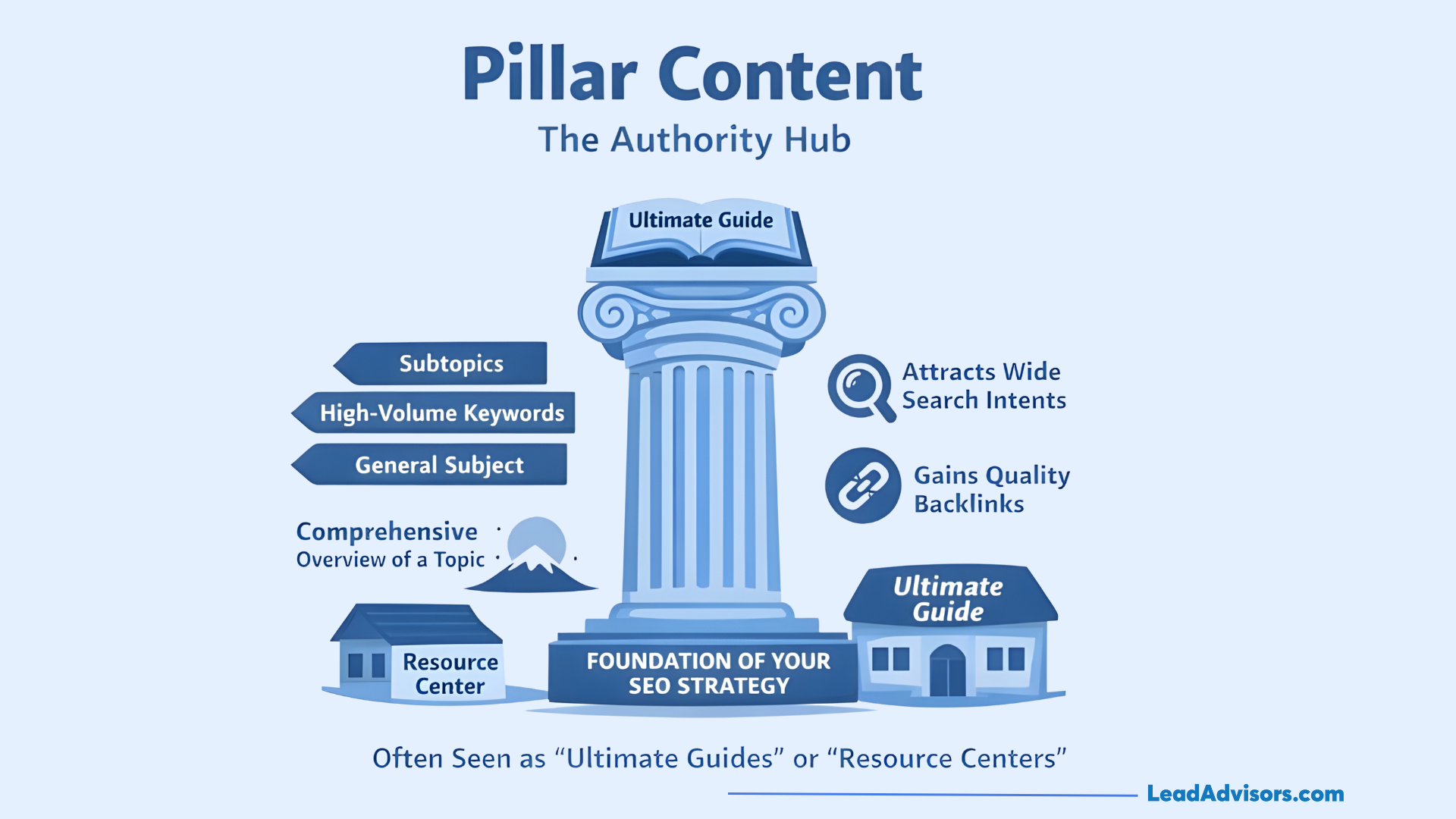
Pillar content helps establish a website as the ultimate authority on a particular topic by consolidating and thoroughly explaining the top-level theme. These fundamentals of your content marketing strategy, which briefly touch upon all key subtopics, intentionally target high-volume head terms and cater to various search intents. The majority of such pages are designed as “Ultimate Guides” or “Resource Centers, ” and their main purpose is to build topical authority and gain a large number of external backlinks.
The figures back up this setup; trustworthy sources such as Moz mention that pillar pages bring four times more visitors than ordinary blog posts because of enhanced crawlability and the broad intent targeting.
In addition, Backlinko’s study covering 912 million posts reveals that long, form pillar content with over 3,000 words receives 77. 2% more backlinks. Through linking to the in-depth subtopics within a cluster model, Semrush shows that websites can attain 15% higher domain authority, thus transforming one webpage into a very effective tool for organic growth.
Cluster Content (The Supporting Specialists)
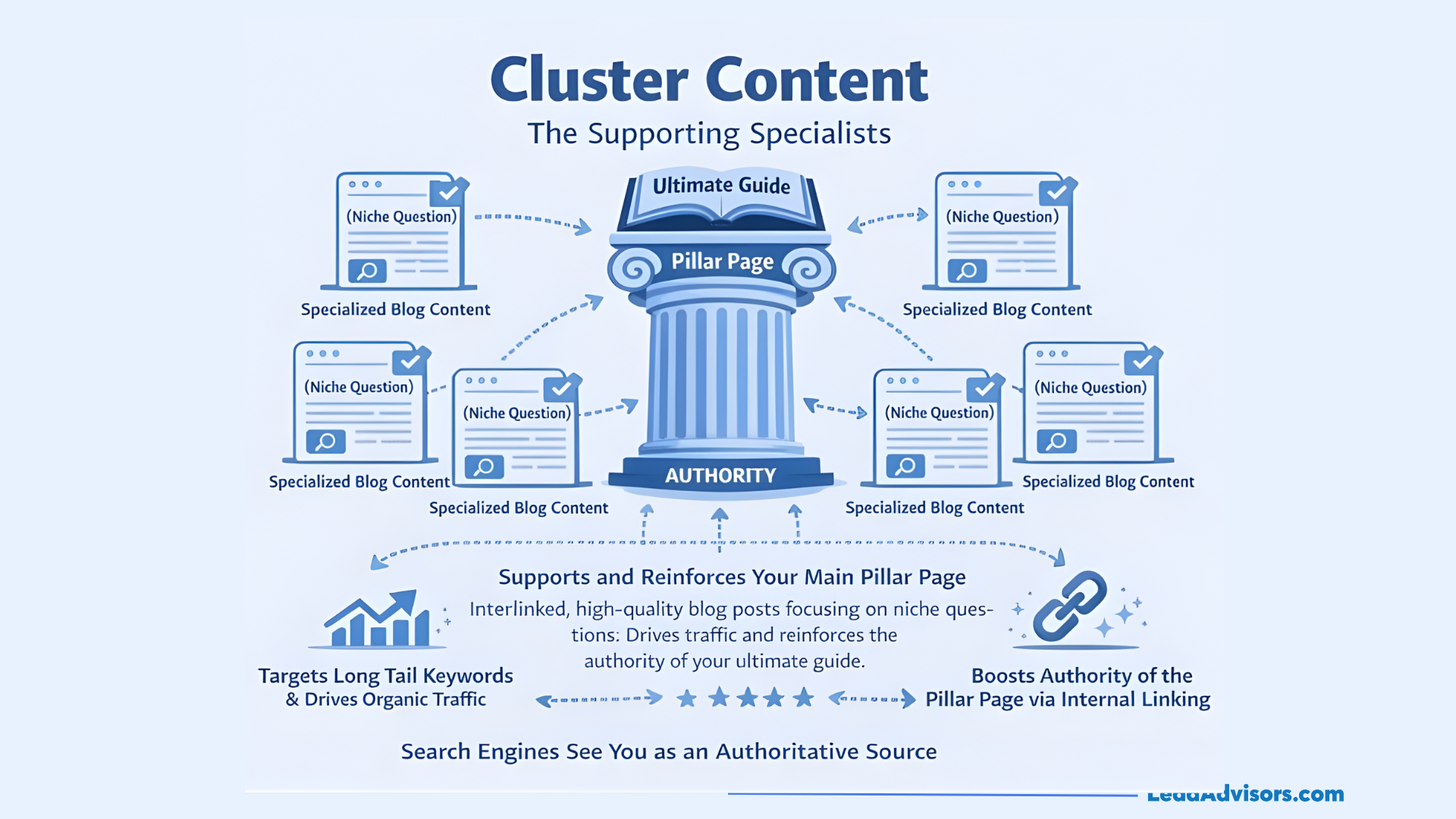
Cluster content consists of specialized blog posts targeting long-tail keywords and niche queries that delve deeper into subtopics than a single pillar post can address.
By focusing on specific keyword intent, these high-quality pages rank independently within search engine results while reinforcing the overall content marketing strategy. Establishing these clusters allows you to be recognized by search engines as an authoritative source, matching specific search intents to drive targeted organic traffic.
The effectiveness of this model is rooted in a strategic internal linking structure. Each piece of cluster content links back to the pillar page, distributing authority across the site and signaling expertise to search engines.
Data supports this approach: Semrush notes that topic clusters build E-E-A-T for better rankings, while a Minuttia case study showed a single cluster ranking for over 1,100 keywords and generating 100 daily organic clicks without external backlinks. Ultimately, well-structured pillar and cluster pages are an essential way to dominate search engine results pages and maximize your site’s topical authority.
Pillar Content vs Cluster Content: Side-by-Side Comparison
In 2026, the search engine results pages are more competitive than ever. Relying on a single blog article won’t cut it. You need a structured site structure to win. This table breaks down the critical differences to help you bridge the gap between “just writing” and building topical authority.
| Dimension | Pillar Content | Cluster Content |
| Primary Goal | Authority & breadth | Depth & specificity |
| Search Intent | Broad, informational | Narrow, intent-specific |
| Keyword Type | Head/entity terms | Long-tail, conversational |
| Typical Length | 2,500–8,000+ words | 800–2,000 words |
| Update Frequency | Quarterly/strategic | As needed |
| Linking Role | Links out to clusters | Links back to the pillar |
| Conversion Role | Assisted / mid-funnel | Direct / action-oriented |
| SEO KPI Focus | Category-wide rankings | Page-level performance |
Identifying Your Content Gaps
Successful content marketing requires a balance of both types. If you only have pillar pages, you miss out on high-intent long tail keywords. If you only have blog posts, you lack a central hub for search engines to anchor your authority.
Pillar pages draw in broad traffic by covering a broader topic. Meanwhile, cluster pages satisfy more detailed queries. This synergy is the heart of the topic cluster model.
Use Google Analytics to see which pages keep users on your site longer. High dwell time on a single pillar page, combined with high click-through rates to cluster content signals a winning SEO strategy.
Why Pillar and Cluster Content Work Best Together
A successful content strategy organizes website content into a logical system. Pillar and cluster pages create a robust internal linking structure that tells search engines your site owns a particular topic.
When you create a pillar page, you build a central hub. You then add internal links to cluster pages covering detailed queries. This internal linking strategy passes authority throughout your site structure, boosting seo rankings for every website page.
Effective pillar pages organize information for bots and humans. This improves crawl efficiency and user experience. Visitors find all relevant content in one place, which improves Google Analytics metrics like bounce rate. Search engine results reward these organized hubs. By creating pillar pages, you transform a standard blog post into a high-authority topic cluster model.
Choosing the Right Pillar Archetype (Based on Search Intent)
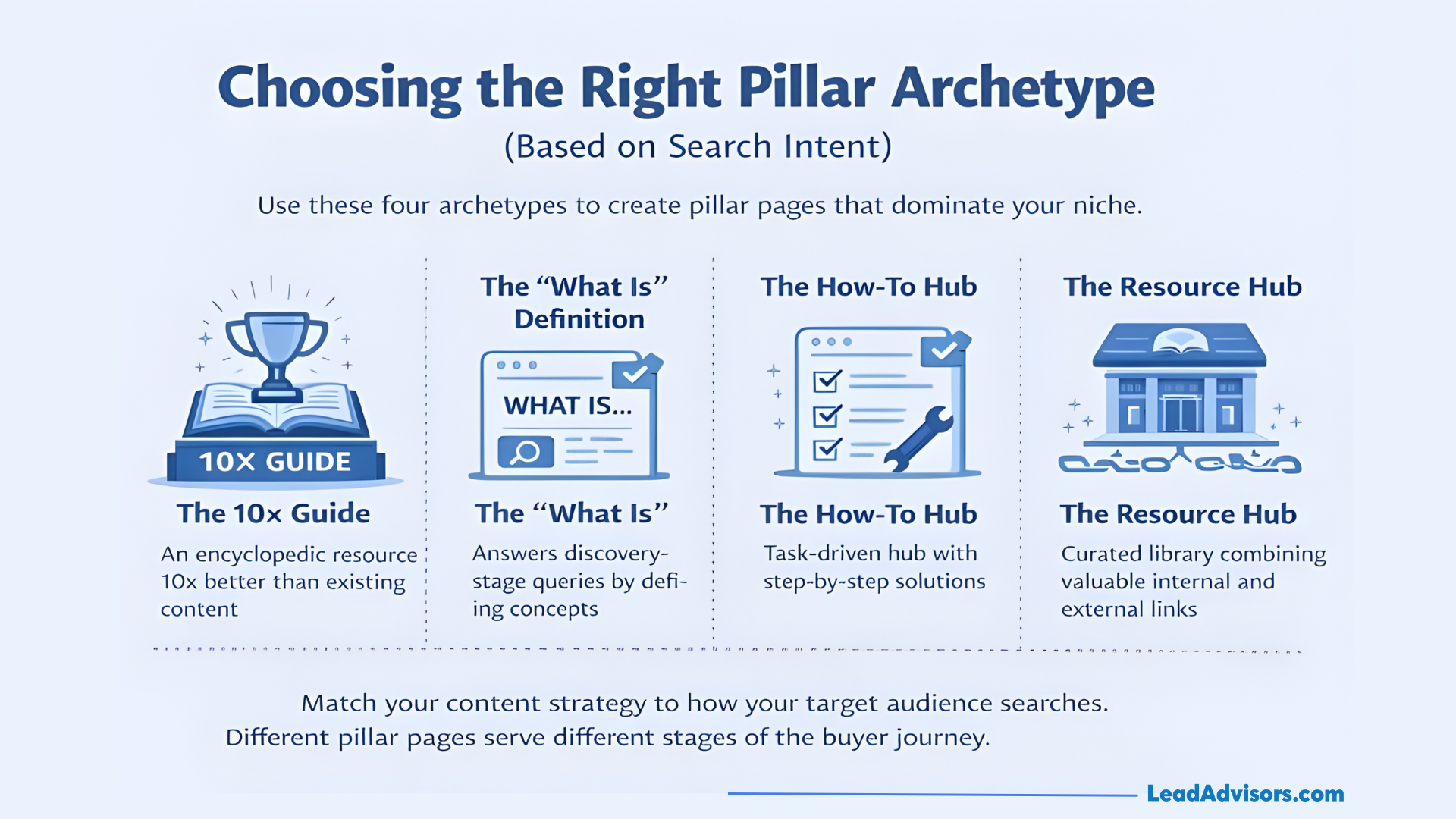
Selecting the right structure for your pillar page content determines your success in search engine results. You must match your content strategy to how your target audience searches. Different pillar pages serve different stages of the buyer journey. Use these four archetypes to create pillar pages that dominate your niche.
1. The 10× Guide
The 10x Guide acts as an encyclopedic resource. It provides high-quality content that is ten times better than anything else on the search engine results pages. This archetype targets a broad topic and aims for absolute topical authority. It anchors your seo pillars by providing in-depth content that naturally attracts external links and link-building opportunities.
2. The “What Is” Definition
This format focuses on discovery-stage queries. This web page targets users looking for a clear pillar page meaning. It is perfect for keyword research terms that define a particular topic. By creating pillar pages that simplify complex ideas, you capture top-of-funnel organic traffic from users just starting their journey.
3. The How-To Hub
The How-To Hub offers task-driven, step-by-step solutions. This pillar’s content focuses on execution. It links to multiple blog posts that explain specific sub-tasks in detail. Our blog on How to Promote Your Website is one of the examples for this kind of archetype. This topic cluster strategy helps search engines recognize your site as a helpful, practical resource for solving problems.
4. The Resource Hub
The Resource Hub serves as a curated library. It combines your internal links with valuable external links to provide a one-stop shop. This site structure makes it easy for users to navigate relevant topics. A well-organized resource hub ensures your pillar pages draw repeat visitors and improve your Google Analytics engagement metrics.
Pillar Content vs Cluster Content in Practice
Implementing the topic cluster model requires a clear site hierarchy. Consider a broad topic like “Digital Marketing.” Your pillar page serves as the ultimate guide, providing an in-depth overview. From there, you branch out into multiple blog posts that focus on detailed queries like “Email Marketing Automation.
The strength of your seo strategy lies in the internal linking structure. Your single pillar page should add internal links to every relevant cluster page. In return, each blog article must link back to the pillar content. This internal linking strategy signals topical authority to search engines.
To avoid cannibalization, assign a specific keyword to each page. While pillar pages organize head terms, cluster pages target long tail keywords. This ensures your website content dominates search engine results without competing against itself.
Pillar First or Cluster Content First? (Real-World Decision Guide)
Deciding where to start your content creation depends on your current topical authority and site history. Strategic planning ensures your internal linking structure maximizes your seo rankings from day one.
Build the Pillar First When:
Launching a new site or tackling a fresh particular topic requires a pillar-first approach. This establishes your SEO strategy by providing a comprehensive foundation for search engines to index.
Building the single pillar page early helps you define your target keywords and secure head-term visibility faster. This is ideal if you have high domain authority and want to claim a broader topic quickly.
Build Cluster Content First When:
You should build cluster content first when retrofitting a large, established site. If you already have multiple blog posts on a topic, your rankings might be fragmented or suffering from cannibalization.
Focus on creating high-quality content for detailed queries to capture immediate organic traffic. Once these cluster pages perform, you can synthesize them into an amazing pillar page that unifies the group.
Recommended Sequencing Framework
The most effective content marketing strategy involves a structured five-step process.
- First, perform a deep audit of your Google Analytics and Google Search Console data.
- Second, map out your topic clusters using thorough keyword research.
- Third, develop your cluster content to satisfy specific user intent.
- Fourth, create a pillar page that summarizes the broader topic.
- Finally, execute an internal linking cleanup to connect everything.
How to Decide What Belongs in the Pillar vs a Cluster Page
Execution fails when the line between a pillar post and cluster content blurs. You must differentiate between a broader topic and more detailed queries to maintain a clean site structure. Use these checklists to audit your content ideas and ensure your topic cluster strategy remains effective.
Pillar Content Qualification Checklist
Your pillar page serves as the ultimate anchor for your SEO strategy. It must be expansive enough to lead into other pages without exhausting every detail.
- Breadth: Can this particular topic support 8–20 distinct subtopics?
- Intent: Does it target a broad, evergreen primary keyword with high search volume?
- User Expectation: Would a member of your target audience expect a single, in-depth, authoritative resource to cover this?
- Connectivity: Can you naturally add internal links to at least five specialized blog posts from this page?
Cluster Content Qualification Checklist
Cluster pages thrive on specificity. They solve the unique problems that a single pillar page cannot address in full.
- Focus: Does the content answer one clear, specific question or solve one distinct problem?
- Independence: Can this blog article rank independently on search engine results pages for long tail keywords?
- Depth: Does it deepen the reader’s understanding rather than repeating the pillar content?
- Linking: Does it make sense to include an internal link back to the main pillar page to provide more context?
Applying these rules prevents keyword cannibalization. It ensures search engines recognize your topical authority while providing the best experience for your users.
Strategy & Implementation: A 2026-Ready Workflow
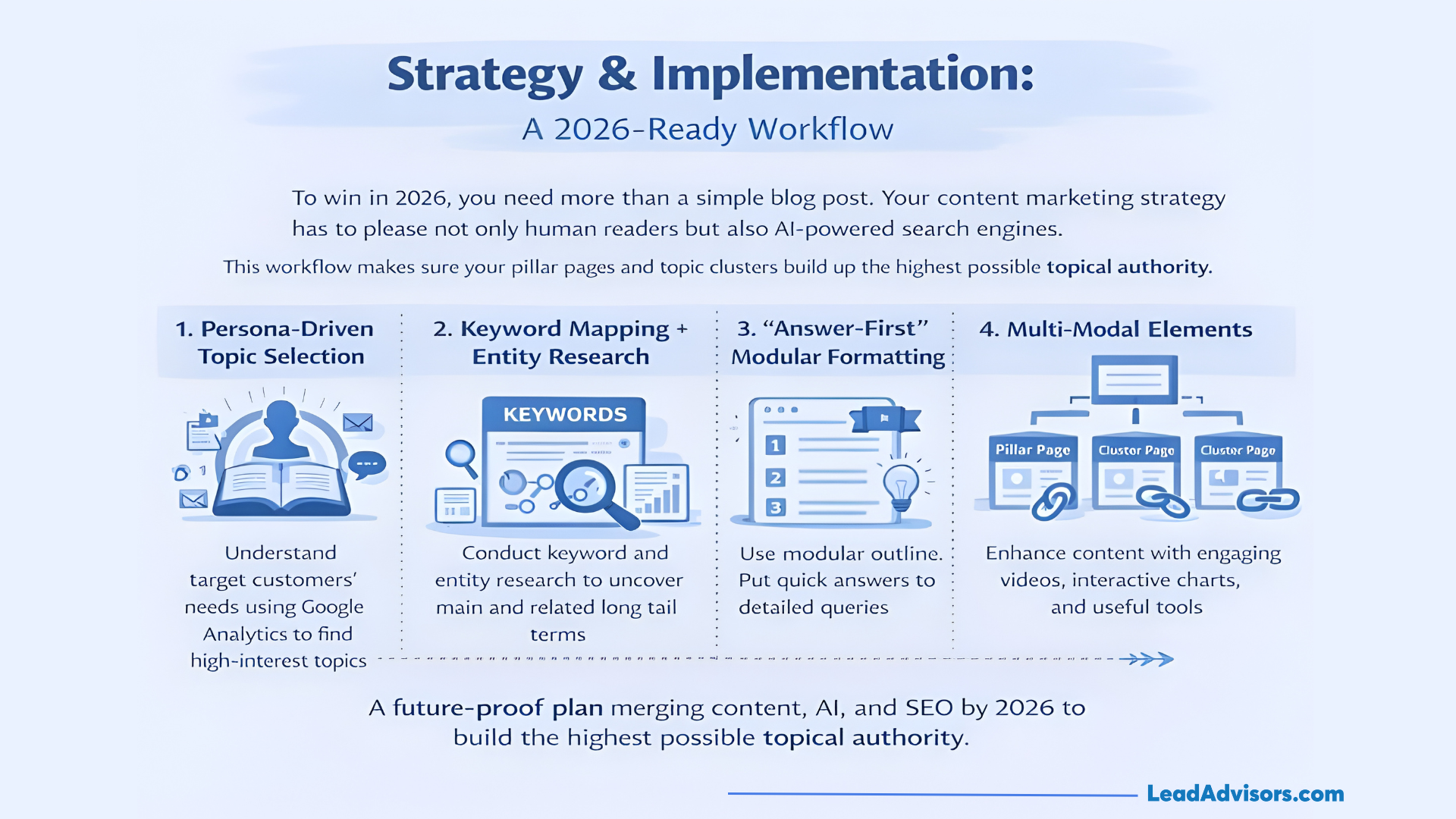
To win in 2026, you need more than a simple blog post. Your content marketing strategy has to please not only human readers but also AI-powered search engines. This workflow makes sure your pillar pages and topic clusters build up the highest possible topical authority.
1. Persona-Driven Topic Selection
First, figure out what problems your target customers are experiencing. Check out Google Analytics to discover the topics that have already created interest. The content of your pillar should cater to the major problem or ambition in your area of expertise.
2. Keyword Mapping + Entity Research
Conduct thorough keyword research to discover your main keyword, along with the related long tail keywords. Besides terms, also consider entities that search engines link with your broader topic. Such a keyword strategy will make your pillar page content semantically rich.
3. “Answer-First” Modular Formatting
Modern search engine results prioritize quick answers. Use a modular pillar page outline. Place direct answers to detailed queries at the top of sections to win featured snippets. This “AI-friendly” structure helps search engines recognize your expertise instantly.
4. Multi-Modal Elements
Don’t rely solely on text. Integrate video, interactive charts, and tools into your website content. High-quality media increases dwell time and encourages link building. Amazing pillar pages are often those that provide the most utility through diverse media.
5. Internal Linking Rules That Scale
Establish a strict internal linking strategy. Every cluster post must link back to its pillar page. The pillar page must point to all cluster pages. This internal linking structure creates a scalable topic cluster model that improves seo rankings site-wide.
Technical SEO & Site Architecture Considerations
Building pillar and cluster pages requires a solid technical foundation. Your site structure determines how efficiently search engines crawl your high-quality content. A topic cluster strategy offers more flexibility than a traditional SEO silo.
Use the topic cluster model to dominate a broader topic through interconnected relevant content. This approach helps search engines recognize the semantic relationship between different pieces of website content.
Maintain a shallow site structure to maximize organic traffic. Every cluster post should be accessible within three clicks from the homepage. Pillar pages organize these links to reduce crawl depth. When search engine bots find your content creation easily, they index it faster.
An effective internal linking strategy acts as a distribution network. Authority from external links flows through your internal links to every blog article. By creating pillar pages, you boost the seo rankings of your entire website page portfolio.
Read More: Mastering Technical SEO: Boost Your Website’s Performance
Common Mistakes That Kill Pillar-Cluster Performance
Even a well-intentioned content strategy fails if execution is sloppy. Avoid these pitfalls to protect your search engine rankings and ensure your topic cluster model remains effective.
- Overstuffed Pillar Pages: Your pillar content should provide a broad overview, not a massive wall of text. If a web page is too dense, your target audience will bounce, hurting your Google Analytics metrics.
- Thin or Redundant Clusters: If multiple blog posts cover the same specific keyword, you risk cannibalization. Each blog article must provide unique value for detailed queries.
- Weak Anchor Text Strategy: Avoid generic “click here” links. Use relevant keywords in your anchor text to help search engines recognize the topic of the linked page.
- No Hierarchy or Governance: Creating too many clusters without a plan dilutes your topical authority. Without a plan to update your pillar page content, your information becomes stale and loses its seo rankings.
Measuring Success: Pillar vs Cluster KPIs
To validate your content strategy, you must track distinct metrics for different parts of your topic cluster model. Because pillar pages and cluster pages serve different roles in the user journey, their performance indicators vary significantly.
Pillar Metrics
Your pillar content serves as the foundation for your topical authority. Success is measured by how well it anchors your broad topic.
- Head-term rankings: Track how your single pillar page performs for high-volume, competitive keywords.
- Category-wide visibility lift: Measure if the presence of the pillar page improves the overall seo rankings of its connected website page portfolio.
- Assisted conversions: These pages often introduce the target audience to your brand; track their role in the early stages of the conversion path.
Cluster Metrics
Cluster content focuses on detailed queries and capturing intent-rich organic traffic.
- Long-tail traffic growth: Monitor how many unique visitors land on your specific blog posts through niche search terms.
- Engagement depth: Use Google Analytics to see if users are clicking through to the pillar page or other relevant topics.
- Direct conversions: Since cluster pages solve specific problems, they often drive immediate actions like sign-ups or downloads.
Pillar Content vs Cluster Content vs Silos (Quick Clarification)
Understanding the structural differences between these models is vital for a clean site structure. While they all organize website content, they serve different strategic goals depending on your target audience.
- Silos: These are rigid, top-down structures where content is isolated into strict categories. A “Silo A” page never links to a “Silo B” page.
- Topic Clusters: This is a more flexible, interconnected model. While cluster content primarily links to a single pillar page, lateral linking between related blog posts is encouraged to build topical authority.
When Silos Make Sense. Silos are highly effective for ecommerce sites with non-overlapping product categories (e.g., “Power Tools” vs. “Garden Seeds”). If your audiences for two sections of your site do not share interests, strict silos prevent confusing the search engine regarding your primary purpose.
Why Clusters Dominate Informational SEO. For content marketing, clusters are superior because they mirror how people learn. Search engines recognize that information is rarely linear. By creating pillar pages that link to various detailed queries, you satisfy “semantic search.” This allows your high-quality content to capture a wider range of long tail keywords while the pillar post gains strength from the collective “link juice” of the entire cluster.