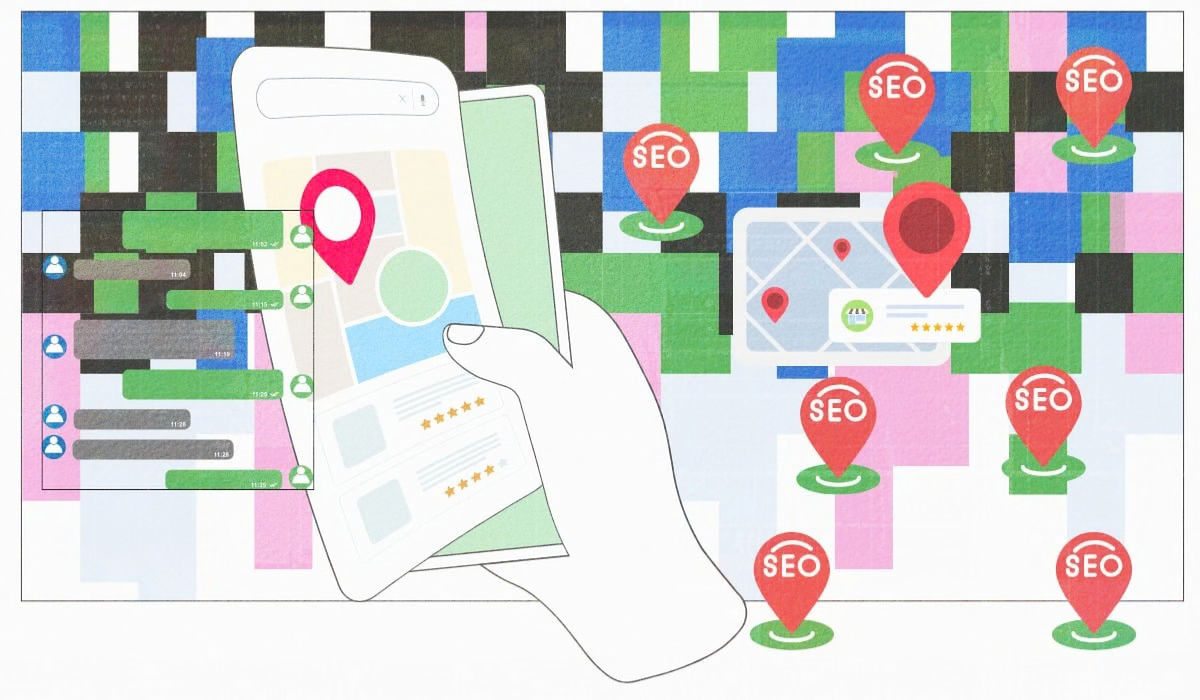
In 2026, proximity outranks prestige. Being the world’s best matters less than being the best within five miles. Local search transforms your physical shop into a digital landmark. It isn’t a marketing extra; it is core infrastructure for your store. High-stakes intent drives this shift. Most local mobile searches trigger a visit or call within 24 hours.
Modern search engine optimization has evolved. Search is no longer a static directory; it is a proactive recommendation engine that suggests the best nearby spots. Building a dominant presence ensures nearby customers find you first. Local relevance is now the ultimate key to success.


TL;DR: The 2026 Local SEO Essentials
In 2026, local search has evolved into a recommendation engine where proximity and “Entity” authority rule. To stay ahead of other local businesses, you must move beyond basic web pages and embrace AI-driven local search visibility.
- Google Business Profile (GBP): This remains your most critical free tool. Active Google Business Profile optimization, including real-time posts and social integration, is a major ranking factor.
- AI Overviews & Zero-Click Search: Google’s Gemini now prioritizes verified “Entities.” Ensure your business details are structured with local schema markup so AI can recommend you without a user needing to click your link.
- The NAP Standard: Your name, address, and phone must be 100% consistent across local business directories. Any mismatch in local listings confuses search engines and tanks your local rankings.
- Intent-Based Keywords: Focus on “Hire Now” local keywords and hyper-local geo-modifiers (neighborhoods/landmarks). This captures potential customers with high purchase intent in your local area.
- Reputation & Trust: High review velocity and positive customer feedback are essential. Respond to all online reviews to prove your expertise and maintain a strong business’s online presence.
The State of Local Search in 2026
The way people find you has changed forever. In early 2026, local search is no longer just a list of blue links. It is now a recommendation engine powered by artificial intelligence.
Recent studies from early 2026 show that AI Overviews now influence nearly 40% of local business queries. These Gemini-powered summaries prioritize “Entities”—real, verified businesses—over simple web pages. To win, you must prove your business is active and trusted.
Why Proximity and Speed Rule 2026
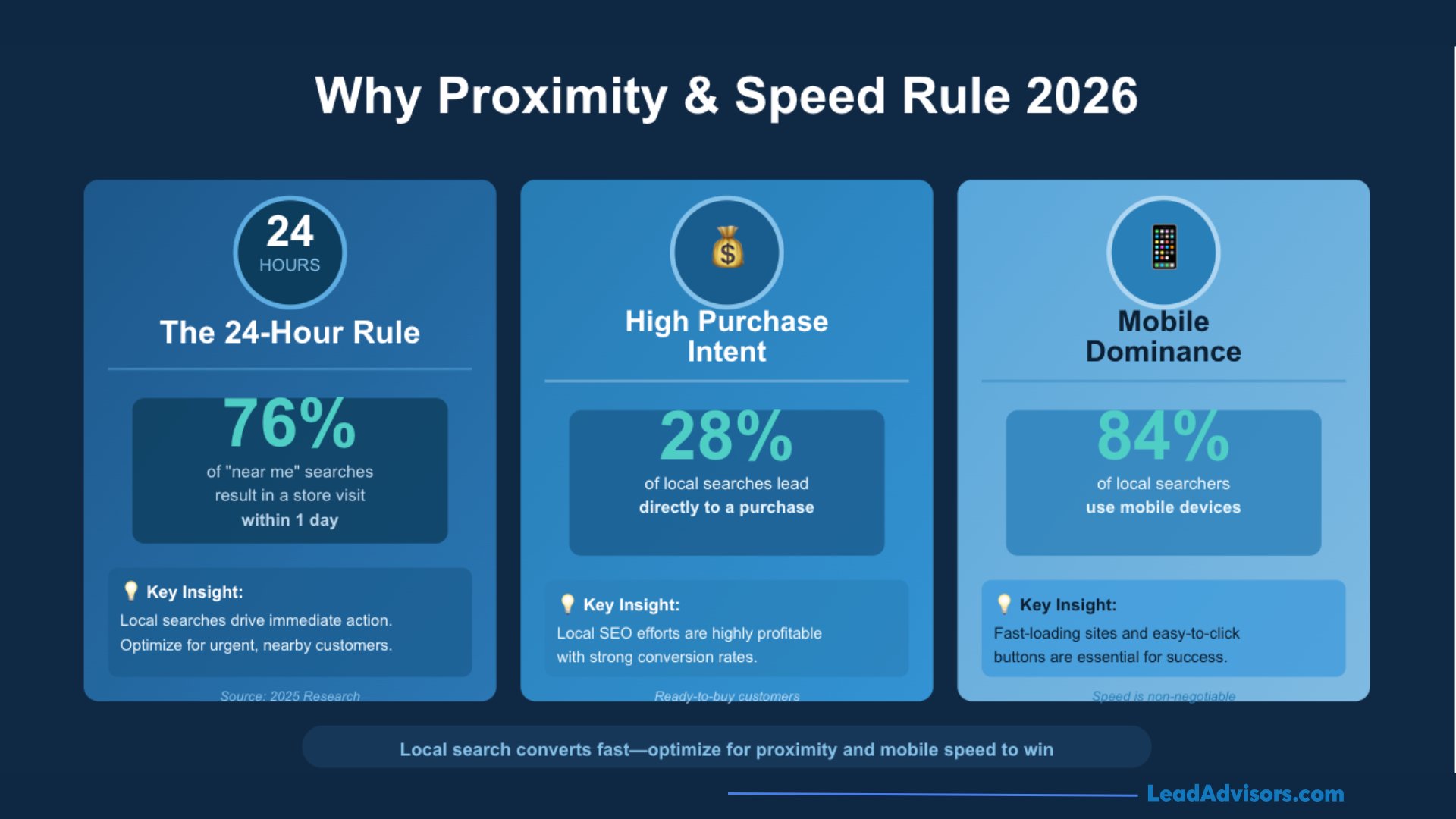
- The 24-Hour Rule: According to 2025 research, 76% of “near me” mobile searches result in a store visit within one day.
- High Purchase Intent: About 28% of all local search queries lead directly to a purchase, making local seo efforts highly profitable.
- Mobile Dominance: Over 84% of local searchers use mobile devices, demanding fast-loading sites and easy-to-click buttons.
Winning the Zero-Click Game
Strategy has shifted because 60% of users now find what they need without clicking a link. They see your business hours, online reviews, and address and phone number right on the search results. To dominate this “zero-click” world, focus on these areas:
- Google Business Profile Optimization: Keep your data fresh. A complete profile is 2.7 times more likely to be considered reputable.
- Sentiment Analysis: Search engines now analyze the tone of customer feedback. Positive sentiment in online reviews is a major ranking factor.
- Conversational AI: More than half of users use voice search for local services. Optimize for natural questions like “Who is the best-rated plumber near me?”
By focusing on local search visibility and local SEO performance, you can attract nearby customers before they even see a competitor. Whether you have multiple locations or one shop, an effective local SEO strategy ensures you stay at the top of the local organic results.
Foundational Pillars: The Technical “Must-Haves”
Technical setup is the backbone of your local SEO guide. In 2026, you cannot just list your business; you must integrate it into the search ecosystem. This requires a shift from static entries to dynamic, code-backed entities.
Google Business Profile (GBP) Mastery
Your profile is now an AI-powered hub. Success requires more than just filling out forms; you must optimize your Google Business for interactive features.
- Social Link Integration: Google now displays your social media profiles directly in your local search results. This builds trust and signals your company’s online presence to the target audience.
- Automated Booking: Modern profiles integrate with scheduling software. Potential customers can book local services without leaving the search engine results pages, significantly lowering marketing costs.
- AI Review Summaries: Search engines now use Gemini to create “Review Summaries.” These highlight common praise or complaints in your customer feedback. High-quality, detailed online reviews are a major ranking factor for these summaries.
- GBP Posts: Treat these like a local news feed. Frequent posts signal real-time relevance to nearby customers and help you appear in relevant local searches.
The NAP Ecosystem and Citation Tiers
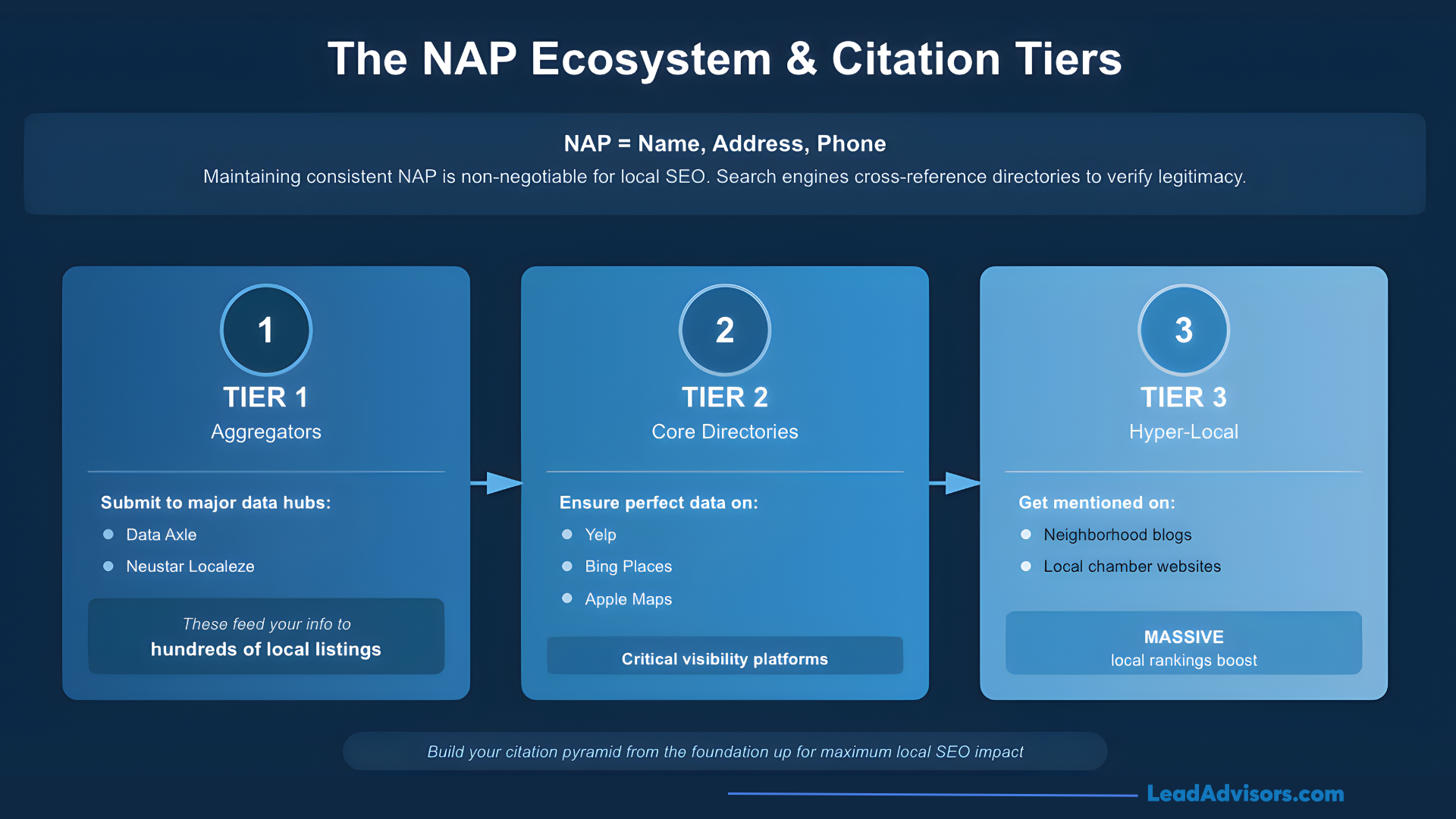
Maintaining a consistent name, address, and phone (NAP) is a non-negotiable local seo rule. Search engines cross-reference local business directories to verify your legitimacy.
- Tier 1 (Aggregators): Submit to major data hubs like Data Axle and Neustar Localeze. These feed your info to hundreds of local listings.
- Tier 2 (Core Directories): Ensure your data is perfect on Yelp, Bing Places, and Apple Maps.
- Tier 3 (Hyper-Local): Get mentioned on local area neighborhood blogs or the local chamber website. These local links provide massive local rankings boosts.
Local Schema Markup (JSON-LD)
To speak directly to the local search engine, you must use local schema markup. This JSON-LD code tells robots exactly who you are. It defines your business details, service area boundaries, and business hours.
Unlike standard web pages, a schema explicitly connects your site to your Google Maps location. Use Google Search Console to verify your markup is error-free, ensuring your local seo efforts result in maximum local search visibility.
The Local Keyword & Intent Strategy
To dominate local search, you must understand exactly how local searchers think. A winning local SEO strategy starts by moving past broad terms. You need to identify “Content Gaps“—the unmet needs where other local businesses are failing to provide answers.
By analyzing local organic results, you can find valuable local keywords your competitors have ignored.
Geo-Modifiers and Hyper-Local Targeting
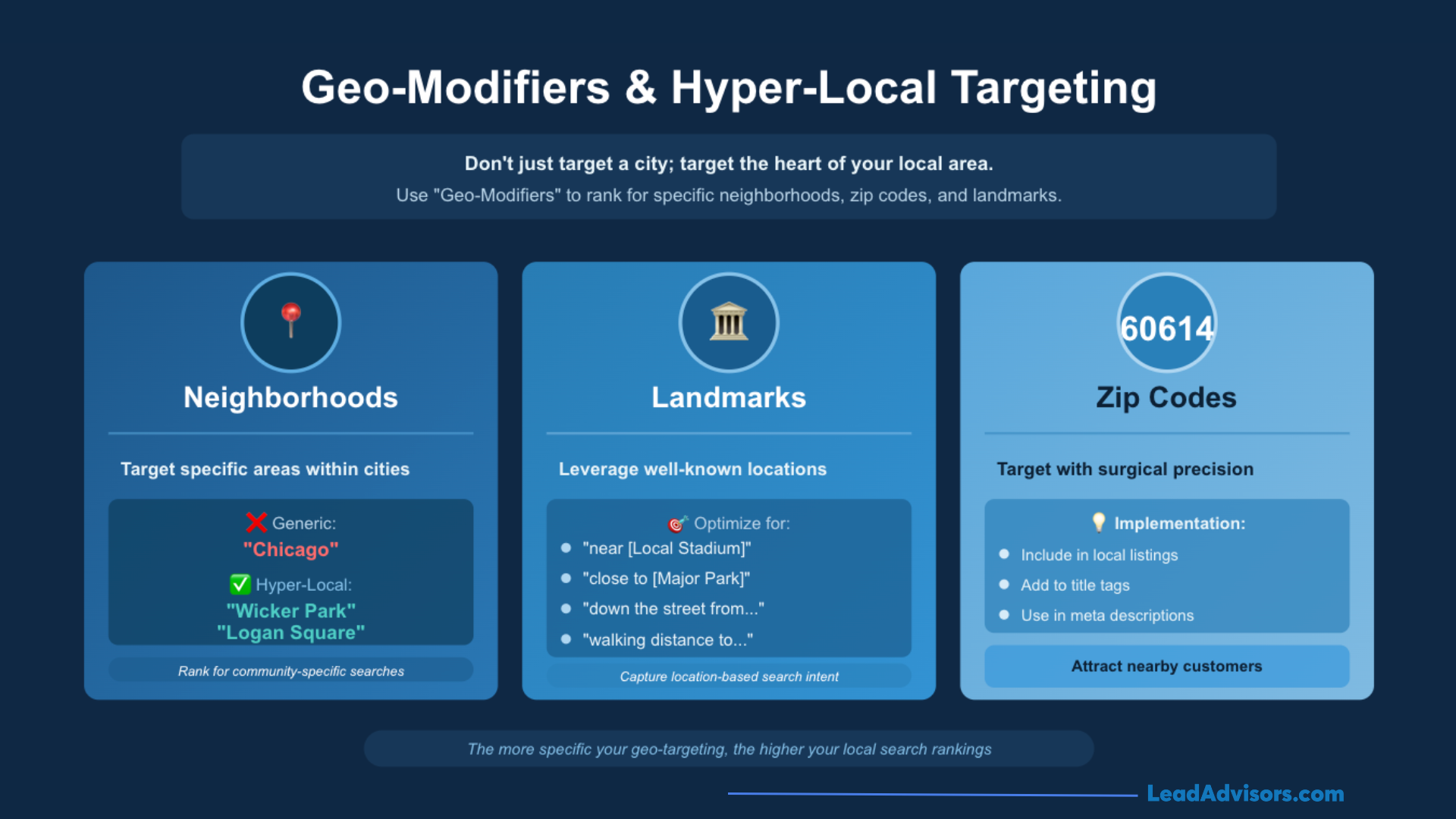
Don’t just target a city; target the heart of your local area. Use “Geo-Modifiers” to rank for specific neighborhoods, zip codes, and landmarks.
- Neighborhoods: Instead of just “Chicago,” target “Wicker Park” or “Logan Square.”
- Landmarks: Optimize for “near [Local Stadium]” or “down the street from [Major Park].”
- Zip Codes: Include specific zip codes in your local listings and title tags to attract nearby customers searching with surgical precision.
Mapping the Intent Spectrum
In 2026, search engine optimization requires matching your content to the user’s specific stage of the journey. Research shows that local intent usually falls into three buckets:
| Intent Type | Search Volume | Example Keywords | Strategy |
| Hire Now | 78% | “emergency HVAC repair near me” | Use landing pages with a clear address and phone number. |
| Research | 13% | “best local seo services in Seattle” | Use online reviews and comparison guides. |
| Tool/DIY | 9% | “how to fix a leaky pipe” | Provide value to build trust in the “Searcher-to-Buyer” pipeline. |
Targeting relevant keywords with high “Hire Now” intent ensures your local SEO efforts lead to immediate sales.
Meanwhile, providing helpful content for “Research” queries builds your company’s online presence as a local authority. Whether you use local SEO tools or hire local SEO services, mapping intent is a major ranking factor for capturing more customers in your local search engine.
Industry-Specific Playbooks (The “High-Ticket” Guide)
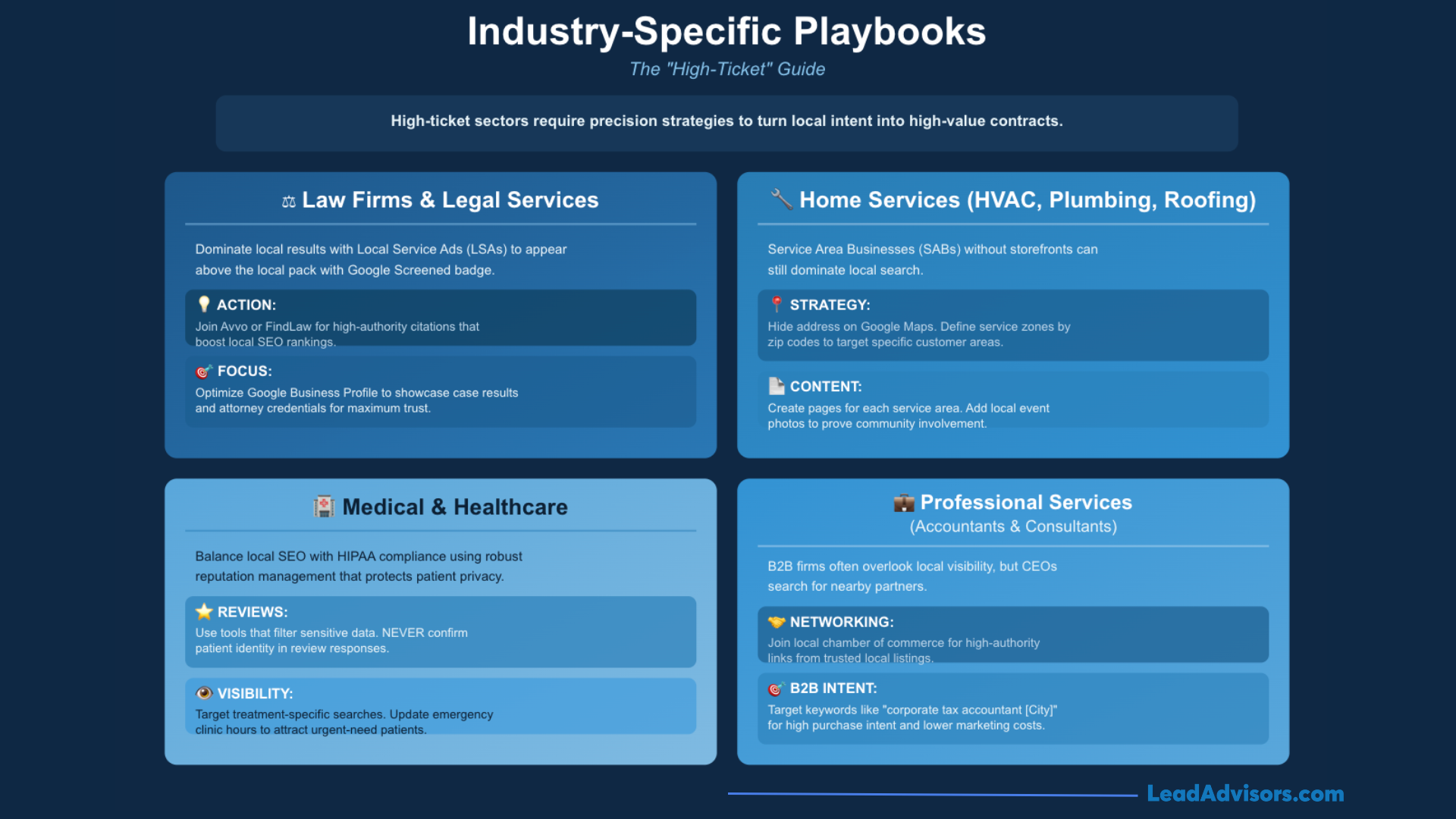
Every industry faces unique hurdles in local search. A general local SEO guide provides the basics, but high-ticket sectors require precision. In 2026, local SEO helps specialized businesses turn local intent into high-value contracts.
Law Firms & Legal Services
Lawyers must dominate local organic results to stay competitive. Local service ads (LSAs) remain the fastest way to appear above the local pack. These ads require a “Google Screened” badge, which builds instant trust with potential customers.
- Action: Join high-authority legal directories like Avvo or FindLaw. These local citations act as a major ranking factor for your local SEO rankings.
- Focus: Use Google Business Profile optimization to highlight specific case results and attorney credentials.
Home Services (HVAC, Plumbing, Roofing)
Many contractors operate as “Service Area Businesses” (SABs) without a physical storefront. You can still win at local search engine optimization.
- Strategy: Hide your address and phone number on Google Maps if you don’t have a shop. Instead, define your service zones by zip codes.
- Content: Create web pages for every local area you serve. Add photos of your team at local events to prove you are active nearby.
Medical & Healthcare
Healthcare providers must balance local SEO efforts with HIPAA compliance. You need robust reputation management that protects patient privacy.
- Reviews: Use local seo tools that filter customer feedback for sensitive data. Never confirm a patient’s identity in your response to online reviews.
- Visibility: Focus on relevant local searches for specific treatments. Update business hours for emergency clinics to attract nearby customers in urgent need.
Professional Services (Accountants & Consultants)
B2B firms often overlook local visibility, but local CEOs search for partners nearby.
- Networking: Joining the local chamber of commerce is a “power move.” It provides a high-authority link from a trusted local listings site.
- B2B Intent: Use valuable local keywords like “corporate tax accountant in [City].” This targets users with high purchase intent, lowering your overall marketing costs.
Geographic Deep Dives: UK vs. USA vs. Global
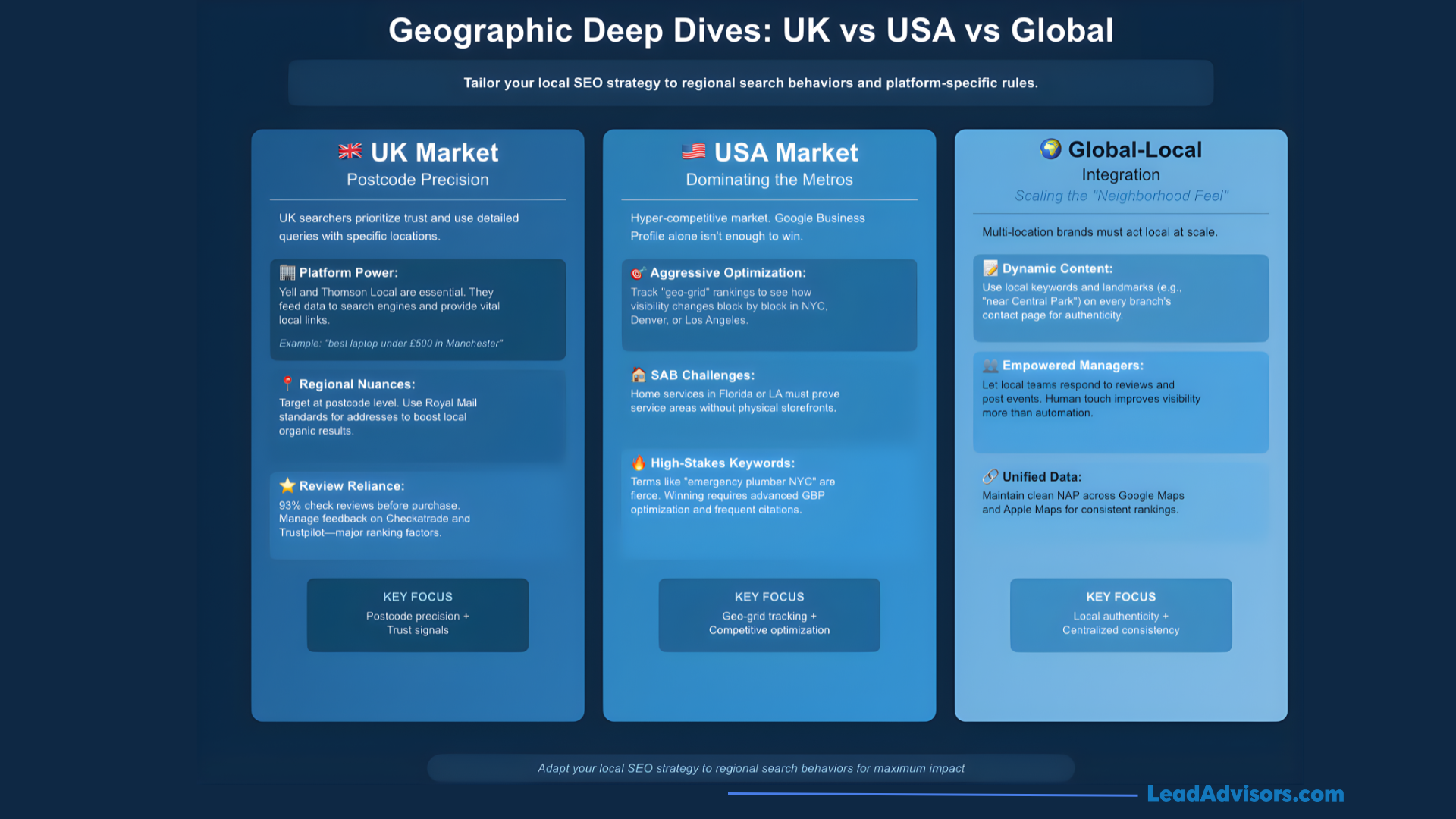
Navigating the local search landscape requires a tailored map for every region. In 2026, local SEO helps businesses overcome cultural search habits and platform-specific rules. Whether you are in a small town or a massive metro, your local SEO strategy must adapt to how nearby customers behave in that specific local area.
Local SEO Services UK: Postcode Precision
In the UK, local searchers prioritize trust and specific details. They often use longer-tail queries like “best laptop for students under £500 in Manchester.”
- Platform Power: High-authority local business directories like Yell and Thomson Local are non-negotiable. They feed data to search engines and provide vital local links.
- Regional Nuances: Success in London, Manchester, or Liverpool depends on postcode-level targeting. Ensure your address and phone number are listed precisely as per Royal Mail standards to boost local organic results.
- Review Reliance: 93% of UK consumers check online reviews before a purchase. Managing customer feedback on Checkatrade or Trustpilot is a major ranking factor.
The US Market: Dominating the Metros
The US local search engine environment is hyper-competitive. In cities like NYC, Denver, or Los Angeles, simply having a profile on Google Business isn’t enough.
- Aggressive Optimization: You must use local SEO tools to track your “geo-grid” rankings. This shows how your local visibility changes block by block.
- SAB Challenges: For Florida or LA home services, local search SEO services focus on proving service area boundaries without a physical storefront.
- High-Stakes keywords: Competition for “emergency plumber” in NYC is fierce. Winning requires advanced Google Business Profile optimization and frequent local citations.
Global-Local Integration: Scaling the “Neighborhood Feel”
Multi-location brands must act like local businesses at scale. Centralized teams often struggle to maintain a “hometown feeling.”
- Dynamic Content: Use local keywords and mention landmarks (e.g., “near Central Park”) on every branch’s contact page.
- Empowered Managers: Let local teams respond to negative reviews and post local events. This human touch improves local search visibility more than any automated tool.
- Unified Data: Maintain a clean name, address, and phone ecosystem across major ranking factor sites like Google Maps and Apple Maps.
How to Sell and Price Local SEO Services
Navigating the financial side of local search engine optimization requires a clear understanding of value. Many providers offer “cheap citations” for a few dollars, but these rarely move the needle.
Local SEO helps businesses grow only when it includes strategy, content, and active management. In 2026, distinguish your brand by offering high-impact growth rather than just static online listings.
The Agency & Reseller Model
Many agencies look to scale without hiring a massive in-house team. This is where the white label local SEO services model excels.
- Reseller Intent: You might wonder, does Garage 2 Global offer local SEO services? Yes, they provide specialized white label local SEO services designed for agencies. This allows you to sell professional local SEO marketing services under your own brand while they handle the technical fulfillment.
- White Labeling: This approach removes the overhead of managing local SEO efforts manually. You gain access to expert local SEO optimization services and branded reports to show more customers the value you provide.
2026 Pricing Transparency
Pricing for local SEO services for businesses has standardized around three main tiers. Avoid “automated junk” packages that cost less than $300, as they often ignore major ranking factor requirements.
| Tier | Monthly Rate | Target Audience | Key Deliverables |
| The Floor | $500 – $1,500 | Solo/Small Biz | Google business profile optimization, basic local citations, and light content. |
| Mid-Tier | $1,500 – $3,500 | Growth-Focused | Local SEO tools, link building, and local organic results strategy. |
| The Ceiling | $5,000+ | Multi-Location | Complex multiple locations management, advanced local schema, and PR. |
Ultimately, local SEO services pricing reflects the competitiveness of your local area. High-competition niches like local SEO services for law firms often sit at the higher end of the spectrum. Whether you are selling affordable local SEO services or high-end consulting, focus on ROI to attract nearby customers sustainably.
Performance Tracking & Revenue Attribution
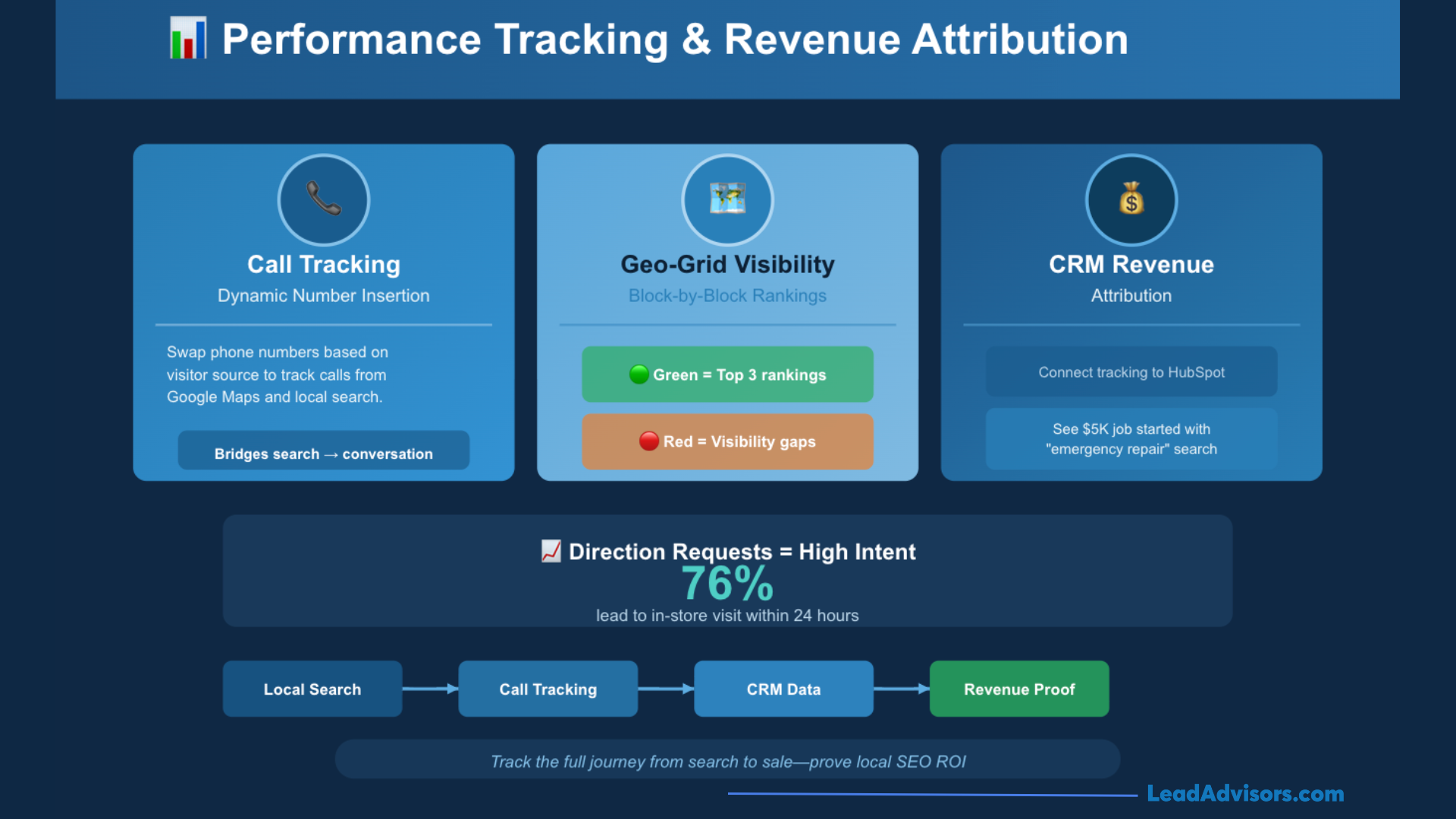
Proving the value of local SEO efforts is the final step in any effective local SEO strategy. In 2026, standard traffic metrics aren’t enough. You must link your local search visibility directly to the bottom line using advanced local SEO tools.
Call Tracking and DNI
To prove a phone call came from the local pack, use Dynamic Number Insertion (DNI). This technology swaps the phone number on your web pages based on the source of the visitor.
- The Setup: Place your tracking number as the “Primary Phone” in your Google Business Profile and your real number as the “Additional Phone.” This preserves your name, address, and phone number while capturing data.
- The Benefit: DNI allows you to see if a customer called after finding you on Google Maps or through a local search on their desktop. It bridges the gap between a Google search and a real-world conversation.
Reading Geo-Grid Visibility
Traditional rank trackers only check from one spot. However, local rankings change block-by-block. Geo-grid heatmaps provide a 3D view of your local SEO performance.
- Green Pins: You rank in the top three for relevant local searches in that specific area.
- Red/Yellow Pins: These highlight “visibility gaps” where other local businesses are beating you.
- Strategy: If you see red pins in a nearby neighborhood, target that local area with local keywords or local citations from that specific district.
Linking Metrics to CRM Revenue
Data from your Google Business Profile should never live in a silo. Use Google Search Console and UTM parameters to track “Direction Requests” and “Click-to-Call” events.
- Conversion Metrics: In 2026, a “Direction Request” is a high-intent signal. Studies show 76% of these lead to an in-store visit within 24 hours.
- Revenue Attribution: Connect your call tracking software to your CRM (like HubSpot or Salesforce). This lets you see that a $5,000 HVAC job started with a local search for “emergency repair.”
- ROI Calculation: By tracking the full journey, you can prove that your local SEO services or local SEO optimization efforts are lowering your marketing costs compared to paid ads.
Case Study: The “Bean Brews” Blueprint
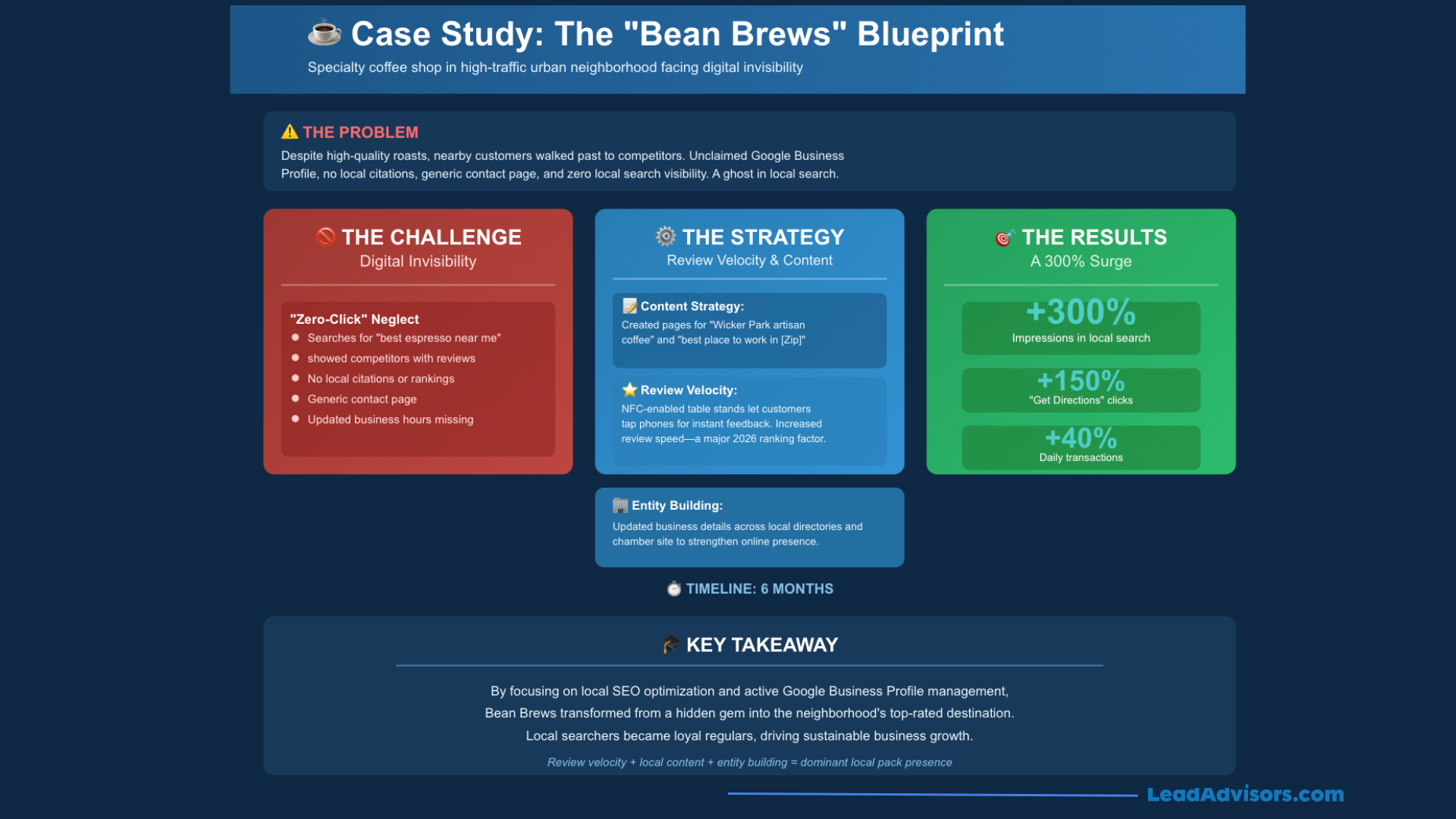
“Bean Brews,” a specialty coffee shop in a high-traffic urban neighborhood, faced a common 2026 problem: they were invisible to foot traffic. Despite high-quality roasts, nearby customers were walking right past them to a competitor three blocks away. Their business profile on Google was unclaimed, and they lacked any local search visibility.
The Challenge: Digital Invisibility
The shop suffered from “Zero-Click” neglect. Potential customers searching for “best espresso near me” saw other local businesses with hundreds of online reviews and updated business hours. Bean Brews had no local citations, a generic contact page, and zero local search rankings. They were a ghost in the local search engine.
The Implementation: Review Velocity and Content
We applied a targeted local SEO strategy focused on real-time relevance.
- Content Strategy: We created web pages optimized for local keywords like “Wicker Park artisan coffee” and “best place to work in [Zip Code].”
- Review Velocity: To boost local rankings, we used NFC-enabled table stands. These allowed local customers to tap their phones and leave customer feedback instantly. This increased their “review velocity”—the speed at which they gained new online reviews—which is a major ranking factor in 2026.
- Entity Building: We updated their business details across local business directories and the local chamber site to strengthen their company’s online presence.
The Result: A 300% Surge
Within six months, Bean Brews dominated the local pack.
- Impressions: A 300% increase in local search results appearances.
- Actions: “Get Directions” clicks rose by 150%, directly impacting foot traffic.
- Revenue: Daily transactions grew by 40% as local searchers became loyal regulars.
By focusing on local SEO optimization and active Google Business Profile optimization, Bean Brews stopped being a hidden gem and became the neighborhood’s top-rated destination.