Have you ever brought on a BPO partner—whether you outsource to Philippines teams or elsewhere—only to find yourself fixing mistakes, following up endlessly, or losing control of operations?
You’re not the only one.
Many business owners enter business process outsourcing with high hopes, only to face poor communication, low-quality output, or teams that don’t align with their goals. The worst part? They blame themselves for the wrong choice.
Here’s the truth: you shouldn’t micromanage your outsourcing partner or sacrifice your brand’s reputation to save money.
Choosing the right BPO partner impacts your business processes, time, and long-term growth.
This guide reveals what truly matters when evaluating a BPO company—the red flags to avoid, green lights to pursue, and hidden dealbreakers.

Understanding Your Business Needs
Before comparing BPO vendors, take time to understand what you actually need. This foundational step determines whether your outsourcing partner becomes a competitive advantage or a costly liability.
Identifying Core Processes to Outsource
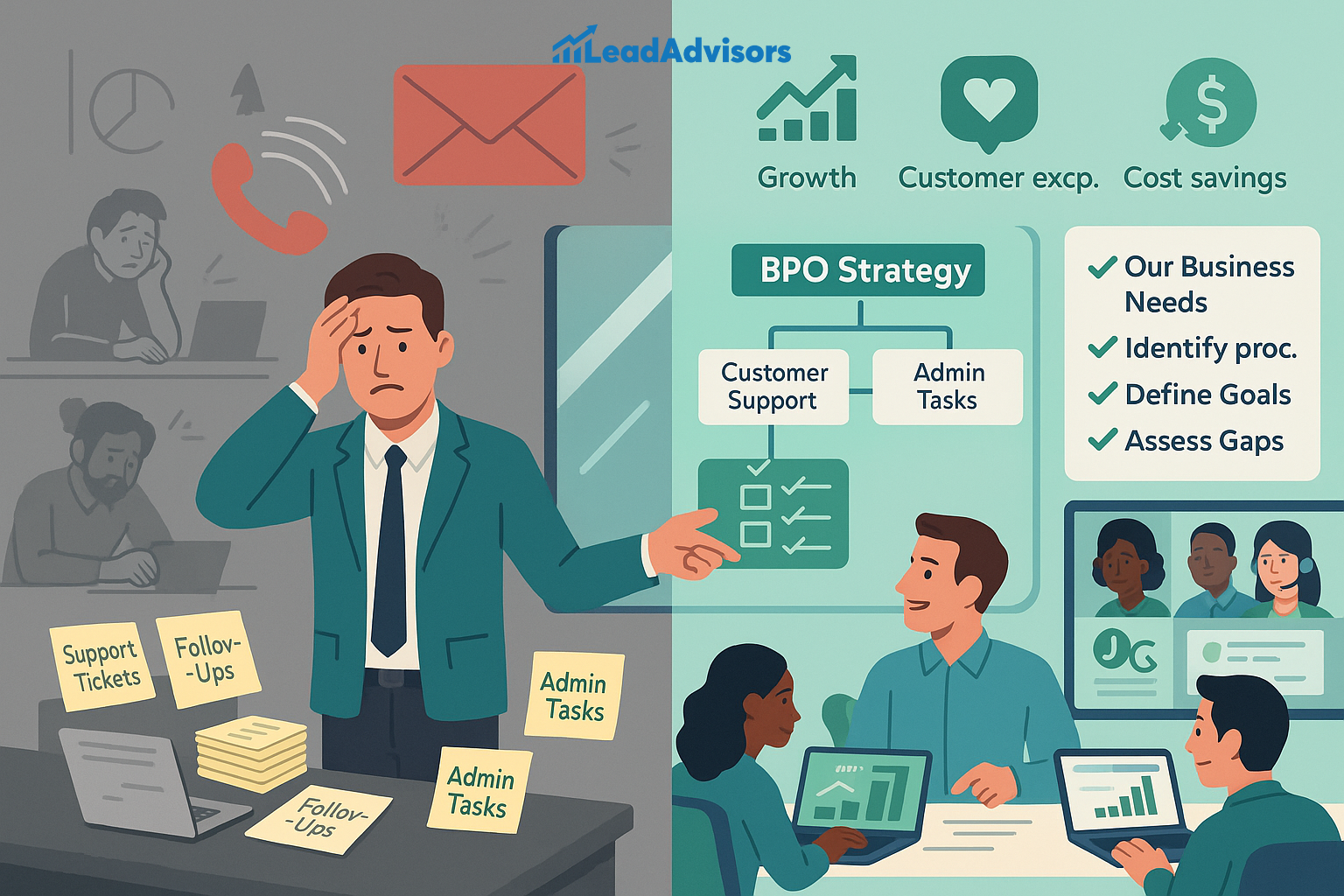
Start by auditing where your team spends the most time. Common bottlenecks include customer support, lead follow-up, data entry, and administrative tasks.
List all recurring processes, then identify which ones don’t require in-house expertise or strategic oversight. These are your primary outsourcing candidates.
When you delegate repetitive tasks to the right BPO company, your internal team can focus on strategy, innovation, and revenue-generating activities. Many businesses discover competitive advantages they didn’t know they were missing.
Determining Your Business Goals and Objectives
Get clear on your “why” before choosing a partner. Are you aiming to:
- Reduce operational costs?
- Improve customer experience and response times?
- Scale operations quickly?
- Enter new markets or time zones?
For example, a SaaS company overwhelmed by support tickets may prioritize faster resolution times and customer satisfaction over pure cost savings. Their ideal partner would offer technical support expertise, multilingual agents, and transparent performance metrics.
Defining your true objective helps you filter out mismatched providers and focus on partners who deliver what you actually need.
Assessing Internal Capabilities and Gaps
Conduct an honest internal assessment: What’s working in-house, and what isn’t?
You might discover your development team is strong, but administrative and sales support are stretched thin. Or perhaps your customer service is excellent during business hours, but after-hours coverage is inconsistent.
Recognizing these gaps makes it easier to bring in a business process outsourcing team that complements your strengths without draining resources.
The more clarity you have upfront, the smoother the partnership. You become a better client, your outsourcing partner becomes more effective, and results come faster.
Evaluating BPO Partner Capabilities
 Once you’ve narrowed down potential providers, the critical question becomes: can they actually deliver what you need?
Not all BPO companies are built the same. Some promise comprehensive solutions but struggle when complexity increases. Others excel at specific functions but can’t scale beyond their core offering.
Here’s a practical evaluation framework to assess any potential partner:
Industry-Specific Experience and Expertise
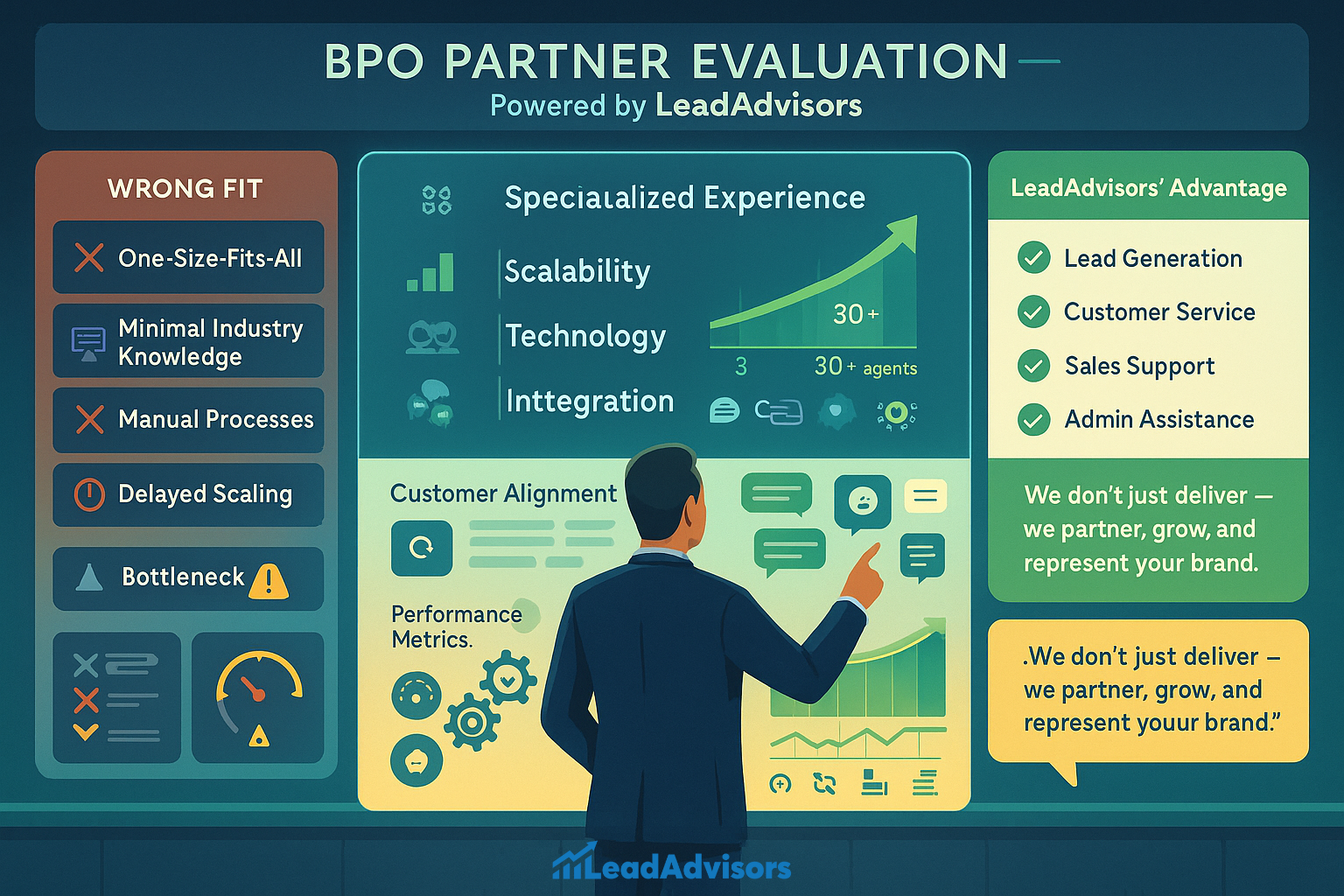
Generic BPO providers rarely deliver the nuance your business requires. Look for partners who understand your industry’s unique workflows, compliance requirements, and customer expectations.
Questions to ask:
- Have they worked with companies in my industry or sector?
- Can they demonstrate knowledge of industry-specific regulations (HIPAA for healthcare, PCI-DSS for payments, etc.)?
- Do they understand the technical language and customer pain points unique to my field?
- Can they provide relevant case studies or references?
What good looks like: A provider who has supported similar businesses, speaks your industry’s language, and can anticipate challenges before you mention them. For instance, a BPO partner serving SaaS companies should understand subscription models, churn metrics, and technical troubleshooting—not just basic customer service.
Scalability and Growth Capacity
You might start with a small team handling non-core functions, but your needs will evolve. Evaluate whether a potential partner can grow with you or will become a bottleneck.
Questions to ask:
- What’s their current capacity, and how quickly can they scale up?
- Have they successfully grown with other clients from small teams to large operations?
- Do they have recruitment and training infrastructure in place?
- Can they handle seasonal fluctuations or sudden demand spikes?
Red flags to watch for:
- Rigid, one-size-fits-all service packages
- No clear process for adding team members or services
- Long lead times for scaling (more than 2-4 weeks)
- Resistance to discussing growth scenarios
Technology Infrastructure and Integration
The right technology should integrate seamlessly with your existing systems—not create additional work for your team.
Questions to ask:
- What CRM, helpdesk, or project management platforms do they support?
- How do they handle data synchronization and real-time updates?
- What’s their approach to automation and AI-enhanced workflows?
- Do they require you to adopt their systems, or do they adapt to yours?
What good looks like: A provider whose infrastructure connects directly with your tools (Salesforce, HubSpot, Zendesk, Slack, etc.) without requiring manual data transfers or custom workarounds. They should also leverage automation thoughtfully—enhancing efficiency without sacrificing quality.
Warning signs:
- Proprietary systems that don’t integrate with standard platforms
- Manual processes for data sharing
- Outdated technology stack
- No investment in modern tools or AI capabilities
Brand Alignment and Representation
Remember: you’re not just outsourcing tasks—you’re trusting someone to represent your brand to customers, prospects, or partners.
Questions to ask:
- How do they ensure agents understand and embody our brand voice?
- What’s their onboarding and training process for new clients?
- Can I review sample scripts, communications, or recordings?
- How do they handle quality assurance and brand consistency?
What good looks like: A partner who invests time learning your brand values, customer personas, and communication style. They should offer tailored training (like mock call scripts specific to your business) and regular quality reviews to maintain consistency.
Putting It All Together
The best BPO partnerships aren’t transactional—they’re strategic. Your ideal provider should feel like an extension of your team, not an external vendor you manage from arm’s length.
At LeadAdvisors, we’ve built our services around these exact principles. We work across tech, e-commerce, healthcare, and financial services—adapting to each client’s unique needs rather than forcing them into rigid packages. Our infrastructure integrates with your existing tools, and we scale alongside your growth.
But regardless of which provider you choose, use this framework to evaluate whether they can truly deliver on their promises.
Assessing Quality and Performance
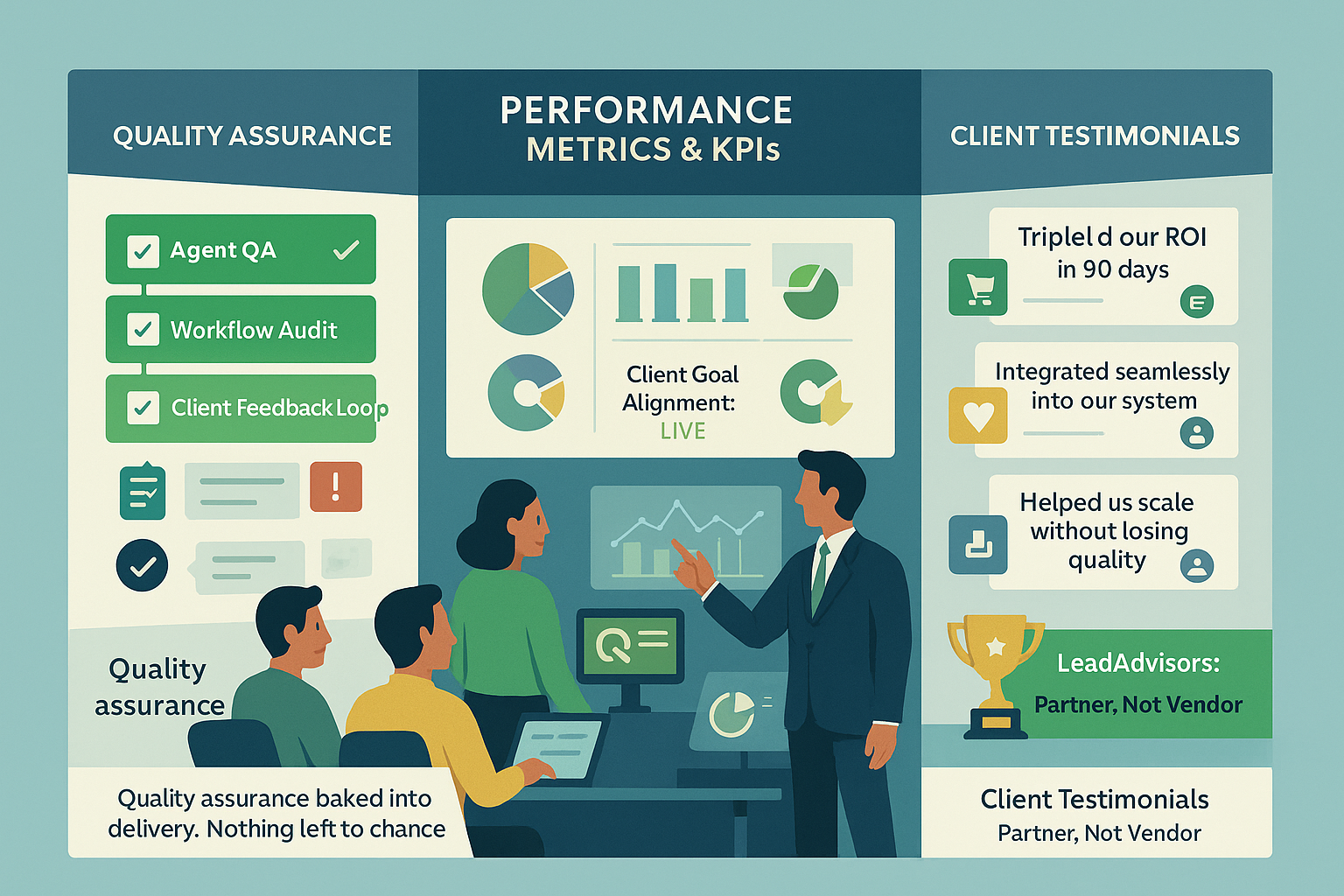
Hope isn’t a strategy when it comes to outsourcing. You need proof of performance, transparent metrics, and a partner who takes ownership of outcomes—not just tasks.
Here’s how to evaluate whether a BPO provider can deliver consistent quality and measurable results.
Quality Assurance Processes
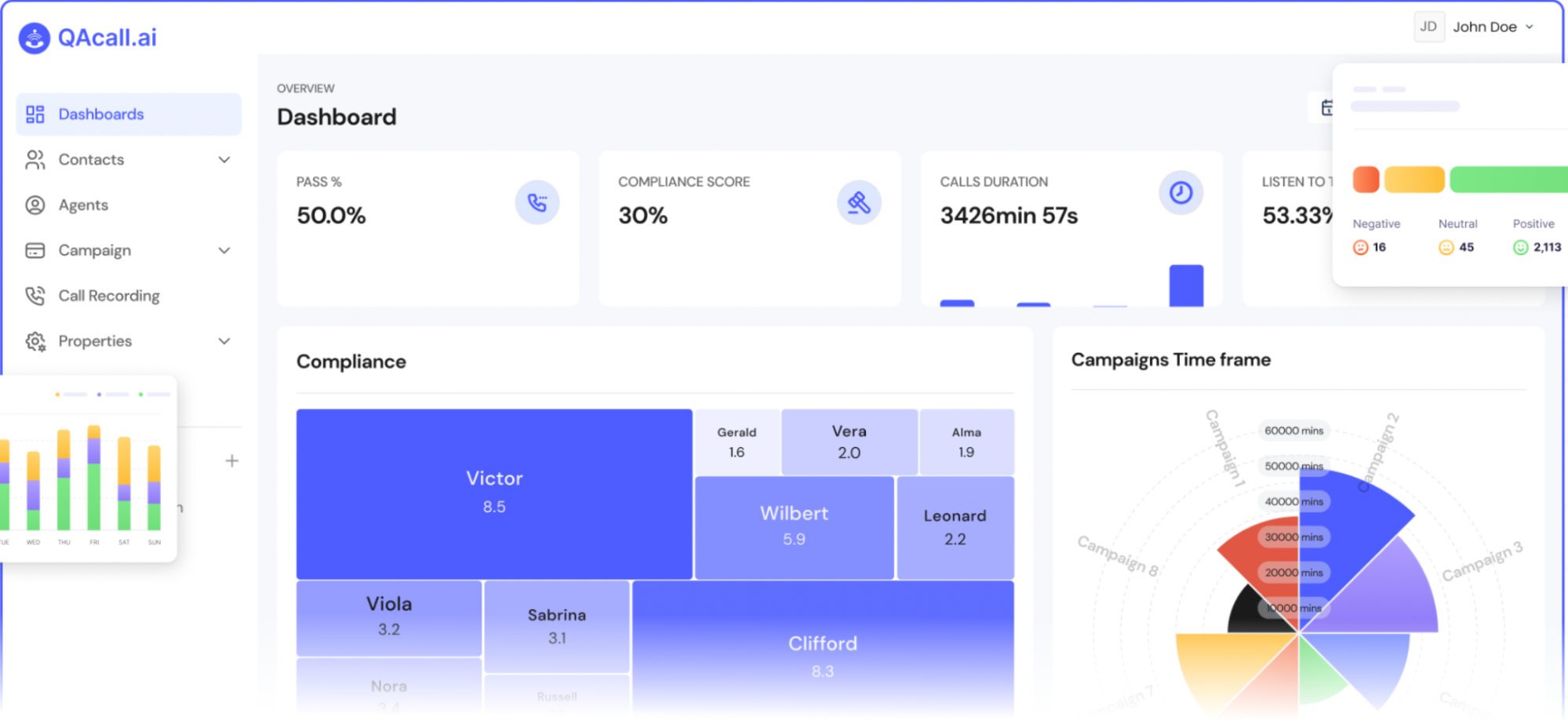
Many BPO providers talk about quality control, but few have systematic processes to prevent errors before they reach your customers.
What to look for:
- Multi-layer QA reviews: Random sampling isn’t enough. Look for providers who implement calibration sessions, side-by-side monitoring, and real-time feedback loops.
- Documented QA frameworks: Ask to see their actual quality scorecard. What criteria do they measure? How often? Who conducts reviews?
- Error prevention systems: Strong providers catch mistakes proactively through automated checks, peer reviews, and supervisor oversight—not just after customer complaints.
- Training refresh cycles: Quality degrades without ongoing coaching. Ask how frequently agents receive performance feedback and retraining.
Questions to ask:
- What percentage of interactions do you QA review?
- How quickly do you identify and correct quality issues?
- Can I access QA scorecards and performance reports?
- What happens when quality standards aren’t met?
Red flag: If a provider can’t show you their QA process in detail or says “we handle that internally,” that’s a warning sign. Quality should be transparent and measurable.
Performance Metrics and KPIs
Vague promises like “we’ll improve your performance” mean nothing without clear measurement frameworks.
Essential metrics to track (depending on your function):
For Customer Support:
- First Call Resolution (FCR) rate
- Average Handle Time (AHT)
- Customer Satisfaction Score (CSAT)
- Net Promoter Score (NPS)
- Ticket backlog and response times
For Lead Generation/Sales Support:
- Lead-to-qualified conversion rate
- Contact-to-appointment ratio
- Cost per qualified lead
- Follow-up response time
- Pipeline velocity
For Back-Office Operations:
- Processing accuracy rate
- Turnaround time per task
- Error rate and rework percentage
- Volume capacity and scalability
What good performance reporting looks like:
- Real-time dashboards: You should have access to live performance data, not just monthly summaries
- Custom KPIs aligned to your goals: Metrics should reflect what matters to your business, not generic industry standards
- Trend analysis: Beyond current numbers, strong providers show improvement trajectories and identify patterns
- Actionable insights: Reports should include context and recommended optimizations, not just raw data
Questions to ask:
- Which specific KPIs will you track for my account?
- How frequently will I receive performance reports?
- Can I access real-time dashboards?
- What’s your process when metrics fall below targets?
Client Testimonials and Case Studies
Generic testimonials like “great service!” or “highly recommend!” provide zero useful information. Demand specificity.
What credible case studies include:
- Client industry and company size: “Mid-sized healthcare provider” is more credible than “a client”
- Specific challenge addressed: “Reducing average call wait time from 8 minutes to under 2 minutes”
- Measurable outcomes with timeframes: “Achieved 94% CSAT score within 6 months, up from 67%”
- Methodology explained: How did they achieve the results? What tools, processes, or strategies were used?
Example of a strong case study format:
Client: B2B SaaS company, 50-200 employees
Challenge: Support ticket backlog averaging 48-hour response time; CSAT score at 72%
Solution: Implemented 24/7 tiered support with L1 technical troubleshooting, integrated Zendesk API for real-time ticket routing, and deployed an AI-assisted knowledge base
Results (90 days):
- Average response time reduced to 4 hours
- First response resolution increased to 68%
- CSAT improved to 89%
- Support team scaled from 5 to 12 agents without quality degradation
Questions to ask:
- Can you share 2-3 detailed case studies relevant to my industry?
- May I speak with current clients as references?
- What results have you achieved for similar-sized companies?
- Can you provide data on client retention rates?
Red flags:
- Unwilling to provide client references
- Only offering anonymous testimonials
- Case studies without specific metrics or timeframes
- Can’t explain their methodology or process
LeadAdvisors Performance Transparency
At LeadAdvisors, we track performance across all these dimensions. For example, we helped a direct-to-consumer e-commerce brand reduce its customer service response time from 12 hours to under 90 minutes while maintaining a 91% CSAT score—achieved through CRM integration, tiered support workflows, and daily performance calibration.
We provide clients with real-time dashboards, weekly performance reviews, and quarterly optimization sessions. Our average client retention rate is 94%, and we’re happy to connect prospects with current clients for reference calls.
But regardless of which provider you evaluate, insist on this level of transparency and proof.
Cost Considerations
You need proof of performance, not promises. Here’s how to evaluate whether a BPO provider delivers consistent quality and measurable results.
Quality Assurance Processes
What to look for:
- Multi-layer QA reviews (not just random sampling)
- Documented quality scorecards you can review
- Error prevention systems, not just error correction
- Regular agent coaching and calibration sessions
Questions to ask:
- What percentage of work gets QA reviewed?
- Can I see your quality scorecard and audit reports?
- How do you catch errors before they reach customers?
Red flag: Providers who can’t show you their QA process in detail or say “we handle that internally.”
Performance Metrics and KPIs
Demand specific, measurable KPIs aligned to your goals:
For Customer Support: First Call Resolution, Average Handle Time, CSAT, NPS
For Lead Generation: Lead-to-qualified rate, contact-to-appointment ratio, cost per lead
For Back-Office: Processing accuracy, turnaround time, error rate
What good reporting looks like:
- Real-time dashboards (not just monthly summaries)
- KPIs customized to your business objectives
- Trend analysis showing improvement over time
- Actionable insights, not just raw numbers
Questions to ask:
- Which KPIs will you track for my account?
- Can I access real-time performance data?
- What happens when metrics fall below targets?
Client Testimonials and Case Studies
Generic testimonials mean nothing. Demand specificity:
Strong case studies include:
- Client industry and size
- Specific challenge with baseline metrics
- Solution methodology
- Measurable outcomes with timeframes
Example:
B2B SaaS client reduced support response time from 48 hours to 4 hours in 90 days, improving CSAT from 72% to 89% through tiered support and CRM integration.
Questions to ask:
- Can you share relevant case studies with real metrics?
- May I speak with current clients as references?
- What’s your client retention rate?
Red flags: Anonymous testimonials, no metrics, unwilling to provide references.
At LeadAdvisors, we provide real-time dashboards, weekly performance reviews, and maintain a 94% client retention rate. We’re happy to share detailed case studies and connect you with current clients.
Cultural and Operational Compatibility
Culture fit often gets overlooked in favor of pricing and capabilities—but misalignment here can undermine even the most skilled BPO team.
Why Cultural Alignment Matters
Your outsourcing partner represents your brand to customers, prospects, and stakeholders. If they don’t understand your values, communication style, or customer expectations, the disconnect shows immediately.
Common compatibility breakdowns:
- Agents who sound scripted or robotic instead of authentic
- Responses that are technically correct but miss your brand voice
- Escalations are handled differently than your internal team would
- Mismatched expectations around autonomy vs. oversight
Evaluating Communication and Collaboration
Smooth collaboration requires more than just scheduled check-ins.
What to assess:
- Communication cadence: How often will you connect? Daily standups? Weekly reviews? Ad-hoc Slack access?
- Dedicated points of contact: Will you work with one account manager or rotate through team members?
- Collaboration tools: Do they adapt to your systems (Slack, Teams, Asana) or require you to use theirs?
- Response time expectations: How quickly do they address urgent issues or questions?
Questions to ask:
- Who will be my primary contact?
- What’s your typical response time for urgent requests?
- How do you handle feedback and course corrections?
Time Zone and Language Considerations
Geography affects more than just meeting schedules—it impacts response times, real-time support, and workflow continuity.
Strategic considerations:
- Coverage needs: Do you need 24/7 support, business-hours overlap, or asynchronous workflows?
- Language proficiency: Beyond basic fluency, can they match your communication style and handle industry-specific terminology?
- Cultural context: Do they understand your target market’s expectations and cultural nuances?
What good looks like:
A provider who builds shift schedules around your peak hours, assigns bilingual or native-speaking agents when needed, and trains teams on your customer demographics—not just your product.
Assessing the Fit
Before committing, test the compatibility:
- Request sample interactions (call recordings, email responses, chat transcripts)
- Conduct a pilot project or trial period
- Meet the actual team members who’ll work on your account
- Evaluate how they handle feedback during onboarding
Cultural compatibility isn’t about finding a team that thinks exactly like you—it’s about finding a partner who understands your mission well enough to represent it authentically.
At LeadAdvisors, we build compatibility through intensive onboarding, brand immersion training, and dedicated account teams who learn your voice and values. But any strong BPO partner should prioritize this alignment from day one.
Security and Compliance
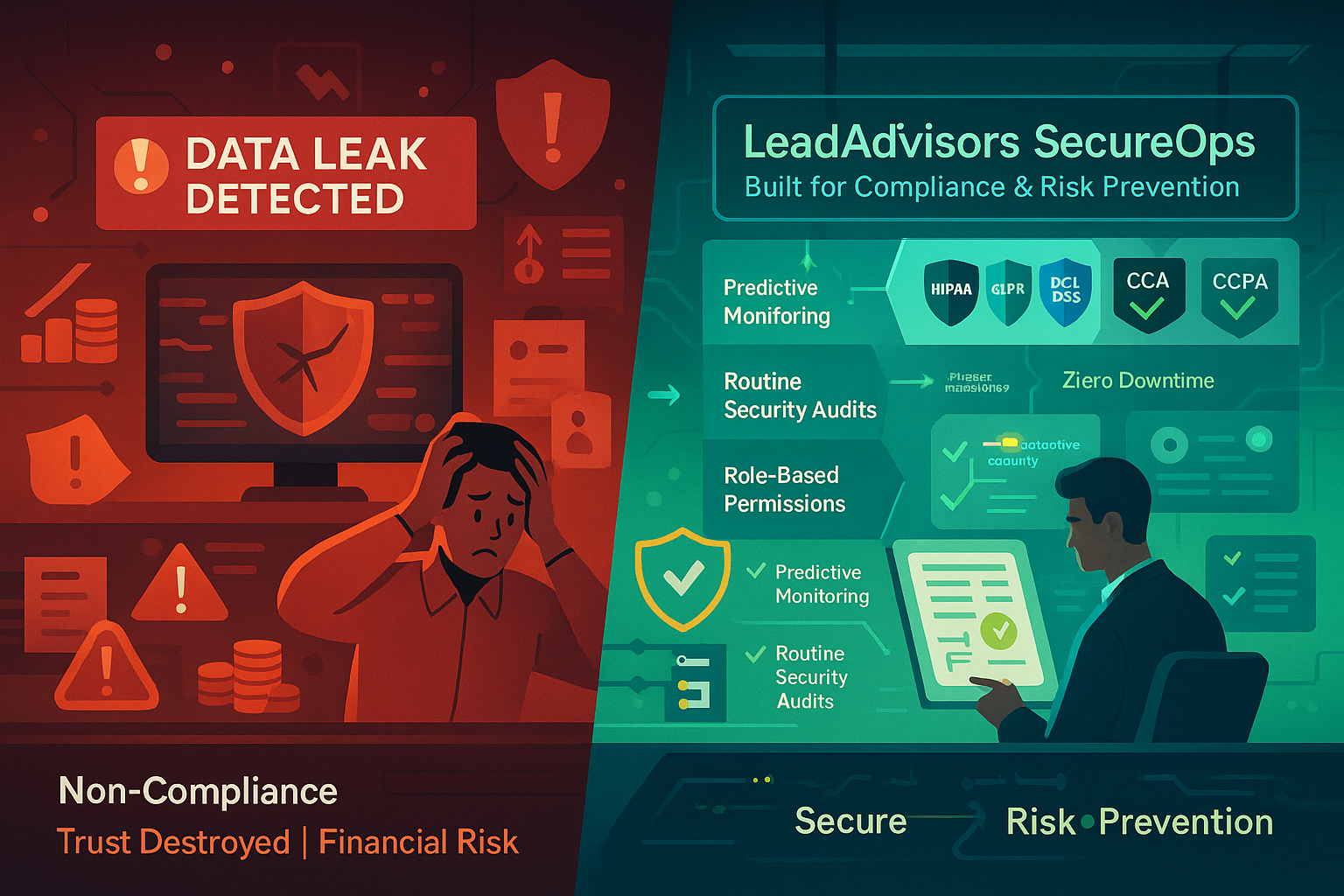
Security and compliance aren’t optional—they’re fundamental requirements when outsourcing business processes. Here’s how to evaluate whether a BPO provider takes data protection seriously.
Data Security Standards
Essential security measures to verify:
- Encryption protocols: End-to-end encryption for data in transit and at rest
- Access controls: Role-based permissions, multi-factor authentication, and regular access audits
- Network security: Firewalls, intrusion detection systems, and secure VPN connections
- Physical security: Controlled facility access, visitor logs, and surveillance systems
- Incident response plan: Documented procedures for breach detection, containment, and notification
Questions to ask:
- What encryption standards do you use?
- How do you manage user access and authentication?
- When was your last security audit, and can I see the results?
- What’s your protocol if a security incident occurs?
- Do you have cyber insurance coverage?
Compliance Requirements
Your BPO partner must comply with regulations relevant to your industry and geography.
Key compliance frameworks:
- GDPR (General Data Protection Regulation): For handling EU customer data
- HIPAA (Health Insurance Portability and Accountability Act): For healthcare information
- PCI-DSS (Payment Card Industry Data Security Standard): For processing payments
- CCPA (California Consumer Privacy Act): For California resident data
- SOC 2 Type II: Industry-standard security and privacy certification
- ISO 27001: International information security management standard
Questions to ask:
- Which compliance certifications do you hold?
- Can you provide current compliance audit reports?
- How do you stay updated on regulatory changes?
- What happens if compliance requirements change during our contract?
- Do you have legal counsel specialized in data privacy?
Risk Management and Business Continuity
Beyond preventing breaches, strong providers minimize operational risks.
What to evaluate:
- Disaster recovery plan: Backup systems, data redundancy, and recovery time objectives
- Business continuity: Redundant facilities, failover capabilities, and uptime guarantees
- Regular testing: Penetration testing, vulnerability assessments, and simulated breach exercises
- Vendor management: How they secure third-party integrations and subcontractors
- Training programs: Ongoing security awareness training for all staff
Questions to ask:
- What’s your guaranteed uptime SLA?
- How often do you conduct security training?
- Do you have backup facilities if primary operations are disrupted?
- What’s your average incident response time?
Red Flags to Watch For
- Unwilling to share security certifications or audit reports
- Vague answers about compliance (“we follow best practices”)
- No documented incident response plan
- Resistance to signing BAAs (Business Associate Agreements) or DPAs (Data Processing Agreements)
- No regular third-party security audits
At LeadAdvisors, we maintain SOC 2 Type II certification, comply with GDPR, HIPAA, and PCI-DSS standards, and conduct quarterly security audits. We’re transparent about our security posture and provide clients with audit reports during the evaluation process.
But regardless of provider, never compromise on security. Request documentation, verify certifications, and ensure compliance requirements are written into your contract.
Scalability and Flexibility
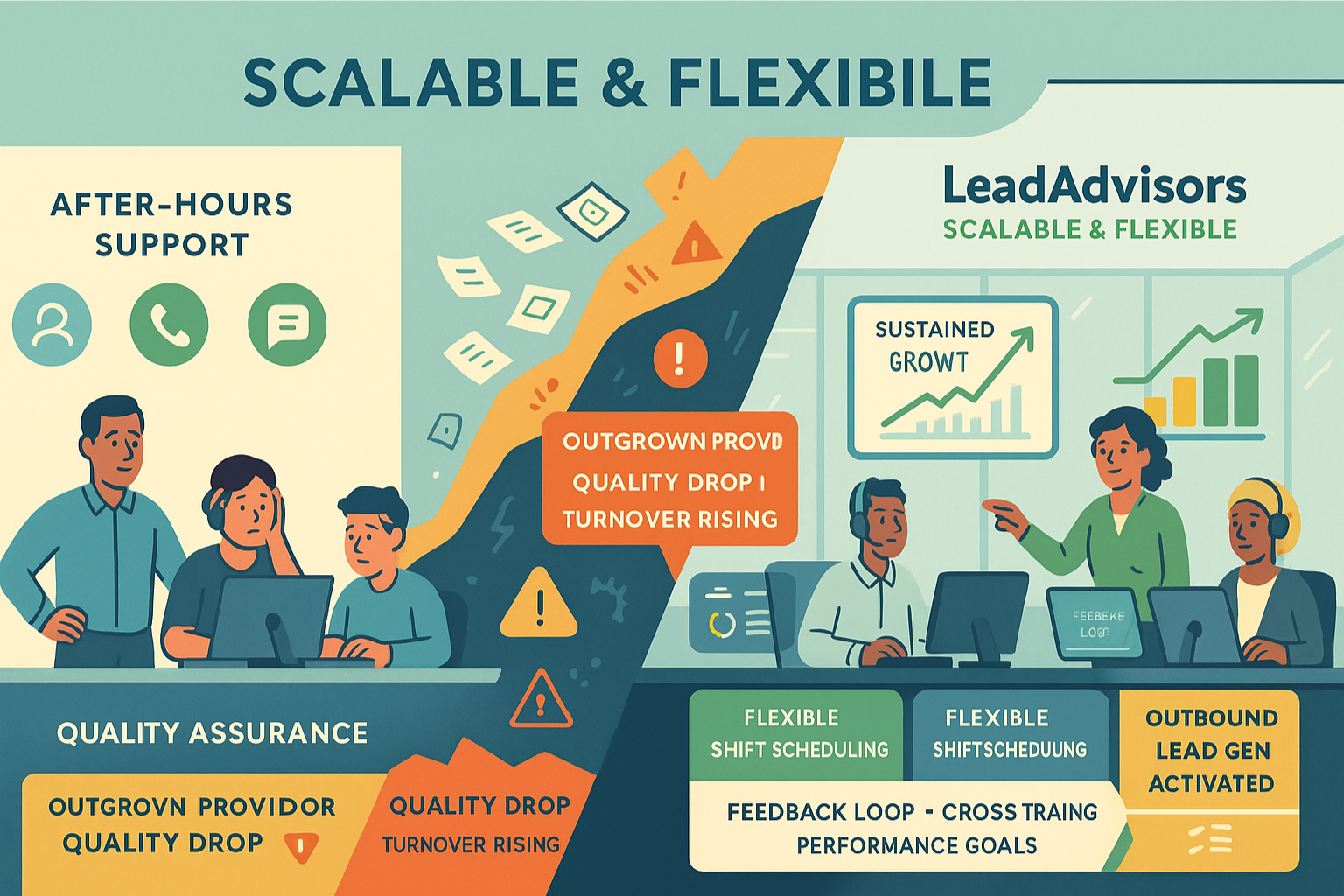
Your business needs will evolve. Choose a BPO partner built to grow and adapt with you, not one that becomes a bottleneck.
Ability to Scale Services
What to evaluate:
- Ramp-up speed: How quickly can they add team members? (Industry standard: 2-4 weeks for trained agents)
- Scaling infrastructure: Do they have recruitment pipelines, training programs, and capacity ready?
- Quality maintenance: Can they scale without sacrificing performance? Ask for metrics during previous scaling periods.
- Volume flexibility: Can they handle seasonal spikes, product launches, or sudden demand increases?
Questions to ask:
- What’s your typical timeline to scale from 5 to 20 agents?
- How do you maintain quality during rapid growth?
- Can you provide examples of successful scaling with other clients?
Flexibility in Service Offerings
What to evaluate:
- Multi-channel support: Can they add new channels (chat, email, phone, social) without separate contracts?
- Service expansion: How easily can you add functions (lead gen, tech support, back-office)?
- Customization capability: Do they adapt to your processes or force you into rigid templates?
- Contract flexibility: Can you adjust scope, volume, or services mid-contract?
Questions to ask:
- How do you handle scope changes or additional services?
- What’s the process for adding new channels or functions?
- Are there penalties for scaling down during slow periods?
Adaptability to Business Changes
What to evaluate:
- Cross-training capabilities: Can agents handle multiple functions if your needs shift?
- Market expansion support: Do they offer multilingual support or new timezone coverage?
- Technology adaptation: Can they pivot to new tools, platforms, or workflows?
- Strategic partnership approach: Do they proactively suggest optimizations or just execute orders?
Red flags:
- Long lead times (6+ weeks) for scaling
- Rigid service packages with no customization
- Quality drops when volume increases
- Resistance to process changes or new tools
At LeadAdvisors, we maintain pre-trained talent pools and modular team structures, allowing us to scale from 3 to 30+ agents within 2-3 weeks while maintaining quality standards. Our clients adjust services quarterly based on changing needs—no rigid contracts.
But any strong BPO partner should demonstrate proven scalability through client references and performance data during growth periods.
Contract and SLA Considerations
I’ve reviewed enough BPO contracts to know one thing for sure: the fine print can either save your business or wreck your entire outsourcing experience.
Too many companies enter partnerships without fully understanding what they’re signing. They assume things will just “work themselves out.” But let me be clear—in outsourcing, ambiguity is your enemy.
Here’s what I’ve learned to look for. And here’s how LeadAdvisors makes sure you’re protected from day one.
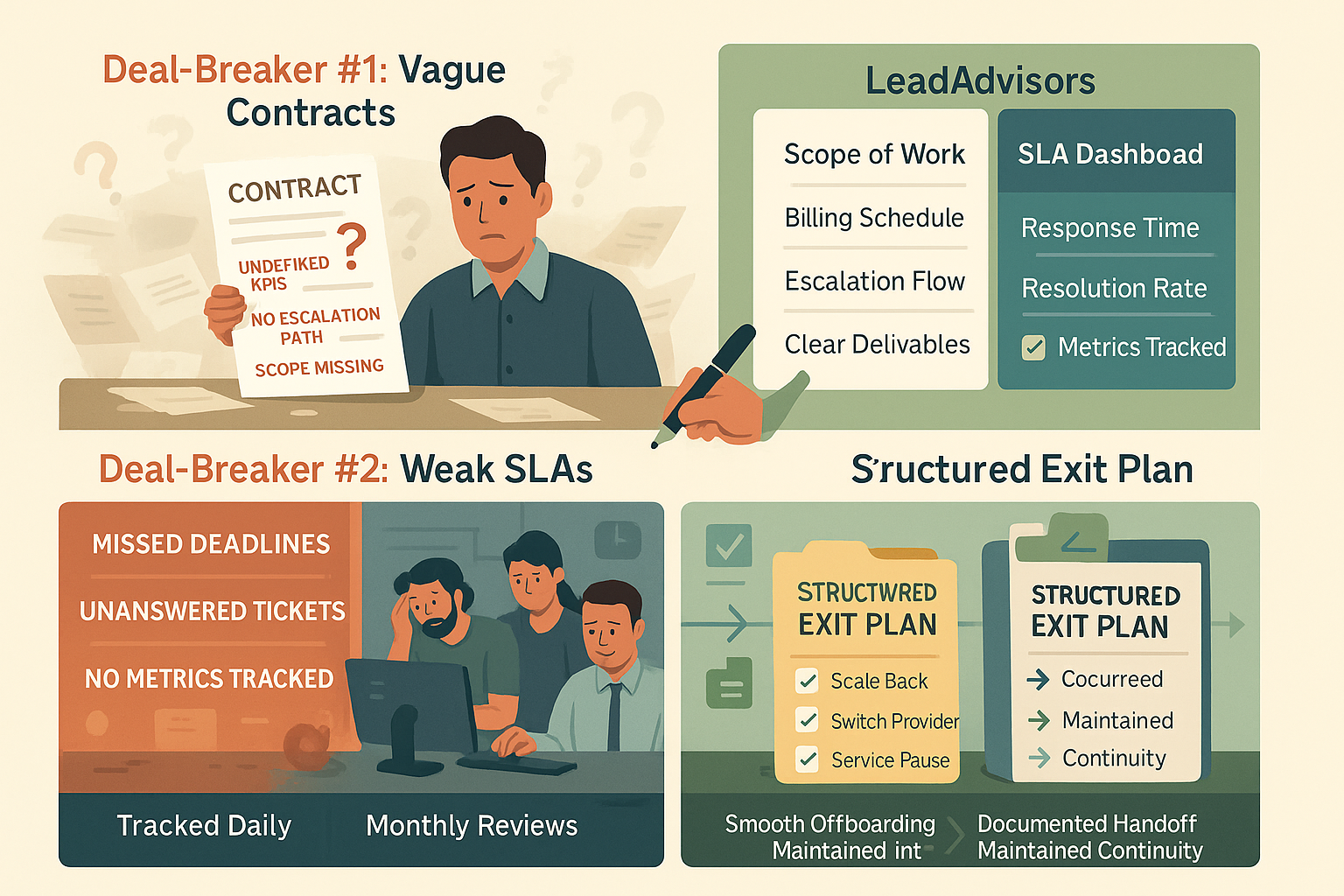
Deal-Breaker #1: Vague or Incomplete Contracts
When I first started outsourcing, I was handed a solid contract — until three months in, when KPIs weren’t being met, and I had no clear recourse.
Key lesson: A BPO contract should be airtight. No fluff. No gray areas.
With LeadAdvisors:
We include all the critical components up front—from the scope of work to billing cycles, communication channels to escalation paths. Everything is documented, transparent, and aligned with your specific business needs. There’s no guessing game when you partner with us—just clarity and commitment.
Deal-Breaker #2: Weak or Unmonitored SLAs
You’d be surprised how many companies skip defining proper Service Level Agreements. Or worse — they set them, but don’t monitor them.
And then comes the flood of missed deadlines, dropped calls, and unacknowledged emails—suddenly, your team is doing double the work to clean up the mess.
With LeadAdvisors:
We define SLAs that matter — response time, resolution time, customer satisfaction scores, and more. But we don’t just explain them. We track them obsessively. You’ll get performance dashboards, monthly reviews, and real-time transparency into how we’re delivering — and improving — every day.
Deal-Breaker #3: No Exit Strategy or Transition Plan
What happens if you need to scale back, change providers, or pause services? Most companies don’t plan for it, and that’s when the handcuffs click.
Suddenly, you’re locked in, bleeding money, with no graceful way out.
With LeadAdvisors:
We write a transition plan directly into the contract. Whether you’re upscaling or shifting gears, our offboarding is just as seamless and well-documented as our onboarding. There is no burned bridge, no messy hand-off, just structured support and clean transitions—because we respect your business, even when you move on.
Your BPO Decision Matters More Than You Think
If you’ve made it this far, then you already know — business process outsourcing (BPO) isn’t just about saving time or cutting costs. It’s about finding a true partner who understands your business, protects your brand, and helps you scale with confidence.
We’ve talked about the essentials:
- Defining your needs and goals up front
- Vetting the BPO companies for real-world capabilities — not just promises.
- Ensuring airtight contracts, service level agreements, and a secure, scalable infrastructure
- Aligning on values, communication, time zones, and team culture
- Building flexibility into every stage of growth — from the first task to a full-scale operation
But here’s what I want you to remember most:
You don’t just need a vendor who checks boxes. You need a partner who thinks like you, adapts like you, and builds with you.
That’s exactly what we’ve built at LeadAdvisors.
We’ve helped startups, scaling teams, and global enterprises streamline their business processes, secure their data, and reduce overhead costs — without compromising quality, control, or culture.
So before you sign anything, take a breath, review the checklists, and ask the tough questions. Protect your team, workflows, and future by choosing a partner who treats your business like their own.
If you’re ready to talk, we’re ready to listen. Let’s build smarter — together.
Let’s make outsourcing your best move yet.