Brand promotion is a fundamental aspect of marketing aimed at generating awareness, enhancing reputation, and improving customer perception. Unlike product-focused tactics, online brand promotion builds long-term recognition and trust. Good campaigns create a distinct identity that appeals to both new and existing customers.
In today’s competitive landscape, companies must blend traditional methods with a robust content marketing strategy to reach audiences where they are most active. Combining offline events with high-authority digital campaigns increases engagement and fuels growth.
This blog explores best practices for conventional and modern internet methods, emphasizing how effective promotion builds loyalty, creates exposure, and ensures long-term success. By moving from simple awareness to brand affinity, businesses can secure a lasting competitive advantage in an AI-driven market.

TL;DR: Brand Promotion in the Age of AI
From Awareness to Affinity: In 2026, simply being “seen” isn’t enough. Modern promotion focuses on Brand Affinity—moving users from generic category searches to brand-specific searches (e.g., from “running shoes” to “Nike”).
The Trust Ecosystem: Success requires a “Digital Paper Trail” of High-Authority Signals, including third-party editorial reviews, user-generated content (UGC), and cross-channel consistency.
E-E-A-T & Entity Validation: Google now rewards “Proof of Life.” Blending offline presence (trade shows, physical touchpoints) with digital authority proves your brand is a legitimate entity, not an AI-generated shell.
Information Gain: Content must provide unique value. “Rehashing” old tips is out; original research, proprietary frameworks (like our Affinity-First Framework), and case studies are the new currency of search ranking.
Success Metrics: Ditch vanity metrics. Track Brand Search Volume, AI Citation Share, and Sentiment Polarity to measure the true health and “Trust Moat” of your business.
What Is Brand Promotion? (And Why “Awareness” is No Longer Enough)
Traditionally, brand promotion was defined as the act of making your company visible and distinct. However, in an era dominated by AI-driven search and social algorithms, the definition has evolved. It is no longer just about Brand Awareness (people knowing who you are); it is about Brand Affinity (people choosing you over others because of shared values).
While product promotion focuses on immediate features or “the solve,” brand promotion is a long-term investment in your company’s reputation capital. It is the difference between a consumer searching for “best running shoes” (Product Search) and searching for “Nike running shoes” (Brand Affinity).
The “Affinity-First” Framework
To succeed today, brand promotion must move through three distinct layers:
Identity: Defining the core values that an AI can clearly categorize.
Validation: Using third-party social proof and editorial mentions to prove those values.
Connection: Moving the customer from a “transactional” relationship to an “emotional” one.
Why Brand Promotion Matters in the AI Era
Google’s recent core updates prioritize “Trust” signals above almost everything else. Here is how modern promotion fuels that trust:
Signals “Authority” to Search Engines: When users search for your brand by name rather than generic keywords, it signals to search engines that you are a trusted entity, boosting your overall site authority.
Encourages High-Value Engagement: Modern promotion turns passive scrollers into active contributors. Interactive campaigns—like user-generated content (UGC)—provide the “first-hand experience” signals that Google now rewards in its search results.
Builds a “Moat” Around Your Business: Product features can be copied overnight, but a brand’s emotional connection cannot. Strong brand promotion ensures that even when competitors offer a lower price, your customers remain loyal due to the established relationship.
Balances Short-Term Gains with Long-Term Stability: While ads drive immediate traffic, brand promotion builds the organic “recognition” that keeps your cost-per-acquisition (CPA) low over time.
Benefits of Brand Promotion
Brand promotion provides quantifiable value that goes way beyond brand awareness. When properly done, it helps to increase revenue, consumer relations, and sustainability. Here are the key benefits:
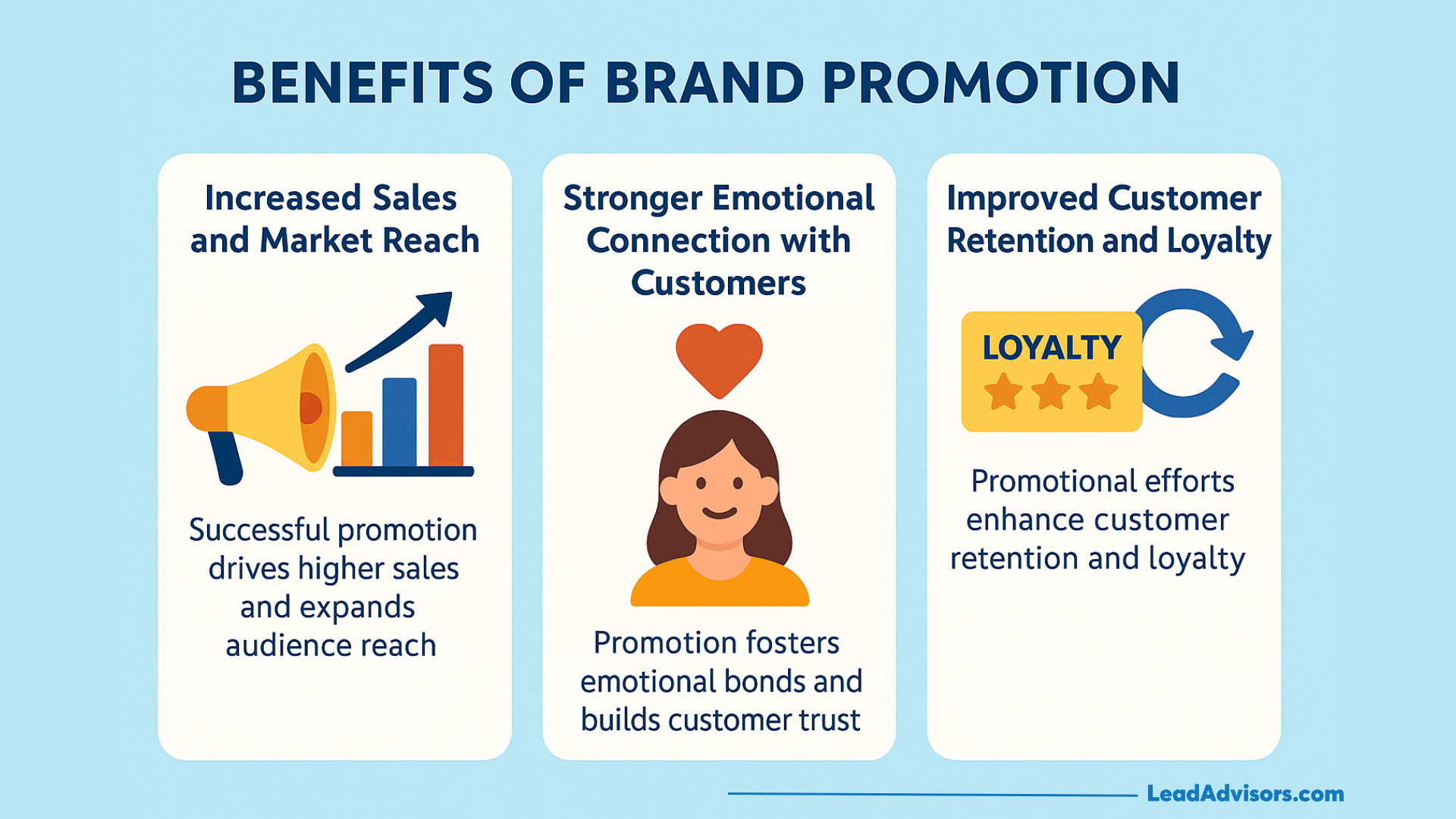
Increased Sales and Market Reach
Powerful advertising assists companies in increasing their presence, and this aspect is directly related to raising sales. Placing the brand uniformly across media allows the companies to capture both the attention of the loyal consumers as well as the new consumers.
This visibility not only increases transactions in the short term but also assists the brands in entering new markets and attracting more people. Powerful campaigns would be tailored to make sales by incorporating a message to build trust and timely promotional offers.
Stronger Emotional Connection with Customers
In addition to the sales, promotion serves to make a company and its customers stronger together. Emotional connection is that which is formed by campaigns that underline similar values or provide some interesting stories of how the brand can be able to play a role in the lives of consumers.
This relationship instills trust and creates customer satisfaction, making one use the same brand over and over again despite other brands being available.
Improved Customer Retention and Loyalty Programs
Retention should be more than acquisitions, and the brand promotion promotes this through the strengthening of loyalty. Such tools as loyalty programs and referral programs reward continued engagement and encourage customers to refer to positive experiences.
Such digital marketing strategies provide a great deal of information on what leads to the repetition of purchase and loyalty. Through a good relationship, brands are able to retain their customers who are satisfied as they promote products and keep the flow of income steady.
Simply put, brand promotion has not only been exposure but a massive sales boosting, emotional loyalty, and customer retention tool.
Modern Brand Promotion Strategies: Building a Trust Ecosystem
In the current landscape, promotion isn’t about being everywhere; it’s about being in the right places with enough frequency to trigger “Brand Trust” signals. We categorize these into three high-impact pillars.
1. High-Authority Digital Signals (The Digital “Paper Trail”)
Modern SEO is no longer just about keywords on your own site; it’s about what other authorities say about you.
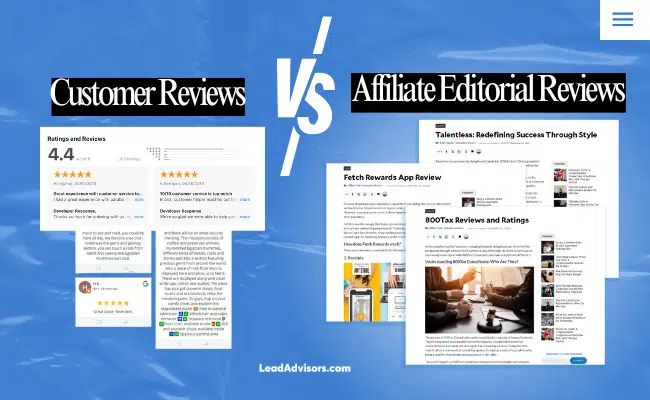
Affiliate Editorial Reviews & Third-Party Validations: This is the gold standard for “Expertise.” When a high-authority publication reviews your brand, it creates a backlink and a sentiment signal that Google uses to verify your E-E-A-T. These reviews act as a “filter” for customers who are already in the consideration phase.
Precision Social Ecosystems: Rather than “blasting” content, brands now use LinkedIn for B2B authority and Instagram/TikTok for “Experience-based” storytelling. The goal is to generate User-Generated Content (UGC), which Google increasingly surfaces in search results as proof of real-world usage.
Strategic Content Clusters: Moving beyond generic blog posts, brands should build “Authority Hubs”—deep-dive content that solves specific user problems, proving you are a leader in your niche.
2. Traditional Credibility & “Real-World” Presence
Offline strategies now serve as the “Proof of Life” for a digital brand. Google’s algorithms look for “Entity” data—physical locations, real-world events, and press mentions—to confirm a brand isn’t just an AI-generated shell.
Experiential Trade Shows & Events: These provide the “Human Connection” that digital cannot replicate. Live demonstrations and face-to-face interactions build the “Experience” (the first ‘E’ in E-E-A-T) that forms the core of brand loyalty.
Tangible Samples & “Touchpoints”: Physical trials create a sensory memory. In a digital-first world, receiving a physical product sample or a high-quality print mailer creates a massive “Reciprocity” trigger that drives high-LTV (Lifetime Value) customers.
3. The Hybrid “Omnichannel” Approach
The most successful modern campaigns use a Closed-Loop Strategy, where offline actions trigger digital signals and vice versa.
The Bridge Strategy: Use a QR code at a physical event that leads to an exclusive digital “Editorial Review” or a community forum. This connects your “Real-World Experience” directly to “Digital Authority.”
Retargeting the “Trust Journey”: A customer may see your brand at a trade show (Awareness), read an editorial review on a trusted tech site (Validation), and finally convert via a personalized social media ad (Conversion).
Expert Insight: In 2026, the “Hybrid” model is no longer optional. Google looks for Cross-Channel Consistency. If your brand message varies wildly between your TV ad and your LinkedIn profile, it creates “Friction,” which lowers your Trustworthiness score.
How to Build a Brand Promotion Strategy
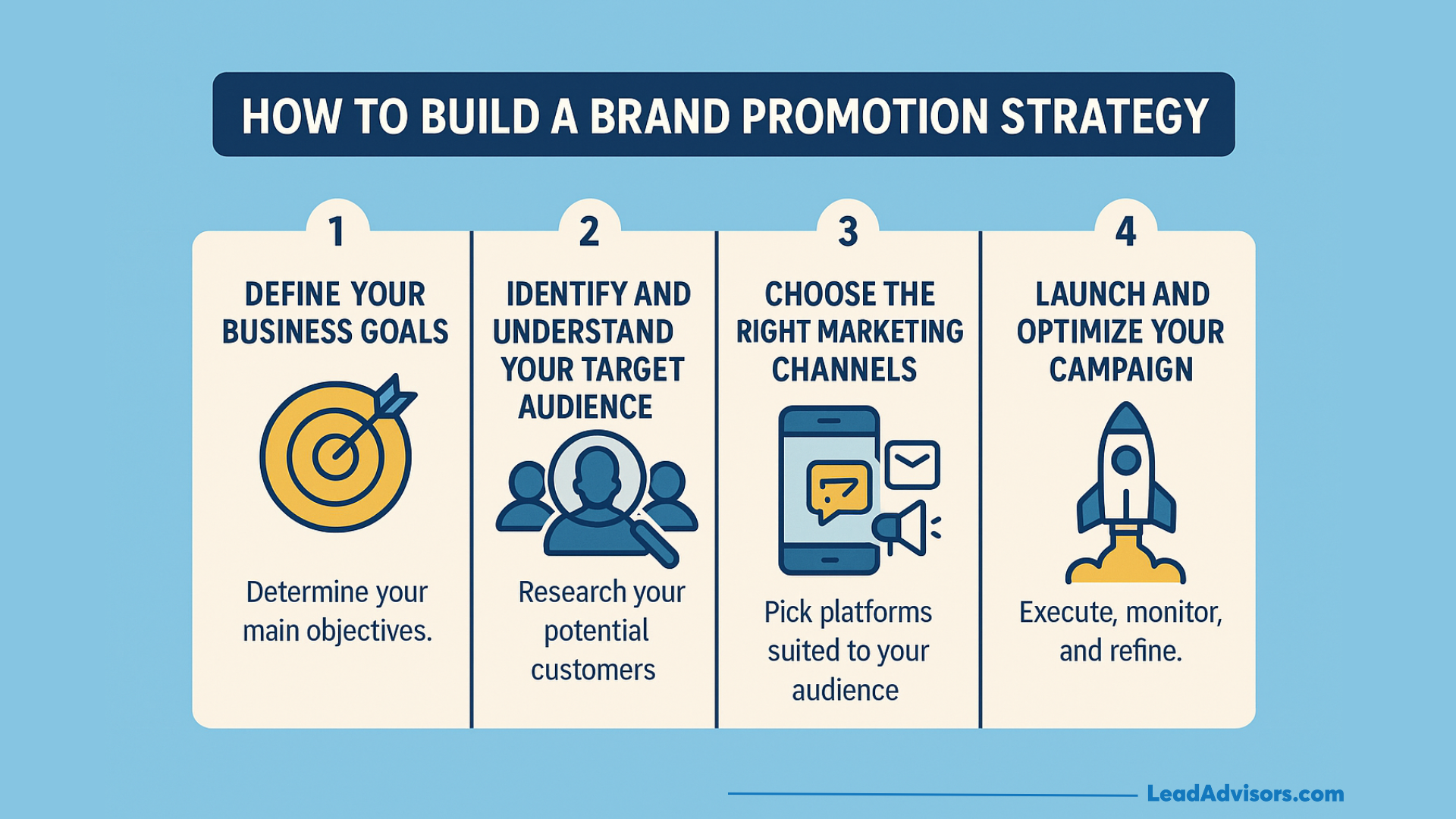
Creating a strategy in 2026 requires moving beyond “launching and hoping.” It requires building a Brand Semantic Infrastructure—a way for both humans and AI to clearly understand what you stand for.
Step 0: The Reputation & Data Audit (The Missing Link)
Before defining goals, you must understand your “starting trust score.”
Brand Sentiment Audit: Use AI-driven tools to analyze how your brand is currently mentioned across social media, forums, and reviews.
The “Entity” Check: Search for your brand on Google and AI assistants (like Gemini or ChatGPT). If they can’t summarize what you do in one sentence, your brand identity is too “noisy.”
Technical Integrity: Ensure your Schema Markup (Organization and Author schema) is robust so search engines can verify your credentials.
Step 1: Define “Outcome-Based” Goals
Shift from vanity metrics (like “likes”) to Engagement Velocity and Brand Search Volume.
The Goal: Increase the number of people searching for “[Your Brand] + [Product]” (e.g., “Apple laptops” vs. just “laptops”). This is a primary authority signal for Google.
Step 2: Map the “Trust Journey” (Beyond the Persona)
Don’t just look at demographics; look at Search Intent and Friction Points.
Identify the “Expertise Gap”: What specific questions are your competitors failing to answer?
Experience-Led Content: Plan for content that only you can write—case studies, original research, or first-hand project photos. This “Information Gain” is highly rewarded in 2026.
Step 3: Architect Your “Authority Hubs”
Choose channels that reinforce each other in a closed-loop system.
Strategic Pillar Pages: Create deep-dive resources on your site that link out to high-authority third-party reviews.
Cross-Channel Validation: Ensure your LinkedIn expertise matches your offline trade show messaging. Inconsistency is a “Trust Killer.”
Step 4: Launch, Monitor, and Pivot
Execution is now about real-time optimization.
Monitor AI Mentions: Use tools to see how often AI search engines cite your brand.
The Incrementality Test: Measure the “Brand Lift.” If you stop your brand ads, does your organic traffic dip? If yes, your brand promotion is successfully building a “Moat.”
Creative Promotion Ideas for 2026
Employee Influencer Programs: Google trusts people more than logos. Turn your subject matter experts into “Verified Entities” on LinkedIn.
Micro-Community Sponsorships: Instead of massive ads, sponsor niche forums or local user groups to build deep-rooted authority.
AI-Enhanced Personalization: Use AI to deliver custom “intermediate rewards” (like small milestones in a loyalty program) that keep customers engaged in the “here and now.”
Measuring Success: The 2026 Metrics Table
| Metric | Why It Matters Now | 2026 Goal |
| Brand Search Volume | Proves users are seeking you, not a category. | 10–15% YoY Growth |
| Information Gain Score | Measures unique value vs. rehashed content. | Low duplication vs. competitors |
| AI Citation Share | How often do AI engines cite you as an authority? | Consistent “Source” status |
| Sentiment Polarity | The “Emotional Health” of your brand mentions. | Majority Positive/Neutral |
Measuring the Success of Brand Promotion
A good brand promotion strategy does not just stop at the point of execution, but also ensures that it is closely followed so as to know what is working and what should be further worked on. The measurement of success assists the business in tying the campaigns and results, and makes smarter choices regarding future marketing campaigns.
Key Metrics to Track
| Metric | What It Measures | Why It Matters |
| Sales | Revenue generated during or after campaigns | Shows the direct impact of promotion on business growth |
| Customer Engagement | Interactions with content, ads, or promotions | Indicates how effectively the brand connects with its target audience |
| User Engagement | Clicks, shares, comments, or time spent online | Reflects how actively people participate in brand activities |
| Website Traffic | Number of visits and sources of visitors | Reveals how campaigns increase visibility and attract potential new customers |
| Customer Retention | Repeat purchases, loyalty program participation, and long-term customer relationships | Demonstrates whether promotions build loyalty instead of just driving one-time sales |
Tools and Techniques for Tracking
Businesses require appropriate tools in order to capitalize on information. Traffic, conversions, and behavior patterns are monitored by Google Analytics, whereas leads, repeat purchases, and customer lifetime value are analyzed by CRM dashboards.
Feedback forms and surveys provide qualitative data, as they indicate the perception of your customers towards your marketing efforts. Powerful data gathering through various platforms has ensured that campaigns are optimized at all times. Performance analysis and strategy adjustment make businesses transform promotional efforts into a consistent, quantifiable outcome that meets the long-term objectives.
Successful monitoring makes brand promotion not a mystery but a growth and loyalty repeat system.