Remote work shifted from a 2020 necessity to the definitive 2026 business strategy. Location no longer dictates potential; instead, efficiency and global collaboration drive the modern enterprise. This evolution is most evident in the BPO sector, where outsourcing to the Philippines has become a primary driver of growth.
By tapping into this high-performing talent pool, businesses achieve 24/7 productivity and creative innovation that extends far beyond traditional geographies. Whether you are a job seeker pursuing independence or a manager unifying a dispersed department, the movement toward remote operations is synonymous with opportunity.
Explore our curated career paths to find your perfect match in this borderless professional landscape.

Why Remote Work Isn’t Just a Perk – It’s a Strategy
Remote work isn’t just a nice-to-have anymore – it’s a real business strategy for creative thinking businesses to grow and stay resilient. The stats prove it. The U.S. Career Institute predicts that over 36 million Americans will be working remotely by 2025. The Bureau of Labor Statistics reports that hybrid and remote options continue to boost productivity and improve employee satisfaction, regardless of industry.
But here’s the real takeaway: remote work gives companies way more than just flexibility. Research shows that remote models help businesses operate more smoothly, attract more diverse talent, and save money by reducing office space. Plus, with fewer commutes and lower energy use in offices, businesses are becoming greener almost effortlessly.
This new normal is especially clear in the BPO and outsourcing industries. Teams can collaborate across time zones, clients get support anytime, and the remote employees have the flexibility to do their best work – while companies stay agile and ready for anything on a global level.
Benefits of Remote Work for Employees
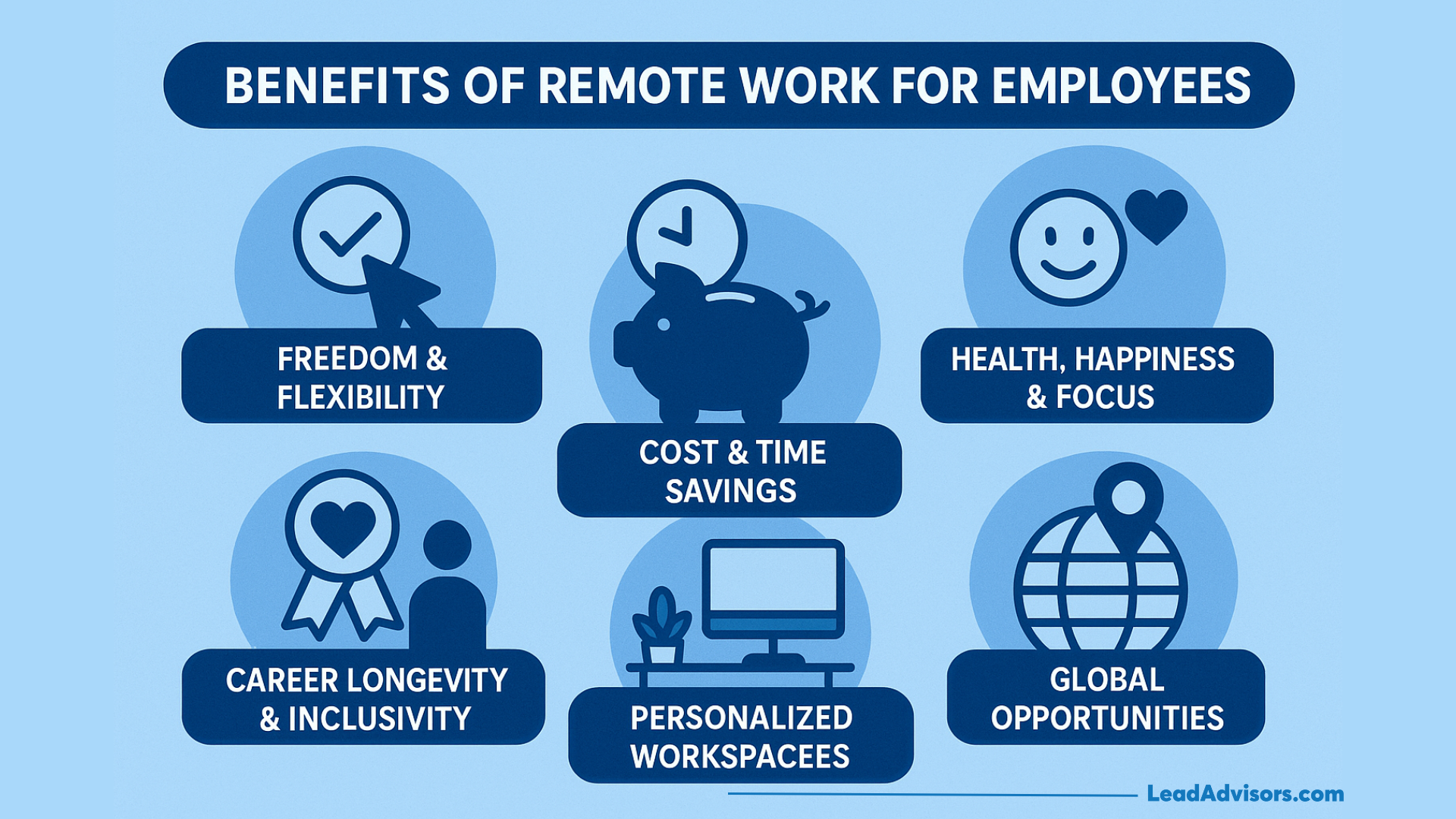
Remote work is not just a luxury – it is the new standard for a great number of people. The workforce is now finding the benefits of working remotely, such as better work-life balance, greater independence, and more opportunities for career development. Workers with roles not defined by location and having flexible hours can better manage their time, health, and career.
1. Freedom & Flexibility
What is remote work’s major advantage? It is freedom. One chooses the time to start, the way to accomplish the work, and the location from which to work. It can be the living room, a silent café, or a specially equipped home office. LumApps reveals that 75% of people working virtually believe that this flexibility increases their happiness and motivation.
2. Health, Happiness & Focus
There are no more train rides packed with people or unpleasant small talk with colleagues. Several people report feeling more mentally healthy and generally happier. In 2025, 79% of people working remotely reported feeling less stressed and focusing better at home. As a result, this concentration is most of the time followed by work of a higher quality, and the person has more energy left, even after his working hours, thus the win-win situation is complete.
3. Cost & Time Savings
When you are working remotely, you will not have to pay for gas, parking, or take expensive lunches. Nearly every remote worker manages to save between $4,000 and $6,000 per year. The time that you would have lost in a heavy traffic jam can now be used to be with your family, do your hobbies, or even take a nap. It is this kind of flexibility that really matters.
4. Personalized Workspaces
Dull and tiny office cubicles or meeting rooms should be totally forgotten. At present, you can either arrange a workspace at home that suits your needs or book a desk at your favorite co-working space. The only thing that you should not lack is a good Wi-Fi connection. Most of the time, being in control of the working environment is a great help to people; thus, they become more motivated and engaged.
5. Career Longevity & Inclusivity
Working from home options open up chances to parents, people looking after an ill or elderly person, people with disabilities, and generally any person who requires a flexible schedule. The New Jersey Institute of Technology (NJIT), through its research, has shown that remote work enables employees to grow their careers while maintaining their personal lives. Firms that provide this kind of flexibility are more likely to create customer loyalty and be more diverse in their staff.
6. Global Opportunities
As long as you and your colleagues have video calls and cloud-based tools, location should not be a barrier. So, you can be a remote employee for a company on the other side of the world or have a few hours of work as a freelancer in different time zones. Anyone with the requisite skills in sectors such as BPO and outsourcing can easily secure international work without relocating.
Find out how remote work can be a game-changer – work with us anywhere in the world and pave the way for yourself.
Benefits of Remote Work for Employers
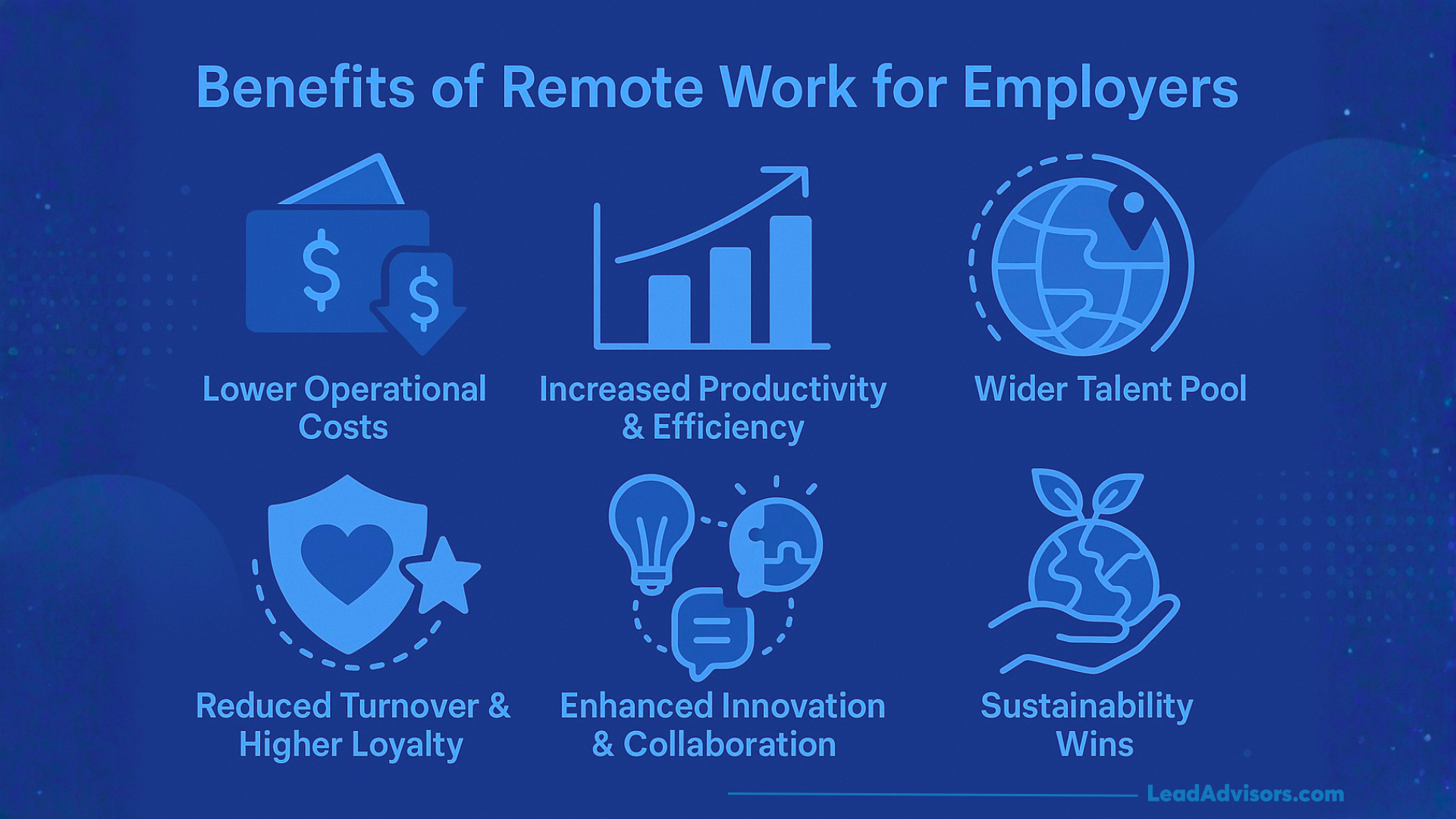
Remote working means not only a temporary fix but also a means to make companies more efficient, streamlined, and flexible. The improvement in the situation as companies move to remote or flexible work is evident in data from the Bureau of Labor Statistics and LumApps. Those results show increased team productivity, greater employee loyalty to their employers, and an overall atmosphere that is noticeably improving.
1. Lower Operational Costs
Not having a physical office means cutting a variety of costs – rent, utilities, and expensive office equipment. When the company reduces spending on large spaces and frequently used supplies, it can allocate more resources for the latest technology, employee perks, or fun activities.
2. Increased Productivity & Efficiency
Working remotely has its advantages, and virtual workers are generally more efficient than their in-office counterparts. Remote workers were also found to be more productive by the U.S. Bureau of Labor Statistics. The most significant factors that affect productivity are fewer interruptions, more flexible working hours, and attractive workplaces.
3. Wider Talent Pool
By doing away with location constraints, remote work is also opening the doors to a whole new pool of talent. Essentially, geolocation is no longer a factor in recruitment. So long as one is qualified, one can be hired regardless of where one lives.
It is quite significant for industries like BPO and outsourcing, whose staff have to operate across different time zones for 24/7 coverage. The benefits of having a global team will enable your company to be agile and react rapidly to market changes.
4. Reduced Turnover & Higher Loyalty
Giving employees the freedom to choose their workplace shows that the employer trusts them, and as a result, employees become more loyal. That kind of flexibility makes people more engaged, and hence reduces the turnover rate. FlexJobs study shows that offering flexible work can decrease employee turnover by 79%. If you want your best employees to be loyal and take charge of the important projects, then remote work is the right choice.
5. Enhanced Innovation & Collaboration
Distance has already been virtually eliminated by the communication means of this era, such as email, video calling, and project management software like ClickUp or Asana. Using these tools, an employee can reach out to anyone on the team with their idea, and the two can proceed with the work regardless of their respective locations. In this way, they have the opportunity to experiment with new ideas, collaborate, and quickly change their direction if needed.
6. Sustainability Wins
In the early days of remote work, the environmental conversation was limited to “saving on gas” and reducing the daily commute. In 2026, the impact is far more profound. Remote work has evolved into a global sustainability strategy that balances planetary health with unprecedented human mobility.
1. Beyond the Commute: Carbon Neutrality
While fewer cars on the road remains a major win, one person working off-site can still cut their carbon footprint by more than half—the focus has shifted to the decentralized office. Companies are no longer heating, cooling, and powering massive, half-empty skyscrapers. By shifting to a distributed model, businesses are hitting their 2026 carbon neutrality goals faster than previously projected.
2. The Explosion of Digital Nomad Visas
The biggest shift in 2025 and 2026 has been the global adoption of Digital Nomad Visas. Over 60 countries now offer specialized pathways for remote professionals, allowing workers to maintain their BPO careers while living in different parts of the world. This has transformed “Remote” from meaning “at home” to meaning “Global.”
3. BPOs as Global Mobility Partners
Leading BPO and outsourcing firms are no longer just employers; they are mobility partners. In 2026, top firms support employees who rotate through different countries, providing:
-
Global Compliance Infrastructure: Handling taxes and legalities across multiple jurisdictions so employees can move freely.
-
Asynchronous Stability: Ensuring that as an employee moves from Lisbon to Tokyo, their contribution to the team remains seamless through AI-managed project handoffs.
-
Eco-Conscious Travel: Supporting “slow travel” initiatives that encourage employees to stay longer in locations, reducing the high carbon impact of frequent short-term flights.
4. Social Responsibility and Community Impact
Work from Anywhere isn’t just good for the planet; it’s good for global equity. By allowing employees to earn international wages while living in smaller, developing communities, BPOs are helping to distribute wealth more evenly across the globe. This “Reverse Brain Drain” allows talented professionals to support their local economies without moving to an overcrowded, expensive tech hub.
AI: From “Tool” to “Autonomous Teammate”
In 2026, the role of Artificial Intelligence in remote work has undergone a radical transformation. We have moved far beyond basic data analytics and chatbots. Today, AI is the invisible “connective tissue” that holds distributed teams together, specifically by eliminating the “administrative drudge work” that used to lead to remote work burnout.
1. The Rise of AI Agents
The modern remote workspace is now populated by AI Agents. Unlike simple software, these agents act as proactive assistants that handle complex coordination. They don’t just notify you of a conflict; they autonomously negotiate schedules across multiple time zones, manage follow-ups, and ensure that project handoffs between a team in Manila and one in New York occur without a single human intervention.
2. Automated Meeting Synthesis & Asynchronous Flow
The “meeting that could have been an email” is officially a relic of the past. In 2026, Automated Meeting Synthesis has become the standard. AI now attends virtual meetings to capture not just transcripts, but context, sentiment, and actionable tasks.
-
For the Remote Worker: You no longer need to attend every 3 AM sync. You can wake up to a “Human-in-the-loop” summary that highlights exactly where your expertise is needed.
-
For the Manager: AI provides a “pulse check” on team collaboration, identifying bottlenecks in real-time before they become project delays.
3. Focus on High-Value Creativity
By offloading the “coordination tax” to AI, remote employees can finally reclaim their deep-work hours. The 2026 workforce isn’t spending its energy on manual data entry or email threading; instead, they are focusing on high-level creative problem-solving and emotional intelligence—areas where the human element remains irreplaceable.
4. Enhancing the BPO Edge
In the BPO and outsourcing sectors, this AI integration has allowed for “Hyper-Personalized Client Support.” AI handles the routine information retrieval and data processing, allowing agents to focus entirely on building empathy and solving complex customer issues. This hasn’t replaced the human worker; it has “up-skilled” them into specialized consultants.
The Human Side: Challenges and How to Overcome Them
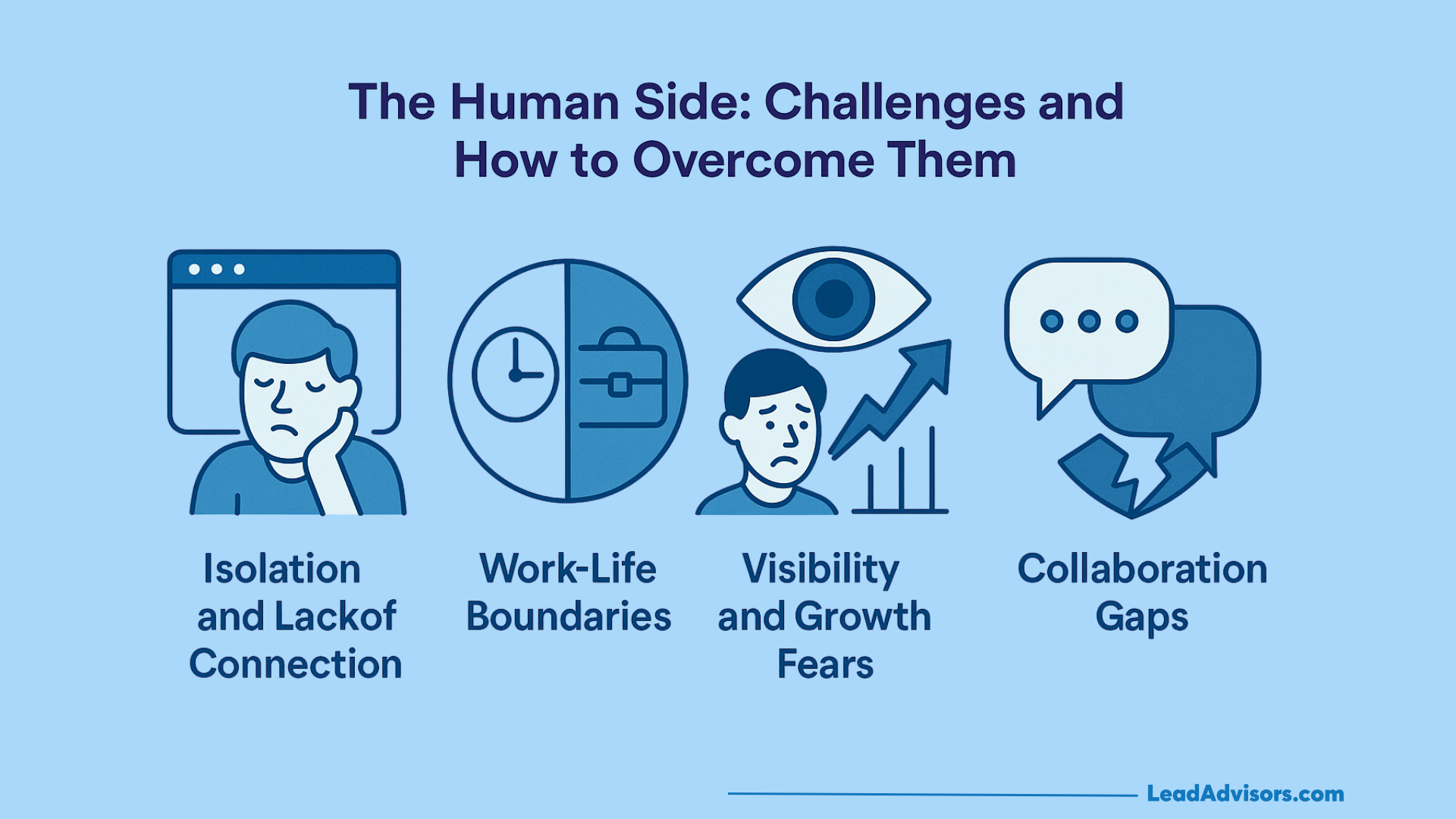
There are certainly advantages to working from home. But it lacks challenges, especially in cases where people need to stay in touch, be recognized, and balance work and personal life. These issues are often discussed not only on Reddit but also among HR professionals.
Remote workers have the freedom they want in their work, but many also admit to feeling lonely and fearing that their names will never be mentioned when promotions come up. The thing is, most of these problems can be fixed by just a little bit of management and intentionality.
Isolation and Lack of Connection
Without the casual interactions in the office, it’s easy to feel disconnected. The answer doesn’t entail any great difficulty. People can be more involved through regular video meetings, informal team check-ins, or even quick online games, as all these activities create opportunities for interaction and, therefore, help to reconnect colleagues and rebuild team spirit.
Work-Life Boundaries
This one might be a little hard to understand. Once your home turns into your workplace, it becomes very difficult to separate the two. That is exactly where routines come into play. It would be a great change if the practice of fixed schedules were promoted, mental health resources were shared, and people were given some room to decide the hours they want to work. The truth is that when people have the power to decide on their routines, they become more satisfied with themselves and more productive, too.
Visibility and Growth Fears
Collaborating with co-workers who are in different locations can be quite difficult. Nevertheless, if you use the right tools, such as cloud-based project management or asynchronous messaging, collaboration will be smoother. Being up to date on progress and holding worldwide check-ins are two things that not only keep all team members on the same page but also spark new ideas.
Beyond the Badge: The Death of “Coffee Badging”
As we move through 2026, one of the most significant cultural shifts in the remote work world is the decline of “coffee badging.” Just a year or two ago, this trend—where employees would briefly swipe into a physical office to “show their face” before returning home to work—was a symbol of the friction between traditional management and modern flexibility.
Today, leading BPOs and forward-thinking enterprises have recognized that “presence” is a poor proxy for “performance.” We have officially entered the era of Outcome-Based Tracking.
From Presence to Productivity
The shift away from monitoring where an employee is to what they have produced has effectively made coffee badging a relic of the 2024–2025 transitional era. Companies have realized that a person sitting in an office chair is not inherently more valuable than a person sitting in a home office.
The New Gold Standard: KPIs Over Clock-ins
In 2026, the “driving seat” of the BPO industry is powered by clear, transparent metrics:
-
Deliverable Milestones: Progress is measured by the completion of specific project phases rather than login duration.
-
Quality of Output: AI-augmented quality assurance tools now provide real-time feedback on the value of work, rendering the “swipe-in” obsolete.
-
Asynchronous Impact: Team members are valued for their ability to move the needle on global projects, regardless of whether they are active at 9 AM or 9 PM.
Why This Matters for the Future
This move toward Outcome-Based Accountability has fostered a deeper sense of trust and psychological safety. When employees are judged on their results, they feel empowered to design a workday that maximizes their individual efficiency. For the employer, this results in a more loyal, high-performing workforce that doesn’t feel the need to perform “productivity theater” just to satisfy an outdated badge-in requirement.
Remote Work Trends and Insights for 2026
The evolution of remote work has reached definitive maturity. While 2025 was a year of transition, 2026 finds the global workforce fully settled into a “remote-first” mindset. Recent data confirms that the milestone of 36 million Americans working remotely has not only been met but surpassed, as decentralized operations have moved from a business “option” to a core survival requirement.
Executive sentiment has followed suit. According to the latest figures from the Bureau of Labor Statistics, the consensus among managers has solidified: over 78% now report that virtual teams maintain or exceed the productivity levels of traditional office settings. This shift has turned the “Hybrid vs. Remote” debate into a more nuanced discussion about intentionality—companies are no longer asking if employees should be remote, but how to maximize the effectiveness of the distributed model.
The Evolution of “Coffee Badging”
The controversial practice of “coffee badging”—where employees swipe in just to satisfy visibility requirements—has reached a fever pitch in 2026. This behavior is no longer seen as a quirky trend but as a clear signal of the tension between rigid corporate mandates and employee autonomy. Progressive BPOs and tech firms are responding by abandoning “badge-in” metrics altogether and replacing them with Outcome-Based Accountability, in which performance is measured by deliverables rather than physical presence.
The Rise of the 4-Day Work Week and AI-Integration
We are also seeing a massive surge in flexible scheduling. The four-day work week has moved from a pilot program to a standard offering for many remote-friendly firms seeking to preserve their staff’s psychological health.
Leading this transformation are BPO and outsourcing firms, which have moved beyond basic video calls. They are now utilizing AI-driven “asynchronous workflows”—intelligent agents that summarize meetings across time zones and manage project handoffs automatically. This technology ensures that even with a team spread across the globe, the workflow remains seamless, setting a new global standard for what high-performing remote teams can achieve in 2026.
How Remote Work Empowers the BPO & Outsourcing Industry
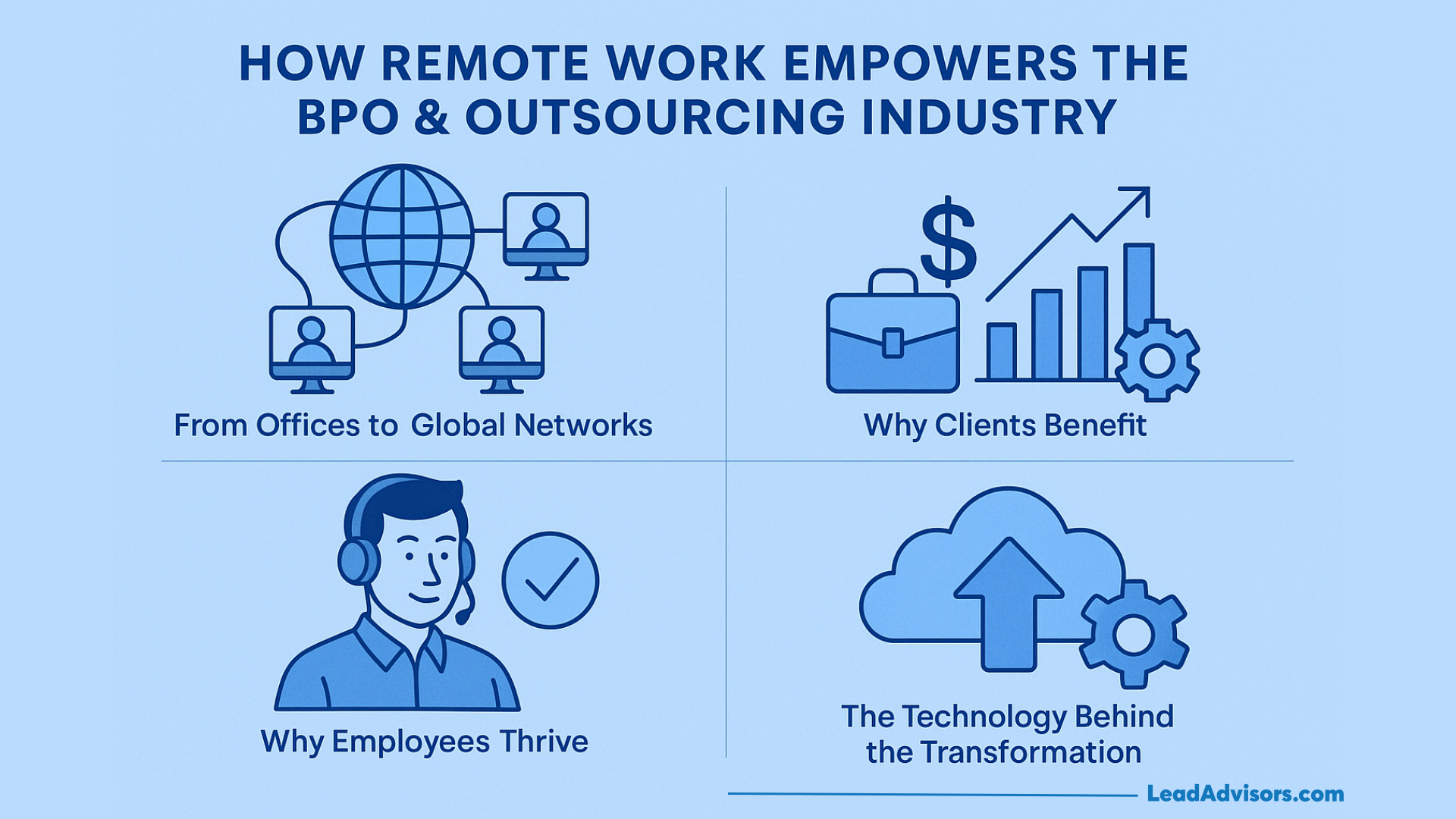
The BPO and outsourcing industry has been a pioneer of remote work, even before the pandemic reshaped how we work internationally. These companies managed teams in all parts of the world, juggling different time zones, and their flexibility and client-centricity were the pillars on which they built their operations. Eventually, the very ideology behind these companies turned the remote work model into their engine for efficiency and innovation.
From Offices to Global Networks
Outsourcing companies didn’t simply test the waters of remote work – on the contrary, they made it the core of their business model. They were already heavily involved in managing international projects and hosting virtual meetings long before most people had even heard of the concept of remote work. With a deep bench of experience, they have transitioned into agile organizations that transcend the constraints of geography and time. Teams are there to support clients 24/7; hence, they react quickly and can adapt quickly to whatever clients may require.
Why Clients Benefit
This approach is very good for clients, as it brings them cost savings, increased productivity, and the opportunity to hire highly qualified professionals from around the world. On the other hand, BPO providers are not limited by office locations; hence, they can tap into the global talent pool to hire highly qualified candidates, keep overhead to a minimum, and still provide services to a very high standard. The outsourcing industry has evolved from being a mere back-office function to becoming a real business growth accelerator.
Why Employees Thrive
Working off-site in BPO roles provides employees with real flexibility and the chance of career progression. In fact, you are in charge of your working hours, you can work with people from all over the world, and you can channel your creative side while working with different teams.
Moreover, this is a great opportunity for you to develop your emotional intelligence, improve your cross-cultural skills, and even become an expert in your preferred field – all while working in your preferred location.
The Technology Behind the Transformation
The smooth operation of everything is made possible by cloud solutions, AI, and secure data systems. Remote BPO teams, armed with reliable internet connections and smart tools, can meet their targets from wherever they want. No driving or walking is involved.
Remote work has not only been a game-changer for the BPO industry sector but also led to its expansion. The sector today is virtually borderless, where efficiency, innovation, and human connection are integrated harmoniously.
Are you considering working with us? Have a look at our remote-friendly roles and see how you can be successful with us.
Building a Future-Ready Remote Culture
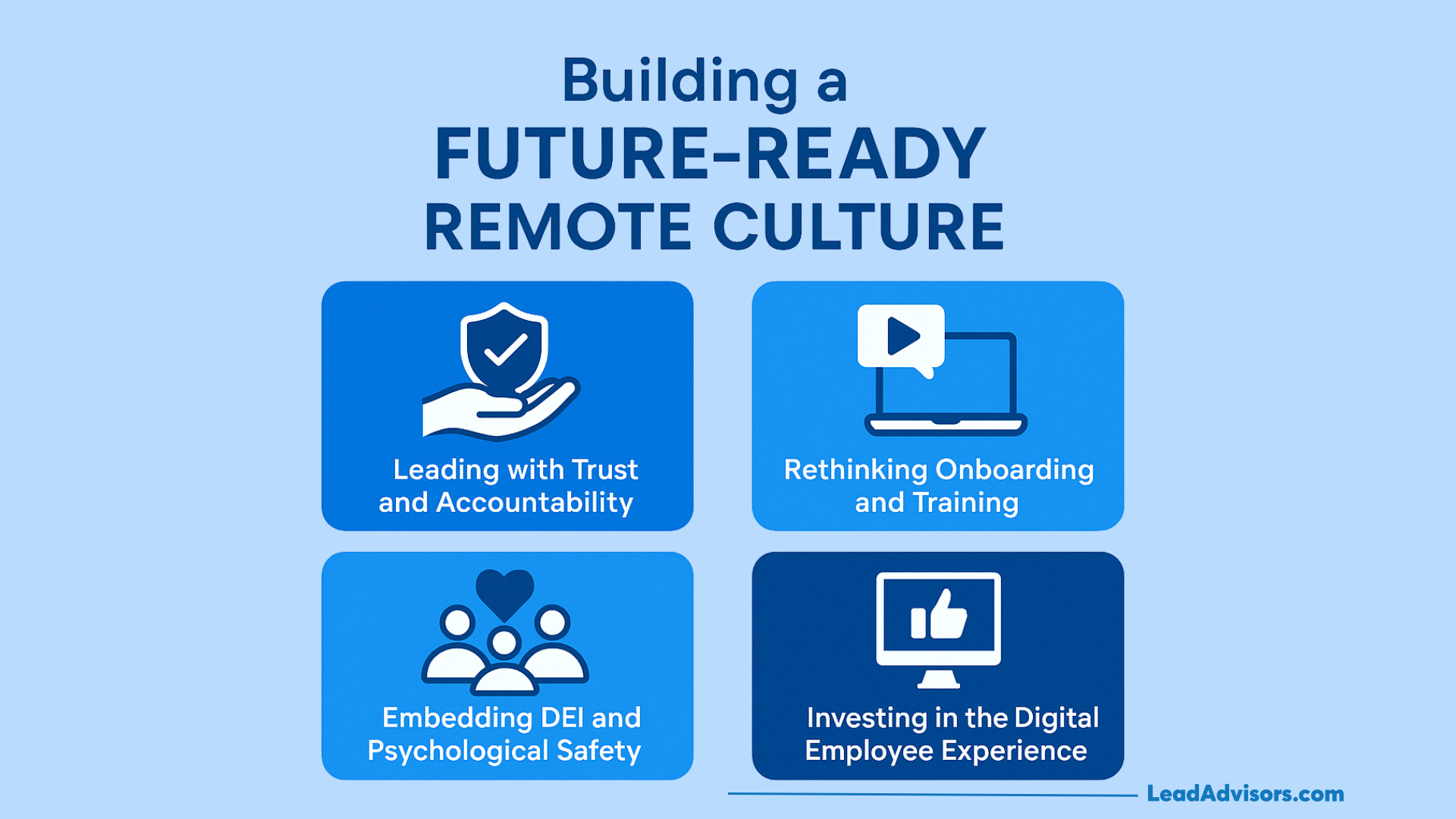
Developing a strong remote office culture is not solely about the location where one logs in. It deals with the ways they interact, work together, and encourage each other’s development. Firms that want to keep their leading position no longer fit old office schedules into their day. Instead, they implement new leadership styles, better technology, and people-oriented values that empower employees to deliver top results.
1. Leading with Trust and Accountability
Trust is the main pillar of every successful, flexible team. Instead of hours of surveillance or online status checking, good leaders focus on results. Remote employees get the freedom to manage their own time, be accountable, and achieve their targets when results are prioritized. This, in turn, nurtures respect and keeps people driven for quite a while.
2. Rethinking Onboarding and Training
The team working virtually has to develop a different approach to employee integration. Research conducted by TTEC and NJIT underscores the importance of employee engagement during training and mentoring, as well as the role of well-defined goals. Using online conferencing and digital learning tools, newcomers can still be part of the team even when physically separated.
3. Embedding DEI and Psychological Safety
A DEI-based recruiting plan is not just a trendy phrase but a competitive advantage. Once organizations address diversity and invest in fostering a sense of psychological safety, employees will be more willing to offer solutions, face problems, and use their emotional intelligence to facilitate team cooperation.
4. Investing in the Digital Employee Experience
An efficiently executed remote work culture is the result of a well-designed company digital policy. They must invest in robust remote IT infrastructure to effectively support distributed teams. The internal networks, async tools, and communication platforms keep employees updated and in line with one another despite their different locations or time zones. Besides that, these channels make managerial processes easier and create a harmony comparable to face-to-face collaboration.
5. Aligning Remote Work with Responsibility
Remote work can be one factor contributing to environmental protection. Less travel results in fewer greenhouse gases being released, whereas flexible work hours give employees the freedom to live their lives and participate in community activities. The majority of companies nowadays are integrating remote work into their corporate social responsibility strategies, showing that a flexible work environment can also pave the way for positive change.
Creating a future-ready remote culture is basically about people first – trust, innovation, and purpose need to be nurtured so that the teams are capable of winning wherever they are in the world.